
Thyridopteryx meadii
Edwards, 1881
Creosote Bush Bagworm, Creosote Bagworm
Thyridopteryx meadii is a North American to the Mojave Desert and adjacent arid regions. Unlike its widespread T. ephemeraeformis, this exhibits extreme specialization, feeding exclusively on creosote bush (Larrea tridentata). The species was named in honor of entomologist T. L. Mead, who collected the in California. Its is tightly coupled to the of its host plant and regional rainfall patterns rather than following a fixed cycle.
Pronunciation
How to pronounce Thyridopteryx meadii: /ˌθɪrɪˈdɑptərɪks ˈmiːdi.aɪ/
These audio files are automatically generated. While they are not always 100% accurate, they are a good starting point.
Identification
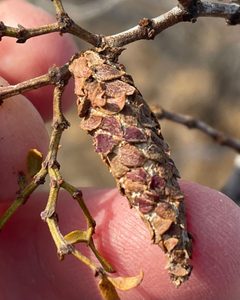
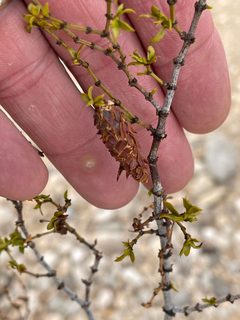
Distinguished from Thyridopteryx ephemeraeformis (evergreen bagworm) by association—T. meadii occurs exclusively on creosote bush, while T. ephemeraeformis feeds on numerous coniferous and deciduous trees and shrubs. The bag composition differs: T. meadii bags incorporate the small, resinous leaves and twigs of Larrea tridentata, producing a more compact, darker bag than the larger, often pendulous bags of T. ephemeraeformis on conifers. Geographic range is also diagnostic: T. meadii is restricted to the Mojave Desert and adjacent arid regions where creosote bush occurs, whereas T. ephemeraeformis is widespread across eastern and central North America. From T. alcora and T. rileyi, which also occur in southwestern North America, T. meadii is distinguished by its exclusive association with creosote bush rather than other host plants.
Images
Habitat
Creosote bush scrubland and desert wash in the Mojave Desert. Occupies the full range of creosote bush distribution, from flat desert plains to rocky slopes and dry washes. Tolerates extreme aridity and temperature fluctuations characteristic of desert environments. Survives long periods of drought and winter freezing either as larvae or as sealed inside bags.
Distribution
Mojave Desert and adjacent arid regions of the southwestern United States. Recorded in California, Arizona, Nevada, Utah, and Texas. Distribution is contiguous with that of its plant Larrea tridentata.
Seasonality
Activity is opportunistic and rainfall-dependent rather than fixed to calendar months. Most active during late summer monsoon season when rainfall stimulates soft new growth on creosote bush. hatch and larvae resume feeding when rains return after dormancy. can complete in weeks under favorable conditions, or extend over a year or more during drought. have been observed in late summer.
Diet
Specialized herbivore feeding exclusively on creosote bush (Larrea tridentata). Larvae consume leaves and young twigs. Has been documented as the primary insect contributor to flower death on creosote bush through defoliating activity.
Host Associations
- Larrea tridentata - exclusive plantCreosote bush; sole food source for larvae
Life Cycle
overwinter inside maternal bags, with hatching triggered by rainfall. Larvae construct and enlarge bags using plant material, feeding throughout development. occurs within the bag. Males emerge as winged and fly to locate females; females remain in bags and release to attract males. Mating occurs with male inserting through bag opening to reach female. Female lays eggs inside bag and dies. Duration highly variable: can complete in weeks with adequate rainfall and host growth, or larvae may remain for at least a year during drought conditions.
Behavior
Males exhibit distinctive resting posture with tip extended, possibly related to the prehensile, highly extensible abdomen required for mating through the narrow bag opening. Larvae spend majority of life inside bags, extending and legs only to feed and move. Bags provide protection from desiccation and temperature extremes. track regional precipitation patterns rather than cycles.
Ecological Role
Primary insect consumer of creosote bush foliage and significant contributor to flower mortality through defoliation. Serves as for including Calliephialtes grapholithae. Represents a case of extreme host specialization in a otherwise known for polyphagy. Its fluctuations may influence creosote bush reproductive success and vegetative growth patterns in the Mojave Desert .
Human Relevance
Named in honor of T. L. Mead, an entomologist who collected the in California. Of limited direct economic importance due to restricted range and specificity; does not impact ornamental plantings like T. ephemeraeformis. Serves as a model organism for studying insect-plant , desert adaptations to aridity, and rainfall-driven . The demonstrates how bagworm can become decoupled from fixed cycles through to unpredictable desert precipitation.
Similar Taxa
- Thyridopteryx ephemeraeformisWidespread conifer-feeding bagworm with similar male wing but on numerous tree , larger bags, and eastern/central North American distribution
- Thyridopteryx alcoraSouthwestern with unclear associations; not restricted to creosote bush
- Thyridopteryx rileyiSouthwestern with limited distribution records; plants unknown
More Details
Etymology
Named after T. L. Mead, entomologist who collected the in California
Physiological Adaptations
and larvae survive extended dormancy within sealed bags, allowing persistence through multi-year droughts characteristic of Mojave Desert climate
Research Significance
Provides exceptional case study of specialization and phenological plasticity in response to abiotic environmental variation
Sources and further reading
- BugGuide
- Wikipedia
- GBIF taxonomy match
- iNaturalist taxon
- Catalogue of Life
- Psychidae | Beetles In The Bush
- Lepidoptera | Beetles In The Bush | Page 7
- November | 2012 | Beetles In The Bush
- Snap to it and bag a bagworm! - Thyridopteryx ephemeraeformis — Bug of the Week
- Not quite adult | Beetles In The Bush
- Bug Eric: A Potential New Host Record for Calliephialtes grapholithae (Hymenoptera: Ichneumonidae) from a Paper Wasp nest (Hymenoptera: Vespidae: Polistes metricus)