
Telenominae
Genus Guides
3- Baeoneurella
- Telenomus
- Trissolcus(samurai wasps)
Telenominae is a of in the Scelionidae (formerly placed in Platygastridae). Members are solitary parasitoids, primarily attacking eggs of Hemiptera, particularly stink bugs (Pentatomidae) and related families in the superfamily Pentatomoidea. The subfamily includes such as Telenomus, Trissolcus, Phanuromyia, and Eumicrosoma. Several , notably Trissolcus japonicus (the Samurai Wasp), are used or studied as agents for agricultural pests.
Pronunciation
How to pronounce Telenominae: //ˌtɛlɛˈnɒmɪniː//
These audio files are automatically generated. While they are not always 100% accurate, they are a good starting point.
Identification
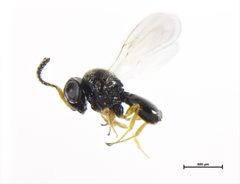
Identification to level within Telenominae typically requires examination of microscopic characters including wing venation, antennal segmentation, and genitalia structure. The can be distinguished from related platygastroid by a combination of characters including the structure of the metasoma and . Species within such as Trissolcus and Telenomus are frequently morphologically similar, necessitating detailed taxonomic keys and often molecular confirmation for accurate identification.
Images
Habitat
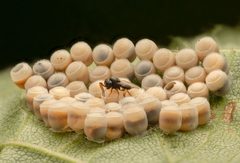
are determined by distribution; members have been recorded from agricultural fields (particularly soybean fields), deciduous forests, and urban environments. masses are typically located on the undersides of leaves.
Distribution
Recorded from multiple biogeographic regions including the Palaearctic (Korea, Japan, China, Europe), Nearctic (North America), and Neotropics (Mexico to southern Paraguay). Specific distribution varies by and .
Host Associations
- Halyomorpha halys - brown marmorated stink bug; Trissolcus japonicus
- Nezara viridula - southern green stink bug; Trissolcus basalis
- Eurydema gebleri - Trissolcus itoi
- Dolycoris baccarum - Trissolcus nigripedius
- Triatoma dimidiata - kissing bug; Telenomus fariai in Mexico
- Pentatomidae - stink bugs; multiple Telenominae
- Reduviidae - assassin bugs; Telenomus
- Acanthosomatidae - shield bugs
- Phyllocephalidae - shield bugs
- Scutelleridae - shield-backed bugs
- Flatidae - planthoppers; Phanuromyia
- Fulgoridae - lanternflies; Phanuromyia
Life Cycle
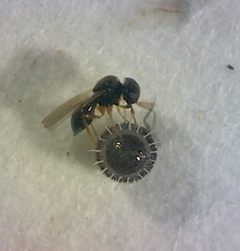
Solitary endoparasitoid development within . Development time from to ranges from 4–24 days under laboratory conditions (~25°C), varying by . Adults of both sexes emerge from host eggs.
Behavior
-finding and acceptance are mediated by chemosensory . Female express odorant binding proteins (OBPs) that detect host-produced . Members exhibit solitary , with only one developing per host .
Ecological Role
Natural enemies and agents of economically important Hemiptera pests. of stink bugs and related insects in agricultural and natural .
Human Relevance
Several are significant agents. Trissolcus japonicus has been introduced to North America as a agent for the brown marmorated stink bug (Halyomorpha halys). Trissolcus basalis has been used in programs for Nezara viridula in various countries.
Similar Taxa
- Telenomus within Telenominae; historically distinguished from Trissolcus by associations (Lepidoptera vs. Hemiptera), though this distinction has been questioned and the genera are morphologically similar
- PlatygastridaeRelated within Platygastroidea; Telenominae was previously classified as a of Platygastridae before molecular and morphological studies supported placement in Scelionidae
More Details
Taxonomic history
Telenominae was historically treated as a of Platygastridae. Current classification places it in Scelionidae based on phylogenetic studies, though some sources still reflect the older placement.
Included genera
The contains at least eight recognized : Eumicrosoma, Nirupana, Paratelenomous, Phanuromyia, Protelenomus, Psix, Telenomus, and Trissolcus.
Molecular resources
COI sequencing has been used to facilitate identification and examine associations, particularly for Telenomus species.
Sources and further reading
- BugGuide
- Wikipedia
- iNaturalist taxon
- NCBI Taxonomy
- Catalogue of Life
- insect diversity | Blog - Part 3
- Samurai Wasp Trissolcus japonicus (Ashmead) (Insecta: Hymenoptera: Scelionidae: Telenominae)
- Identification and expression of odorant binding proteins in the egg-parasitoid Trissolcus basalis (Wollaston) (Hymenoptera, Scelionidae, Telenominae)
- Host Records of Trissolcus (Hymenoptera: Platygasteridae: Telenominae) Parasitizing Eggs of Stink Bugs in Korea
- Egg-parasitoids of the genus Trissolcus (Hymenoptera, scelionidae, telenominae) from the Palaearctic region. The flavipes morphological group: 2. A key to the species of the flavipes group
- Egg-parasitoids of the genus Trissolcus (Hymenoptera, Scelionidae, Telenominae) from the Palaearctic fauna (the flavipes morphological group). 1. New species of the genus Trissolcus
- First record of Telenomus fariai Costa Lima, 1927 (Hymenoptera, Scelionidae, Telenominae) as a parasitoid of Triatoma dimidiata (Latreille, 1811) (Hemiptera, Reduviidae, Triatominae) eggs in Mexico
- Supplementary material 1 from: King K, Meuti ME, Johnson NF (2021) Identification and expression of odorant binding proteins in the egg-parasitoid Trissolcus basalis (Wollaston) (Hymenoptera, Scelionidae, Telenominae). In: Lahey Z, Talamas E (Eds) Advances in the Systematics of Platygastroidea III. Journal of Hymenoptera Research 87: 251-266. https://doi.org/10.3897/jhr.87.68954
- Figure 1 from: King K, Meuti ME, Johnson NF (2021) Identification and expression of odorant binding proteins in the egg-parasitoid Trissolcus basalis (Wollaston) (Hymenoptera, Scelionidae, Telenominae). In: Lahey Z, Talamas E (Eds) Advances in the Systematics of Platygastroidea III. Journal of Hymenoptera Research 87: 251-266. https://doi.org/10.3897/jhr.87.68954
- Supplementary material 2 from: Ramirez-Ahuja ML, Davila-Barboza JA, Talamas EJ, Moore MR, Bobadilla-Utrera C, Ponce-Garcia G, Rodriguez-Sanchez IP, Flores AE (2021) First record of Telenomus fariai Costa Lima, 1927 (Hymenoptera, Scelionidae, Telenominae) as a parasitoid of Triatoma dimidiata (Latreille, 1811) (Hemiptera, Reduviidae, Triatominae) eggs in Mexico. In: Lahey Z, Talamas E (Eds) Advances in the Systematics of Platygastroidea III. Journal of Hymenoptera Research 87: 309-322. https://doi.org/10.3897/jhr.87.73546
- Figure 16 from: Ramirez-Ahuja ML, Davila-Barboza JA, Talamas EJ, Moore MR, Bobadilla-Utrera C, Ponce-Garcia G, Rodriguez-Sanchez IP, Flores AE (2021) First record of Telenomus fariai Costa Lima, 1927 (Hymenoptera, Scelionidae, Telenominae) as a parasitoid of Triatoma dimidiata (Latreille, 1811) (Hemiptera, Reduviidae, Triatominae) eggs in Mexico. In: Lahey Z, Talamas E (Eds) Advances in the Systematics of Platygastroidea III. Journal of Hymenoptera Research 87: 309-322. https://doi.org/10.3897/jhr.87.73546
- Supplementary material 1 from: Ramirez-Ahuja ML, Davila-Barboza JA, Talamas EJ, Moore MR, Bobadilla-Utrera C, Ponce-Garcia G, Rodriguez-Sanchez IP, Flores AE (2021) First record of Telenomus fariai Costa Lima, 1927 (Hymenoptera, Scelionidae, Telenominae) as a parasitoid of Triatoma dimidiata (Latreille, 1811) (Hemiptera, Reduviidae, Triatominae) eggs in Mexico. In: Lahey Z, Talamas E (Eds) Advances in the Systematics of Platygastroidea III. Journal of Hymenoptera Research 87: 309-322. https://doi.org/10.3897/jhr.87.73546