
Triatoma rubida
(Uhler, 1894)
kissing bug, Arizona kissing bug
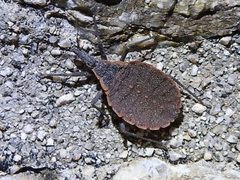
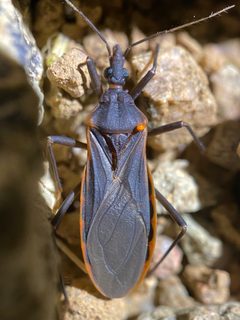
Triatoma rubida is a assassin bug and important potential of in the southwestern United States and northern Mexico. Laboratory studies demonstrate it has the shortest -to- development time (~4 months) among comparable , with high survival rates and rapid defecation that enhances vector competence. In southern Arizona, the species is primarily associated with white-throated woodrat (Neotoma albigula) nests, with occurring from late May through mid-July when adults may be attracted to artificial lights and invade human dwellings. Females consistently defecate while feeding (93%), unlike males and stages, increasing transmission risk. The species shows 41.5-66% of in some and has been documented feeding on humans.
Pronunciation
How to pronounce Triatoma rubida: //tɹaɪˈətəmə ˈɹuːbɪdə//
These audio files are automatically generated. While they are not always 100% accurate, they are a good starting point.
Images
Habitat
Primarily , associated with white-throated woodrat (Neotoma albigula) nests in southern Arizona. Also found in peridomestic and domestic environments, particularly homes with abundant artificial light sources. Laboratory colonies maintained at 25°C and 50-60% relative humidity.
Distribution
Southwestern United States (Arizona, New Mexico, southwest Texas) and northern Mexico (Chihuahua, Sonora, Nuevo León, Coahuila). New records reported from municipalities of Ocampo (Coahuila) and China, General Bravo, Santiago, and Villaldama (Nuevo León).
Seasonality
occur from late May through mid-July. attracted to artificial lights during this period may invade human dwellings. Generally active during late spring and summer months; rarely encountered in autumn.
Diet
(blood-feeding). Feeds on defibrinated rabbit blood in laboratory conditions. Blood meal analysis confirms regular feeding on humans in Arizona. Natural include white-throated woodrats (Neotoma albigula) and other endothermic vertebrates including pets and livestock.
Host Associations
- white-throated woodrat (Neotoma albigula) - primary natural lives primarily in association with woodrat nests in southern Arizona
- humans - incidental Regular feeding on humans confirmed by blood meal analysis; specimens frequently found in human dwellings
- Trypanosoma cruzi - 41.5-66% in some ; specimens from human dwellings found infected
Life Cycle
incubation averages ~19 days with ~72% rate. Egg-to- development approximately 4 months under laboratory conditions (25°C, 50% RH), significantly shorter than related . Five nymphal instars; nymphs require 1-5 blood meals between (average ~2.5 meals). First instars show high molting success after single blood meal (84.29%). Higher mortality observed in first-instar nymphs. Pre-feeding intervals range from 6.32 to 16.37 days.
Behavior
Nymphs orient preferentially to airstreams at 1600 or 3200 ppm carbon dioxide and prefer relative humidity levels of about 30%. males are most attracted to 470 nm (blue) light. Mean time lapse before feeding initiation is 0.3-3 minutes for most nymphs; adults show significantly longer feeding initiation times. Most instars complete feeding in less than 10 minutes. Females consistently defecate while feeding (93%), whereas stages rarely do so (3%) and males do not defecate during feeding. More than half of immature insects with multiple feeding bouts (62%) defecate during interruptions of feeding while likely on or near the .
Ecological Role
of (). Maintains through and peridomestic cycles involving vertebrate . Considered of greater epidemiological importance than T. recurva and T. protracta due to faster development, lower mortality, and rapid defecation facilitating transmission.
Human Relevance
Important potential of to humans in areas where the occurs. Bites are painless during feeding but cause itching and swelling the next morning; some individuals may experience allergic reactions including anaphylaxis requiring emergency treatment. may invade homes when attracted to artificial lights during . Simple preventive measures in rural areas, such as eliminating woodrat nests near dwellings, substantially reduce encounter risk. Urban areas pose minimal concern. Frequently misidentified by the public; 85% of alleged submissions in some regions are actually other insects such as the western conifer- (Leptoglossus occidentalis).
Similar Taxa
- Triatoma sanguisugaMost common U.S. ; T. rubida distinguished by geographic range (southwest-focused) and association with woodrat nests versus T. sanguisuga's broader distribution
- Triatoma recurvaLarger Arizona ; T. rubida has shorter development time (~4 months vs. longer in T. recurva) and lower mortality rates under laboratory conditions
- Triatoma protractaRelated southwestern ; T. rubida shows significantly faster development and is considered of greater epidemiological importance
- Leptoglossus occidentalis (western conifer-seed bug)Plant-feeding frequently misidentified as due to similar body shape; distinguished by lack of blood-feeding mouthparts, different structure, and plant-feeding
- Reduvius personatus (masked hunter)Non-blood-feeding assassin bug that enters homes; distinguished by different body shape and predatory rather than blood-feeding
Misconceptions
Widespread public misidentification of indoor insects as kissing bugs causes unnecessary alarm. The is frequently confused with the western conifer- (Leptoglossus occidentalis), a harmless plant-feeding insect. Despite concerns, native U.S. Triatoma species including T. rubida are relatively poor compared to Latin American species because they typically defecate after leaving the ; however, T. rubida females are exceptions with consistent defecation during feeding. Climate change concerns about northward range expansion require baseline distribution data for accurate assessment.
Sources and further reading
- BugGuide
- Wikipedia
- GBIF taxonomy match
- iNaturalist taxon
- NCBI Taxonomy
- Catalogue of Life
- Best Sentence Collection: Stings Happen When Bees Are 'Aminated and Antagonistic' | Bug Squad
- Bug Eric: Kissing Bugs
- New Study Expands Knowledge of Kissing Bug Range in U.S.
- Bug Eric: November 2015
- Not a Kissing Bug: Invasive Western Conifer-Seed Bug Causes Undue Alarm
- Bug Eric: 2015
- The biology of three Mexican-American species of Triatominae (Hemiptera: Reduviidae): Triatoma recurva, Triatoma protracta and Triatoma rubida
- Short-Range Responses of the Kissing Bug Triatoma rubida (Hemiptera: Reduviidae) to Carbon Dioxide, Moisture, and Artificial Light
- Laboratory rearing of the kissing bugs, Triatoma rubida and T. gerstaeckeri (Hemiptera: Reduviidae), in New Mexico using an artificial feeding system
- Nuevos registros geográficos y notas de infección de Triatoma gerstaeckeri (Stål) y Triatoma rubida (Uhler) (Hemiptera: Reduviidae: Triatominae) en Nuevo León y Coahuila, México
- Feeding and Defecation Behavior of Triatoma rubida (Uhler, 1894) (Hemiptera: Reduviidae) under Laboratory Conditions, and Its Potential Role as a Vector of Chagas Disease in Arizona, USA