
Triatoma sanguisuga
(LeConte, 1855)
Eastern Bloodsucking Conenose, Mexican Bed Bug, Kissing Bug
Triatoma sanguisuga is a blood-feeding assassin bug in the Triatominae, commonly known as the eastern bloodsucking conenose or kissing bug. It is the most widespread triatomine in the United States and serves as a for , the that causes . Unlike highly efficient South American vectors such as Triatoma infestans, T. sanguisuga typically defecates after feeding rather than during, reducing but not eliminating transmission risk to humans. The species has been implicated in documented autochthonous human Chagas disease cases in the United States.
Pronunciation
How to pronounce Triatoma sanguisuga: //ˌtraɪəˈtoʊmə ˌsæŋɡwɪˈsuːɡə//
These audio files are automatically generated. While they are not always 100% accurate, they are a good starting point.
Identification
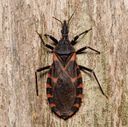
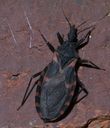
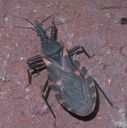
Distinguished from similar reduviid by the combination of reddish-orange lateral abdominal spots on a dark background, kinked , and overall size. May be confused with the western conifer seed bug (Leptoglossus occidentalis), but the latter has leaf-like expansions on the hind tibiae and lacks the reddish abdominal spots. Distinguished from other Triatoma by geographic range and specific spot pattern; T. gerstaeckeri occurs in Texas and adjacent states, while T. rubida is found in the southwestern United States.
Images
Habitat
and peridomestic environments; associated with woodrat (Neotoma) nests and middens; enters human dwellings through cracks and crevices, particularly attracted to outdoor lights. In domestic settings, found in bedrooms and areas where sleep.
Distribution
Widespread across the eastern and central United States, extending from the Southeast north to Pennsylvania and west to Ohio, Missouri, and Arizona; also occurs in Latin America. Documented in Illinois, Missouri, Louisiana, Tennessee, Texas, and California with established at the northern edge of its range.
Seasonality
Active during late spring, summer, and early fall; disperse to find new during this period. Rarely observed in autumn and winter; not typically found indoors during colder months.
Diet
Obligate blood-feeder on mammals including raccoons, rats, opossums, dogs, cats, and humans; tree frogs have been documented as a significant food source. Requires blood meals for growth and .
Host Associations
- Trypanosoma cruzi - that causes ; T. sanguisuga can harbor and transmit the
- Neotoma - primary Woodrats or packrats; primary in the United States
- Procyon lotor - Raccoon; common blood meal source
- Didelphis virginiana - Virginia opossum; documented blood meal source
- Homo sapiens - incidental Humans are not normal but are frequently bitten, especially on the during sleep
- Canis lupus familiaris - Domestic dogs; significant in peridomestic settings
- Felis catus - Domestic cats; documented blood meal source
- Hyla - Tree frogs; documented as significant food source
Life Cycle
Females lay 4-6 days after a blood meal; one female may lay hundreds of eggs in her lifetime. Eggs hatch into nymphs that require blood meals and pass through five instars before reaching adulthood. Development in laboratory culture is challenging; nymphs often experience developmental arrest at the fourth instar without nutritional supplementation beyond vertebrate blood. Supplementation with artificial media enables completion of development to adulthood in approximately 17 weeks from fourth instar.
Behavior
; seeks by detecting carbon dioxide in breath using , then switches to thermal detection as it approaches. Feeds on exposed facial skin, particularly around the mouth and , because it avoids being confined under bedding. Bites are painless during feeding but cause itching and swelling afterward. Unlike efficient Chagas , typically defecates 20-30 minutes after feeding rather than during, usually having left the host. Attracted to lights at night, which facilitates entry into human dwellings.
Ecological Role
Major of in the southeastern United States, maintaining a robust zoonotic transmission cycle among wildlife . Serves as a bridge vector between cycles and human . Gut composition varies with developmental stage and geographic location, with potential implications for vector competence and transmission.
Human Relevance
Public health concern as a for ; implicated in documented autochthonous human in Texas, California, Tennessee, and Louisiana. Bites cause localized swelling and itching; repeated exposure may lead to allergic reactions including anaphylaxis in sensitive individuals. Controlled through exclusion methods: screens on windows and doors, sealing cracks, vacuuming, and removing woodrat nests from peridomestic areas. Frequently misidentified, leading to unnecessary public concern; distinguished from harmless household invaders like the western conifer seed bug.
Similar Taxa
- Triatoma gerstaeckeriOverlaps in Texas; distinguished by geographic distribution and subtle morphological differences in pronotal shape
- Triatoma rubidaSouthwestern United States; generally smaller and with different coloration pattern
- Triatoma lecticulariaOccurs in overlapping range; distinguished by specific morphological characters of the and pronotum
- Leptoglossus occidentalisWestern conifer seed bug; harmless non-blood-feeding frequently mistaken for kissing bugs, distinguished by leaf-like hind tibial expansions and lack of reddish abdominal spots
- Reduvius personatusMasked hunter; non-blood-feeding assassin bug that enters homes, distinguished by covered wings giving a 'masked' appearance
- Melanolestes picipesBlack corsair; non-blood-feeding assassin bug found in eastern North America, distinguished by uniformly dark coloration without abdominal spots
Misconceptions
Frequently misidentified by the public as any large, dark insect found indoors, leading to unnecessary alarm. Despite valid public health concerns, the risk of transmission in the United States is significantly lower than in Latin America because T. sanguisuga defecates after rather than during feeding. The 'kissing bug' refers to the facial feeding location, not any benign ; bites are not romantic or harmless. Urban encounters are rare; simple preventive measures in rural areas, such as removing woodrat nests, substantially reduce encounter probability.
More Details
Laboratory Culture Challenges
T. sanguisuga has proven remarkably difficult to maintain in laboratory culture, with consistent developmental arrest occurring prior to the fifth nymphal instar when maintained on blood-only feeding protocols. Successful rearing requires supplementation with artificial media, suggesting complex nutritional requirements beyond vertebrate blood alone.
Gut Microbiota and Development
Significant differences in gut composition exist between nymphs and , and between laboratory-raised and field-caught individuals. Laboratory-raised nymphs show higher bacterial diversity but restricted metabolic functionality, correlating with poor development in captivity. Field-caught adults have lower bacterial diversity but broader metabolic capacity.
Genomic Resources
The first whole sequence for T. sanguisuga was completed in 2024 using long-read sequencing from a Delaware specimen. The 1.162 Gbp genome is the most complete for any Triatominae and the first for a North American triatomine, enabling research on blood feeding, seeking, and competence.
Sources and further reading
- BugGuide
- Wikipedia
- GBIF taxonomy match
- iNaturalist taxon
- NCBI Taxonomy
- Catalogue of Life
- Best Sentence Collection: Stings Happen When Bees Are 'Aminated and Antagonistic' | Bug Squad
- Bug Eric: Indoor Insects of Autumn (part 1 of 4)
- Bug Eric: Kissing Bugs
- New Study Expands Knowledge of Kissing Bug Range in U.S.
- Bug Eric: November 2015
- Bug Eric: 2015
- Metabolomics of developmental changes in Triatoma sanguisuga gut microbiota
- Factors Associated With PeridomesticTriatoma sanguisuga(Hemiptera: Reduviidae) Presence in Southeastern Louisiana
- The Biology and Vector Capability of Triatoma Sanguisuga Texana Usinger and Triatoma Gerstaeckeri (StÅL) Compared With Rhodnius Prolixus (StÅL) (Hemiptera: Triatominae)1
- Genome report: First whole genome sequence of Triatoma sanguisuga (Le Conte, 1855), vector of Chagas disease
- Laboratory culture of Triatoma sanguisuga (Hemiptera: Reduviidae) by supplementation with Drosophila artificial hemolymph media
- Ecological interactions of Triatoma sanguisuga (Hemiptera: Reduviidae) and risk for human infection with Trypanosoma cruzi (Kinetoplastida: Trypanosomatidae) in Illinois and Louisiana
- Interactions among Triatoma sanguisuga blood feeding sources, gut microbiota and Trypanosoma cruzi diversity in southern Louisiana