
Triatoma lecticularia
(Stål, 1859)
kissing bug
Triatoma lecticularia is a kissing bug in the Triatominae, a group of blood-feeding assassin bugs. It is a known of , the that causes . The has been documented in North America and Mexico, with records extending to northwestern Mexico where it has been introduced. Like other triatomines, it is an obligate insect requiring blood meals for development and . It has been found in dog kennels in Texas, where it poses transmission risks to canines.
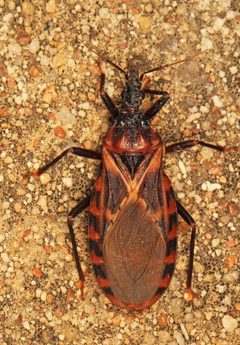
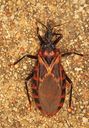
Pronunciation
How to pronounce Triatoma lecticularia: //traɪəˈtoʊmə lɛktɪkjuˈleɪriə//
These audio files are automatically generated. While they are not always 100% accurate, they are a good starting point.
Images
Habitat
Forest-dwelling . Associated with wildlife including rodents. Has been documented in dog kennels in Texas, where dead specimens have been found to harbor viable . In northwestern Mexico, the species has been introduced and established under laboratory conditions.
Distribution
North America and Central America. Documented in the United States (including Texas, Missouri, Illinois, and Kansas), Mexico, and northwestern Mexico where it has been introduced. Records indicate presence across the southern United States with northern range extensions into Missouri and Illinois.
Seasonality
Late spring and summer activity, with dispersing during this period. Rarely encountered in autumn.
Diet
Obligate ; feeds on blood of vertebrate . In laboratory rearing, has been maintained using chickens as blood meal sources. Natural hosts include various vertebrates, with documented association with woodrats and other wildlife.
Host Associations
- woodrats (Neotoma spp.) - primary wild nymphs dwell in woodrat middens and nests
- domestic dogs - incidental documented in Texas dog kennels; dogs may acquire T. cruzi through ingestion of infected or contact with
- chickens - laboratory used for blood meal provision in laboratory rearing
- Trypanosoma cruzi - 40% rate documented in some ; dead can harbor viable
Life Cycle
stage: eggs laid singly by female. Nymphal stage: five instars, each requiring blood meals for growth and molting; nymphs primarily inhabit rodent nests and sheltered situations near . Adult stage: sexually mature with functional wings; capable of to find new host . Blood meals required for development throughout all active stages.
Behavior
blood-feeding activity. Uses to detect carbon dioxide from breath, then thermal detection to locate warm-blooded prey. Feeds on exposed skin, particularly around the . Defecates during or after feeding; post-feeding defecation timing varies by . disperse during late spring through early fall, attracted to outdoor lights and may enter human dwellings. Extremely flat body allows entry through narrow crevices.
Ecological Role
Potential of , the etiological agent of . Important for maintenance of the wild cycle of this in North America. Serves as a bridge vector between wildlife (rodents) and domestic animals or humans. Dead specimens can retain viable T. cruzi , posing alternative transmission risks through ingestion by dogs or other animals.
Human Relevance
Medical significance as a of , though U.S. appear to have lower vector than Latin American due to post-feeding defecation habits. Bites can cause allergic reactions including anaphylaxis in sensitive individuals. Public health concern in dog kennels where transmission to canines occurs. Frequently misidentified by the public, causing unnecessary alarm and overuse.
Similar Taxa
- Triatoma sanguisugaoverlapping distribution in Missouri and Illinois; both documented in same region and require careful morphological distinction
- Triatoma rubidasouthwestern U.S. kissing bug with similar general appearance and preferences
- Triatoma gerstaeckeriTexas kissing bug with similar size range and conenose
- Leptoglossus occidentalis (Western Conifer-Seed Bug)frequently misidentified as kissing bug; plant-feeding coreid that enters homes but lacks blood-feeding mouthparts and capacity
Misconceptions
Frequently confused with the Western Conifer- (Leptoglossus occidentalis) by the public, leading to unnecessary concerns. Unlike some Latin American triatomines, U.S. are relatively inefficient due to defecation habits that reduce fecal of bite wounds. Dead are often assumed harmless, but can harbor viable T. cruzi capable of infecting dogs if ingested.
More Details
Taxonomic Note
The has been placed in the Paratriatoma in some classifications (as Paratriatoma lecticularia), but is currently accepted as Triatoma lecticularia in major databases including Catalogue of Life and GBIF. The basionym Conorhinus lecticularius was established by Stål in 1859.
Reproductive Biology
Females possess a pair of elongated spermathecal without associated accessory glands. The reservoir opens into the common via a narrow muscular duct that controls release of spermatozoa. The columnar secretory epithelium produces polysaccharides, glycoconjugates, and proteins that maintain viability of stored spermatozoa until .
Research Significance
First successful culture of viable from a dead triatomine was achieved from a Paratriatoma lecticularia specimen collected in a Texas dog kennel, demonstrating persistence after death and highlighting alternative transmission .
Sources and further reading
- BugGuide
- Wikipedia
- GBIF taxonomy match
- iNaturalist taxon
- NCBI Taxonomy
- Catalogue of Life
- Best Sentence Collection: Stings Happen When Bees Are 'Aminated and Antagonistic' | Bug Squad
- New Study Expands Knowledge of Kissing Bug Range in U.S.
- Chagas Disease Parasite Can Survive in Dead Kissing Bugs, Study Finds
- Bug Eric: Kissing Bugs
- Bug Eric: November 2015
- Not a Kissing Bug: Invasive Western Conifer-Seed Bug Causes Undue Alarm
- Morphology of the spermatheca of Triatoma lecticularia (Hemiptera: Reduviidae) (Stal, 1859)
- Biology of the introduced species Triatoma lecticularia (Hemiptera: Reduviidae) to northwestern Mexico, under laboratory conditions