
Paratriatoma
Barber, 1938
kissing bugs
Species Guides
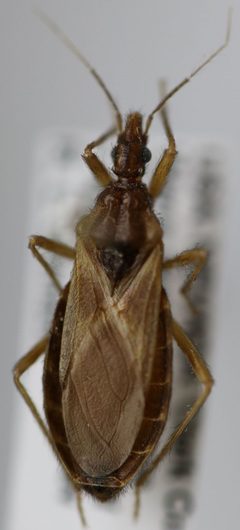
1Paratriatoma is a of kissing bugs ( Triatominae) in the assassin bug Reduviidae. The genus contains at least two : Paratriatoma hirsuta, the type species, and Paratriatoma lecticularia. Members are blood-feeding insects that serve as of , the that causes . Research on P. lecticularia has revealed notable parasite persistence in dead specimens and mediated by fecal .
Pronunciation
How to pronounce Paratriatoma: //paɹətraɪəˈtoʊmə//
These audio files are automatically generated. While they are not always 100% accurate, they are a good starting point.
Identification
Distinguished from the related and more diverse Triatoma by genitalic and morphological characteristics; specific diagnostic features for the genus require examination. -level identification relies on morphological traits including body size, pilosity, and genitalic structure.
Images
Habitat
Paratriatoma lecticularia has been documented in dog kennels in south Texas, where dense dog attract these from surrounding natural environments. The is also associated with wildlife such as rodents and raccoons in natural settings.
Distribution
Documented from Texas, USA, particularly in the southern region. The likely occurs more broadly in the southern United States and potentially Mexico, though precise range boundaries are not well established.
Seasonality
Collections in Texas dog kennels occurred between June and October 2022, indicating and nymphal activity during warm months. Seasonal patterns beyond this period have not been documented.
Diet
Blood-feeding on mammals; documented include domestic dogs and wildlife such as rodents and raccoons.
Host Associations
- Canis lupus familiaris - domestic dogs in kennel environments
- Rodentia - wildlife
- Procyon lotor - raccoons as wildlife
- Trypanosoma cruzi - transmits that causes
Life Cycle
Hemimetabolous development with and five nymphal instars preceding adulthood. Fifth-instar nymphs have been documented in behavioral studies alongside .
Behavior
Aggregates in response to fecal volatiles that function as an . Both nymphs and are attracted to dry and hexane extracts containing compounds including 6-methyl-5-hepten-2-one, 2-ethyl-1-hexanol, limonene, menthol, decanal, undecane, and tridecane.
Ecological Role
of between wildlife and domestic animals. Dead specimens can harbor viable , creating potential for oral transmission to dogs that ingest insect remains.
Human Relevance
Medical and veterinary significance as a of . Dogs are at risk of through ingestion of dead infected in kennel environments, a transmission route confirmed by culture of viable T. cruzi from a dead P. lecticularia. The 7-component synthetic blend derived from fecal volatiles may be useful for surveillance and monitoring.
Similar Taxa
- TriatomaLarger and more diverse of kissing bugs; Paratriatoma distinguished by morphological and genitalic characteristics, though specific field identification requires examination
More Details
Pheromone research
A 7-component synthetic blend matching hexane fecal extracts attracts both nymphs and , offering potential for improved surveillance tools.
Parasite persistence
First documented case of viable T. cruzi cultured from a dead triatomine collected in a dog kennel; survived despite Texas summer temperatures and exposure.
Sources and further reading
- BugGuide
- Wikipedia
- GBIF taxonomy match
- iNaturalist taxon
- NCBI Taxonomy
- Catalogue of Life
- Paratriatoma lecticularia kissing bug - Entomology Today
- Paratriatoma lecticularia Archives - Entomology Today
- Chagas Disease Parasite Can Survive in Dead Kissing Bugs, Study Finds
- Trypanosoma cruzi parasite - Entomology Today
- Attraction of Paratriatoma lecticularia (Hemiptera: Reduviidae) to fecal volatiles reveals an aggregation pheromone