
Melanolestes picipes
(Herrich-Schaeffer, 1848)
Black Corsair, Black May Beetle-Eater
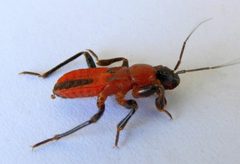
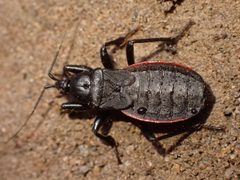
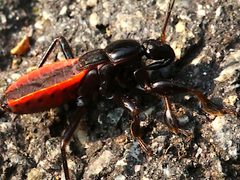
Melanolestes picipes, commonly called the Black Corsair, is a predatory assassin bug in the Reduviidae. The exhibits pronounced : males are fully winged and strong fliers, while females typically have reduced or absent hind wings and merely pad-like forewings. measure 15–20 mm in body length. Northern are uniformly jet black; southern specimens may display red or orange abdominal margins or entirely red . The species is among the most abundant assassin bugs in the United States and is frequently attracted to outdoor lights at night.
Pronunciation
How to pronounce Melanolestes picipes: /ˌmɛlənoʊˈlɛstiːz ˈpɪsɪˌpiːz/
These audio files are automatically generated. While they are not always 100% accurate, they are a good starting point.
Identification
Distinguished from the similar Masked Hunter (Reduvius personatus) by the presence of fossula spongiosa on the first and second leg pairs—Masked Hunters lack these structures. Black Corsairs average smaller (15–20 mm versus 15–22 mm for Masked Hunters). Red-bordered forms may be confused with bordered plant bugs ( Largidae), but the assassin bug's front legs and curved rostrum visible beneath the separate them. Males are readily identified by their capability and attraction to lights; females are flightless or poor fliers.
Images
Appearance
are 15–20 mm long with an elongated, somewhat flattened body. Coloration varies geographically: northern specimens are uniformly jet black, while southern individuals may have red or orange margins on the or entirely red abdomens. A highly distinctive feature is the fossula spongiosa—dense hair pads on the ends of the tibiae of the first and second leg pairs, appearing like 'ankle weights' or 'leg-warmers.' These pads secrete oil that aids in gripping prey and mates. Males possess fully developed wings; females usually have reduced hind wings and forewing pads only.
Habitat
Found in diverse terrestrial across its range. By day, hides under stones, boards, and other ground-level debris. Frequently enters human dwellings, especially when attracted to outdoor lighting. Associated with areas where insect prey is abundant.
Distribution
Nearctic and Neotropical distribution. In North America: from New England to Florida, west to Colorado, Utah, and California. Also recorded from Central America, South America, and Oceania (specific records include Hawaii).
Seasonality
active during warmer months. Males frequently observed at lights from spring through fall, with peak activity varying by latitude. In northern regions, likely single-brooded; southern may have extended or multiple .
Diet
feeding on other insects. Specific prey records include various beetles and other . The 'Black May -Eater' suggests association with scarab beetles (May/June beetles, Phyllophaga spp.).
Life Cycle
(hemimetabolous). Nymphs resemble but lack wings and are smaller. Females lay in concealed locations. Development includes multiple nymphal instars before adulthood. Detailed poorly documented in published sources.
Behavior
. Males are strong, agile fliers attracted to artificial lights, where they hunt other insects drawn to illumination. When disturbed, runs and flies with great speed. Defensive bite is delivered readily if handled or trapped against skin. Stridulation (sound production) has been reported in related assassin bugs but not specifically documented for this .
Ecological Role
in terrestrial , contributing to regulation of insect . Serves as prey for larger predators including birds and other arthropods. Fossula spongiosa represents a morphological for prey capture on varied substrates.
Human Relevance
Frequently enters homes when attracted to outdoor lighting, sometimes leading to defensive bites if accidentally contacted. Bites are described as excruciatingly painful, causing immediate sharp pain, burning sensation, and localized swelling that may persist for days. Not associated with transmission (unlike kissing bugs, Triatominae). Historical confusion with kissing bugs contributed to the 'kissing bug scare' of 1899 in the eastern United States. Occasionally kept as pets by insect enthusiasts and fed crickets or .
Similar Taxa
- Reduvius personatus (Masked Hunter)Nearly identical appearance but lacks fossula spongiosa on tibiae; nymphs cover themselves in debris, unlike Black Corsair nymphs
- Triatoma spp. (Kissing Bugs)Both are assassin bugs but kissing bugs feed on vertebrate blood, have different body proportions, and are not attracted to lights for hunting
- Largidae (Bordered Plant Bugs)Red-bordered Black Corsair forms resemble these plant-feeding , but assassin bugs have front legs and predatory mouthparts
Misconceptions
Frequently mistaken for blood-feeding 'kissing bugs' (Triatominae) due to general resemblance to other assassin bugs. This confusion contributed to historical panics about transmission. The does not feed on blood or transmit or other . Reports of 'unprovoked' attacks often involve accidental trapping of the insect in clothing or bedding.
More Details
Sexual Dimorphism
One of the most pronounced examples in Reduviidae: males fully winged and , females typically flightless with reduced wings. This likely reflects different foraging strategies and mate-finding .
Fossula Spongiosa Function
The tibial pads consist of dense hairs with subcutaneous oil glands. The oil film allows adhesion to smooth surfaces and improved grip on struggling prey, analogous to adhesive toe pads in some lizards.
Historical 'Kissing Bug Scare'
In 1899, sensationalized newspaper reports of mysterious biting in Washington D.C. and elsewhere caused widespread panic. The actual culprits were likely Black Corsairs or Masked Hunters attracted to lights and accidentally biting sleepers—not blood-feeding kissing bugs.
Sources and further reading
- BugGuide
- Wikipedia
- GBIF taxonomy match
- iNaturalist taxon
- NCBI Taxonomy
- Catalogue of Life
- Bug Eric: The Black Corsair
- Bee Assassin on Coneflower | Beetles In The Bush
- Bug Eric: Kissing Bugs
- Bug Eric: Indoor Insects of Autumn (part 1 of 4)
- Bug Eric: True Bug Tuesday: Masked Hunter
- Bug Eric: Wasp Wednesday: Netelia
- Revision of the genus Melanolestes StÅl (Heteroptera: Reduviidae, Peiratinae)