
Triatoma protracta
(Uhler, 1894)
western bloodsucking conenose
Triatoma protracta is a blood-feeding assassin bug in the Triatominae, commonly known as the western bloodsucking conenose. Native to western North America, it serves as a of , the protozoan causing , though its vector is considered secondary to some due to its relatively long development time and defecation . The is primarily associated with woodrat (Neotoma) nests and occasionally invades human dwellings, where it may bite and cause allergic reactions. Laboratory studies indicate -to- development averages 6.7 months with 72.5% egg rates.
Pronunciation
How to pronounce Triatoma protracta: //traɪəˈtoʊmə pɹoʊˈtræktə//
These audio files are automatically generated. While they are not always 100% accurate, they are a good starting point.
Identification
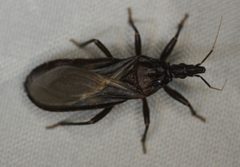
measure 12.7–19 mm (0.5–0.75 inches). Body dark brown to black with lighter margin along . Wings lie flat across back. Three-segmented ("beak") curls beneath when not in use. Nymphs similar but smaller and wingless. Distinguished from other Triatoma by geographic range (western U.S. and Mexico) and association with woodrat nests. May be confused with other reduviids or the western conifer- (Leptoglossus occidentalis), which has expanded leaf-like hind tibiae and lacks the conenose profile.
Images
Habitat
in nests of woodrats ( Neotoma), particularly in rocky or brushy terrain. occasionally disperse to human dwellings, especially rural structures near woodrat . Laboratory colonies maintained at 25°C, 50% RH, 12:12 light:dark cycle.
Distribution
Western United States and Mexico. Documented from Sonora (Caborca region), with distributed across the western U.S. border region.
Seasonality
disperse during late spring, summer, and early fall. Activity peaks in warm months; rarely encountered in autumn or winter.
Diet
Obligate blood-feeder. In nature, feeds on woodrats and other small mammals. In laboratory, accepts blood from immobilized New Zealand rabbits.
Host Associations
- Neotoma - primary woodrat nests serve as primary microhabitat
- Trypanosoma cruzi - competent but considered of secondary importance compared to T. rubida
Life Cycle
-to- development averages 6.7 months under laboratory conditions (25°C, 50% RH). Egg incubation approximately 19 days; rate 72.5%. Five nymphal instars; nymphs require 1–5 blood meals between (averaging ~2.5). Higher mortality in first-instar nymphs. Adults sexually mature with functional wings.
Behavior
blood-feeder. Initiates feeding within 0.3–3 minutes for most instars; fifth-instar nymphs show longer latency. Feeding duration exceeds 10 minutes for most instars. Defecation delay variable: less than 10 minutes for nymphal instars II–IV in some , but patterns differ among geographic populations and . attracted to lights during .
Ecological Role
Secondary of ; lower vector potential than T. rubida due to longer development time and variable defecation patterns. Serves as blood-feeding of wild rodent .
Human Relevance
Bites humans when invading dwellings, causing local irritation and potentially severe allergic reactions including anaphylaxis in sensitized individuals. of , though transmission in U.S. considered low due to "potty-trained" defecation (typically defecates 20–30 minutes post-feeding, after leaving ). Public health concern prompts misidentifications with harmless insects.
Similar Taxa
- Triatoma rubidasimilar size and coloration; T. rubida has shorter development time and higher
- Triatoma sanguisugaeastern with overlapping general ; distinguished by distribution
- Leptoglossus occidentaliswestern conifer- frequently misidentified as kissing bug; has leaf-like expansions on hind tibiae and is plant-feeding
- Reduvius personatusmasked hunter assassin bug enters homes but is not blood-feeding; has different body proportions
Sources and further reading
- BugGuide
- Wikipedia
- GBIF taxonomy match
- Catalogue of Life
- Best Sentence Collection: Stings Happen When Bees Are 'Aminated and Antagonistic' | Bug Squad
- Bug Eric: Kissing Bugs
- New Study Expands Knowledge of Kissing Bug Range in U.S.
- Bug Eric: November 2015
- Not a Kissing Bug: Invasive Western Conifer-Seed Bug Causes Undue Alarm
- Bug Eric: 2015
- The biology of three Mexican-American species of Triatominae (Hemiptera: Reduviidae): Triatoma recurva, Triatoma protracta and Triatoma rubida
- Biological Parameters of TwoTriatoma protractaSubspecies (Hemiptera: Reduviidae)
- Blood Leukocyte Response in Hosts Parasitized by the Hematophagous Arthropods Triatoma protracta and Lutzomyia longipalpis
- Revisiting the taxonomy and geographic distribution of the subspecies Triatoma protracta woodi Usinger, 1939 (Hemiptera: Triatominae)
- Habitat Management to Reduce Human Exposure to Trypanosoma cruzi and Western Conenose Bugs (Triatoma protracta)
- Biosystematics and Hosts of the Triatoma protracta Complex in North America (Hemiptera: Reduviidae) (Rodentia: Cricetidae).Raymond E. Ryckman
- Life history data of a Triatoma protracta nahuatlae, T. sinaloensis, and their laboratory hybrids (Hemiptera: Reduviidae)