
Gonatocerus
Nees, 1834
fairyfly
Species Guides
2Gonatocerus is a speciose of fairyflies (Mymaridae) comprising at least 260 described . These minute are primary parasitoids of leafhoppers and sharpshooters (Hemiptera: Cicadellidae), with several species extensively studied for of agricultural pests, particularly the glassy-winged sharpshooter (Homalodisca vitripennis). The genus is divided into five subgenera: Gonatocerus (nominate), Lymaenon, Cosmocomoidea, Gastrogonatocerus, and Gahanopsis, with species distributed across all major biogeographic regions.
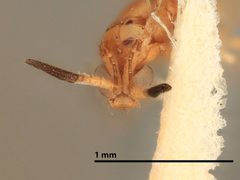
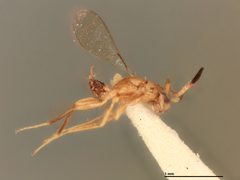
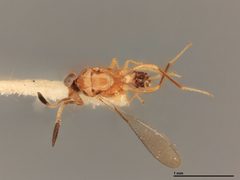
Pronunciation
How to pronounce Gonatocerus: //ɡoʊˌnætəˈsɪrəs//
These audio files are automatically generated. While they are not always 100% accurate, they are a good starting point.
Identification
Gonatocerus are distinguished from other Mymaridae by combinations of antennal structure, wing venation patterns, and genital . The is characterized by forewings with a distinct venation pattern including a relatively long and characteristic arrangement of setae. Females possess a well-developed ovipositor adapted for penetrating . Species-level identification requires examination of multiporous plate distribution on , ovipositor length relative to body, and male genitalia structure. The five subgenera are separated by features of the propodeum, petiole, and wing microtrichia patterns.
Images
Habitat
occur in diverse terrestrial including agricultural systems, vineyards, citrus groves, and natural vegetation associated with their leafhopper . Many species are found in riparian zones and areas with dense herbaceous vegetation where host leafhoppers are abundant.
Distribution
distribution with recorded from North America (including California, Arizona, Florida), South America (Argentina, Brazil, Peru, Rica, Mexico), Europe, Asia (China, Russia, Korea, Japan, Taiwan), Africa, and Australia. The shows highest diversity in the Neotropical and Palaearctic regions.
Seasonality
Activity patterns are closely tied to leafhopper oviposition cycles. In temperate regions, emerge in spring and summer coinciding with host availability. Some overwinter as larvae within host eggs, with adult from late April to early July. Multiple occur annually in warmer climates.
Diet
feed on honeydew and floral nectar; larvae are obligate endoparasitoids developing within . Specific sugar sources including honeydew from Dialeurodes citri have been documented to significantly increase adult longevity compared to honey or water alone.
Host Associations
- Homalodisca vitripennis - primary glassy-winged sharpshooter, major target for
- Homalodisca coagulata - primary congeneric , important agricultural pest
- Tapajosa rubromarginata - primary on citrus and corn in South America
- Anoplotettix putoni - primary leafhopper on grapevine in Europe
- Various Proconiini - primary proconiine sharpshooters, major group for many
- Various Cicadellidae - primary diverse leafhopper across multiple
Life Cycle
Development occurs entirely within . Females oviposit into freshly laid host eggs, with larvae feeding on host embryonic tissues. Development time varies with temperature; occurs as undeveloped larvae within parasitized eggs in temperate regions. from overwintering hosts takes approximately 85 days. lifespan is extended by access to food sources.
Behavior
Females exhibit -searching directed toward leafhopper masses on plant foliage. can exceed 95% within 24 hours under optimal conditions. No has been observed in studied . demonstrate positive response to honeydew sources for supplementary feeding. Competitive interactions occur among sympatric Gonatocerus species sharing hosts.
Ecological Role
Important natural enemies of leafhoppers and sharpshooters, serving as significant mortality factors for these herbivore . Several are primary agents for agricultural pests, particularly in California's Pierce's management programs. The contributes to top-down regulation of populations that transmit plant including Xylella fastidiosa.
Human Relevance
Multiple (G. ashmeadi, G. morrilli, G. tuberculifemur, G. deleoni) are deployed or evaluated as agents against the glassy-winged sharpshooter in California and other regions. These are mass-reared and released for management of Pierce's in vineyards. selectivity studies have identified compounds compatible with parasitoid conservation, including buprofezin and dimethoate as relatively safe options.
Similar Taxa
- AnagrusAlso Mymaridae of leafhoppers, but distinguished by different antennal structure and wing venation; Anagrus typically have shorter and different arrangements of
- ErythmelusSmaller Mymaridae with reduced wing venation and different body proportions; often associated with different groups including lace bugs (Tingidae)
- PolynemaRelated mymarid with distinct wing microtrichia patterns and different male genitalia structure; often associated with planthopper rather than leafhoppers
Sources and further reading
- BugGuide
- Wikipedia
- GBIF taxonomy match
- iNaturalist taxon
- NCBI Taxonomy
- Catalogue of Life
- gonatocerus_mitjaevi_triapitsyn_rakitov_ht_ucrc_ent_315236_wgright.jpg | Entomology Research Museum
- gonatocerus_barbos_triapitsyn_ht_ucrc_ent_151715_slide0002.jpg | Entomology Research Museum
- Primary Type List | Entomology Research Museum
- Publications | Entomology Research Museum
- A New Guide for Understanding Insect Vectors of Plant Pathogen Xylella fastidiosa
- Overwintering Biology, Food Supplementation and Parasitism of Eggs of Homalodisca Coagulata (Say) (Homoptera: Cicadellidae) by Gonatocerus Ashmeadi Girault and Gonatocerus Morrilli (Howard) (Hymenoptera: Mymaridae)
- Comparative assessments of Gonatocerus ashmeadi and the ‘new association’ parasitoid Gonatocerus tuberculifemur (Hymenoptera: Mymaridae) as biological control agents of Homalodisca vitripennis (Hemiptera: Cicadellidae)
- Suitability of non-fertilized eggs of Homalodisca vitripennis for the egg parasitoid Gonatocerus morrilli
- A key to the Mymaridae (Hymenoptera) egg parasitoids of proconiine sharpshooters (Hemiptera: Cicadellidae) in the Nearctic region, with description of two new species of Gonatocerus
- The competitive ability of three mymarid egg parasitoids (Gonatocerus spp.) for glassy-winged sharpshooter (Homalodisca coagulata) eggs
- Genetic differentiation among geographic populations of Gonatocerus ashmeadi, the predominant egg parasitoid of the glassy-winged sharpshooter, Homalodisca coagulata
- First record of Gonatocerus litoralis (Haliday) (Hymenoptera: Mymaridae) from Anoplotettix putoni Ribaut (Hemiptera: Cicadellidae)
- Review of <i>Gonatocerus</i> (Hymenoptera: Mymaridae) in the Palaearctic region, with notes on extralimital distributions
- A new species of Gonatocerus (Hymenoptera: Mymaridae) from Argentina, an egg parasitoid of Tapajosa rubromarginata (Hemiptera: Cicadellidae)
- Reproductive and developmental biology of Gonatocerus ashmeadi (Hymenoptera: Mymaridae), an egg parasitoid of Homalodisca coagulata (Hemiptera: Cicadellidae)
- Effect of Formulated Insecticides on Homalodisca vitripennis (Germar) (Hemiptera: Cicadellidae) and its Parasitoid Gonatocerus ashmeadi Girault (Hymenoptera: Mymaridae)
- The effect of resource provisioning and sugar composition of foods on longevity of three Gonatocerus spp., egg parasitoids of Homalodisca vitripennis
- Biology and host specificity of Gonatocerus deleoni (Hymenoptera: Mymaridae), a potential biocontrol agent of Homalodisca vitripennis (Hemiptera: Cicadellidae) in California, USA
- Review of Gonatocerus (Hymenoptera: Mymaridae) in the Neotropical region, with description of eleven new species