
Mymaridae
Haliday, 1833
Fairy Wasps, Fairyflies
Genus Guides
17- Acmopolynema(fairyflies)
- Alaptus
- Anagrus(fairyflies)
- Anaphes(fairyflies)
- Camptoptera
- Cleruchus
- Dicopomorpha(fairyfly)
- Dicopus
- Gonatocerini
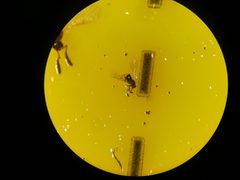
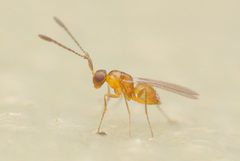
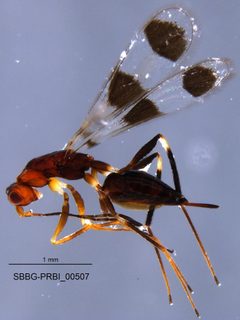
, commonly known as fairy or fairyflies, is a of microscopic chalcidoid wasps containing approximately 100 and 1,400 described distributed worldwide in temperate and tropical regions. Members are among the smallest known insects, with body lengths ranging from 0.2 to 1.5 mm; the smallest species, Dicopomorpha echmepterygis, measures only 0.139 mm and is the smallest known insect. All known species are solitary, idiobiont endoparasitoids of insect , with primarily in Hemiptera (especially leafhoppers, planthoppers, and true bugs), Coleoptera, and Psocodea. The family is economically significant as agents for agricultural pests, particularly for leafhoppers that plant .
Pronunciation
How to pronounce Mymaridae: /mɪˈmærɪdiː/
These audio files are automatically generated. While they are not always 100% accurate, they are a good starting point.
Identification
Identification to requires microscopic examination of wing venation, antennal segmentation and club structure, and tarsal segmentation. Key genera include Anagrus (common of leafhoppers, with 5-segmented and characteristic antennal club), Gonatocerus (parasitoids of sharpshooters, with 4-segmented tarsi and elongated body), and Erythmelus (parasitoids of beet leafhopper and lace bugs, with distinctive wing shape). -level identification often requires examination of male genitalia and molecular markers (COI, ITS2). Distinguishing from Trichogrammatidae (another egg parasitoid ) by reduced wing venation and generally smaller size; from Aphelinidae by absence of postmarginal and different antennal structure.
Images
Habitat
Found in diverse terrestrial including forests, grasslands, wetlands, and agricultural systems. Associated with vegetation supporting their insects. Many inhabit crop systems (vineyards, orchards, row crops) where leafhopper and planthopper hosts occur. Some (e.g., Camptoptera) associated with aquatic or semi-aquatic habitats where hosts occur on emergent vegetation. Elevation range from sea level to montane regions; distribution limited by presence of suitable hosts rather than climate alone.
Distribution
distribution in temperate and tropical regions worldwide. Particularly diverse in tropical regions; well-represented in North America, South America, Europe, Asia, Africa, and Australia/Oceania. Documented from Argentina, Brazil, Mexico, USA (including California, Florida, and Pacific Northwest), Spain, Portugal, Taiwan, Japan, China, Russia (Far East), Australia, and numerous Pacific islands. Many have been introduced beyond native ranges for programs.
Seasonality
Activity patterns closely tied to availability and local climate. In temperate regions, multiple per year with peak activity during warm months when leafhopper hosts are abundant. In tropical and subtropical regions, continuous breeding possible year-round. Specific varies by and host system; for example, Anagrus species associated with grape leafhoppers active from spring through fall in California vineyards. Some species overwinter as or larvae within host .
Diet
of some feed on honeydew or nectar; laboratory studies indicate Anaphes nitens adults feed on pure honey. Larvae are obligate endoparasitoids, developing entirely within and consuming egg contents. No free-living feeding stage; nutrition derived exclusively from host egg and embryo.
Host Associations
- Hemiptera: Cicadellidae (leafhoppers) - primary groupMajor for Anagrus, Gonatocerus, and other ; includes economically important pests like Empoasca, Erythroneura, Amrasca, Homalodisca, and Dalbulus
- Hemiptera: Delphacidae (planthoppers) - primary group for Anagrus and other ; includes rice pests like Nilaparvata and Sogatella
- Hemiptera: Cicadellidae: Proconiini (sharpshooters) - specialized groupPrimary for Gonatocerus , including glassy-winged sharpshooter Homalodisca vitripennis
- Hemiptera: Tingidae (lace bugs) - group for Erythmelus
- Coleoptera: Curculionidae (weevils) - group for Anaphes , including Gonipterus platensis (Eucalyptus snout-)
- Psocodea: Psocoptera (barklice) - group for Alaptus
Life Cycle
Solitary or occasionally gregarious idiobiont endoparasitoids. Female locates using chemical and tactile cues, drills through egg or plant tissue with long ovipositor, and deposits single egg (rarely multiple eggs) inside host egg. Larva develops through typically three instars, consuming host embryo and . occurs within host egg; emerges by chewing exit hole. Development time temperature-dependent, ranging from approximately 10–30 days. Sex ratio typically female-biased. Mating usually occurs immediately after ; males often emerge before females (protandry). Some exhibit (unfertilized eggs produce males).
Behavior
Females actively search for using from host eggs, host feeding damage, or host plant volatiles. Oviposition includes antennal tapping to locate eggs, drilling with ovipositor, and assessment of host suitability. Some (e.g., Anagrus) can use openings created by host oviposition to access eggs, reducing drilling time. ability varies; winged forms disperse to locate hosts, while some species have wingless females adapted for localized host patches. Males often exhibit rapid, erratic flight patterns searching for emerging females. No parental care beyond oviposition. typically short-lived (days to weeks).
Ecological Role
Important natural enemies regulating of leafhoppers, planthoppers, and other herbivorous insects. Significant in trophic cascades by suppressing herbivores that damage plants and plant . Serve as food for larger and (hyperparasitism documented in some systems). Contribute to biodiversity in insect , with high in some . services in agriculture include reduction of pest damage and pathogen transmission; enhanced by maintaining non-crop vegetation that supports alternative .
Human Relevance
Widely used as agents in augmentative and programs. Anaphes nitens introduced globally for control of Eucalyptus snout-beetles (Gonipterus spp.). Gonatocerus released in California and other regions for control of glassy-winged sharpshooter (Homalodisca vitripennis), of Pierce's in grapes. Anagrus species conserved and augmented in vineyards for leafhopper management. Research interest due to extreme miniaturization, with implications for understanding limits of insect body size, mechanics, and neurobiology. No known negative impacts; species are -specific and do not attack beneficial insects or vertebrates.
Similar Taxa
- TrichogrammatidaeAlso of similar size; distinguished by different wing venation (more complete venation with closed in forewing), different antennal structure, and generally larger body size
- AphelinidaeSimilar size range and lifestyle; distinguished by presence of postmarginal in forewing, different antennal segmentation, and often broader range including non- stages
- EncyrtidaeRelated chalcidoid with some ; distinguished by larger size, different wing venation, and typically different stages (often parasitoids of nymphs or )
- MymarommatidaeHistorically confused with ; distinguished by distinct wing venation with long , different antennal structure, and unique mesosomal features
More Details
Miniaturization and Biology
exhibit extreme miniaturization with associated biological modifications including reduced numbers, simplified musculature, and novel mechanisms for flight at low Reynolds numbers. The smallest , Dicopomorpha echmepterygis, has males that are blind, wingless, and possess reduced mouthparts, living entirely within .
Taxonomic Complexity
-level is challenging due to morphological similarity, , and cryptic species. Molecular markers (COI, ITS2, ISSR-) increasingly used to resolve species boundaries, as demonstrated in like Anagrus epos and Gonatocerus tuberculifemur.
Rearing and Research
Laboratory rearing requires access to , often maintained through continuous host colonies. Anaphes nitens reared on Gonipterus platensis eggs; cold storage of host eggs at 7°C for up to 20 days enables colony maintenance without significant effects on .
Sources and further reading
- BugGuide
- GBIF taxonomy match
- iNaturalist taxon
- NCBI Taxonomy
- Catalogue of Life
- Publications | Entomology Research Museum
- Primary Type List | Entomology Research Museum
- Wasps, Wasps, Wasps: Weird and Wonderful Wasps | Bug Squad
- Two Native Anagrus spp. (Hymenoptera: Mymaridae) Are Egg Parasitoids of the Invasive Two-Spot Cotton Leafhopper Amrasca biguttula (Ishida) (Hemiptera: Cicadellidae) in Florida, USA.
- Cold storage of Gonipterus platensis (Coleoptera: Curculionidae) eggs for Anaphes nitens (Hymenoptera: Mymaridae) rearing.