
Polynema
Haliday, 1833
fairyflies, fairy wasps
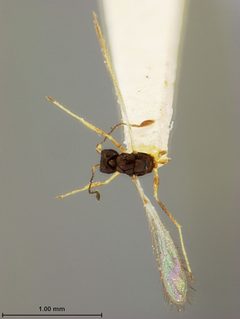
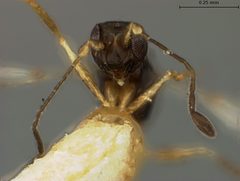
Polynema is a of fairyflies in the Mymaridae, comprising approximately 270 described . These are among the smallest known insects, with typically measuring less than 1 mm. The genus is taxonomically challenging, currently treated as a conglomerate of poorly defined related groups classified into subgenera including P. (Polynema), P. (Doriclytus), and P. (Dorypolynema). Members are idiobiont endoparasitoids of insect , attacking across multiple orders including Hemiptera, Coleoptera, Hymenoptera, Orthoptera, , and Odonata. The genus has distribution with significant diversity in the Neotropical, Palaearctic, and Oriental regions.
Pronunciation
How to pronounce Polynema: //ˌpɒlɪˈniːmə//
These audio files are automatically generated. While they are not always 100% accurate, they are a good starting point.
Identification
Polynema are distinguished from other Mymaridae by combinations of antennal segment counts, wing venation patterns, and genitalia structure. The is characterized by specific arrangements of wing microtrichia, mesosomal , and ovipositor length relative to body size. Species-level identification requires microscopic examination of antennal proportions, forewing marginal fringe length, and male genitalia. The subgenera can be separated by antennal formula and forewing shape: P. (Polynema) typically has 9-segmented in females, P. (Doriclytus) has reduced antennal segments with distinctive clava structure, and P. (Dorypolynema) shows intermediate characteristics.
Images
Distribution
distribution with documented records from: North America (Ontario, Quebec, California), South America (Argentina, Bolivia, Brazil, Chile, Paraguay, Uruguay), Europe, Russia (Primorskii Krai, Far East), China (Xinjiang, Oriental region), Taiwan, Japan, and Madagascar. Within Argentina, specimens have been collected in Buenos Aires, Córdoba, Corrientes, Entre Ríos, Misiones, and Neuquén provinces.
Host Associations
- Lygus pratensis - endoparasitoid of in common mullein
- Lygus lineolaris - main in southwestern Quebec
- Cicadellidae (leafhoppers) - reared from field collections
- Miridae - general association
Life Cycle
Development occurs entirely within . is assumed to occur as the last larval instar or within host eggs, though this has not been directly confirmed for most . No evidence exists for overwintering in Mymaridae. Adults are short-lived and do not feed.
Behavior
Females use their elongated ovipositors to access concealed in plant tissue. Searching involves host location followed by antennal examination of substrate to detect host egg vibrations or chemical cues. Mating typically occurs immediately after . are capable of but are also passively dispersed by wind.
Ecological Role
Idiobiont endoparasitoid of insect , contributing to natural regulation of in diverse insect orders. Significant potential as agent, particularly against pest Hemiptera including mirid bugs and leafhoppers. are closely tied to egg availability and seasonal abundance.
Human Relevance
Evaluated for of agricultural pests including Lygus in strawberry and other crops. Taxonomic complexity has hindered practical application. Some species have been mass-reared and released for pest management, though species identification challenges complicate efficacy assessment.
Similar Taxa
- AnagrusBoth are Mymaridae with reduced wing venation; Polynema differs in antennal segmentation and absence of distinct wing clouding patterns characteristic of Anagrus
- GonatocerusSimilar associations with Hemiptera ; Polynema lacks the enlarged hind and distinctive mesopleural carina of Gonatocerus
- AcmopolynemaFormerly included within Polynema sensu lato; separated based on wing venation and antennal structure differences
More Details
Taxonomic Complexity
The represents one of the most taxonomically difficult groups in Mymaridae, with approximately 270 valid classified into poorly defined related groups. Recent revisions have transferred several species to other genera (Acmopolynema, Agalmopolynema, Stephanodes) based on cladistic analysis of morphological characters.
Size and Collection
are typically collected using , yellow pan traps (Moericke), and sweep netting. Specimens require slide-mounting for reliable identification. The extreme small size (often under 0.5 mm) makes field observation and behavioral study challenging.
Molecular Studies
Recent integrative taxonomic approaches combining morphological and molecular analyses (COI, ITS2) have revealed cryptic and helped resolve boundaries, particularly in the P. (Doriclytus) subgenus from Oriental China.
Sources and further reading
- BugGuide
- iNaturalist taxon
- NCBI Taxonomy
- Catalogue of Life
- Publications | Entomology Research Museum
- Revisión del género Polynema Haliday s.l. (Hymenoptera: Mymaridae) en Argentina y paises limítrofes
- Genera coelomycetum. XIV. Allelochaeta, Basilocula, Ceuthosira, Microgloeum, Neobarclaya, Polynema, Pycnidiochaeta, and Xenodomus
- NOTE ON OVERWINTERING OF POLYNEMA PRATENSIPHAGUM (WALLEY) (HYMENOPTERA: MYMARIDAE) IN SOUTHWESTERN QUEBEC
- Integrative Taxonomy of Polynema (Doriclytus) (Hymenoptera: Mymaridae) from Oriental China: Three New Species and Five New Records Revealed by Morphological and Molecular Analyses.
- Polynema (Polynema) Haliday (Hymenoptera, Mymaridae) of Xinjiang: descriptions of three new species, with eleven new records from China.