
Acmopolynema
Ogloblin, 1946
fairyflies
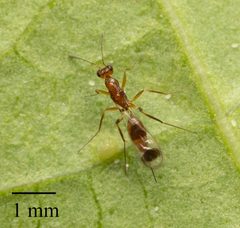
Acmopolynema is a of fairyflies (Hymenoptera: Mymaridae) established by Ogloblin in 1946. in this genus are minute , with new species described from India and distributional records from China, Japan, Madagascar, and other regions. The genus belongs to a renowned for containing some of the smallest known insects.
Pronunciation
How to pronounce Acmopolynema: //ˌækməˌpɒlɪˈniːmə//
These audio files are automatically generated. While they are not always 100% accurate, they are a good starting point.
Identification
Acmopolynema can be distinguished from related within Mymaridae by genitalic and antennal characters detailed in taxonomic revisions. The genus is placed in the tribe Mymarini. Identification to species level requires examination of microscopic characters including wing venation, antennal segment proportions, and male genitalia.
Images
Distribution
Recorded from India (new described), China, Japan, Madagascar, and Primorskii Krai in the Russian Far East. The appears to have an Oriental and Palaearctic distribution with possible extensions into the Australasian region.
Ecological Role
As members of Mymaridae, in this are presumed of other insects, though specific records remain undocumented in the available literature.
Similar Taxa
- PolynemaBoth belong to Mymaridae and share similar wing venation patterns; Acmopolynema is distinguished by antennal and genitalic characteristics.
- PalaeoneuraHistorically associated within Mymaridae; Acmopolynema differs in body proportions and antennal structure.
- XenopolynemaRelated within the same tribe; separated from Acmopolynema based on male genitalia and wing characters.
More Details
Taxonomic history
The was revised in 2007 by Triapitsyn & Berezovskiy, who provided taxonomic notes on related genera Palaeoneura and Xenopolynema. Two new from India were described in 2017 by Manickavasagam, Palanivel & Triapitsyn.
Sources and further reading
- BugGuide
- Wikipedia
- GBIF taxonomy match
- iNaturalist taxon
- NCBI Taxonomy
- Catalogue of Life
- Publications | Entomology Research Museum
- Two new species and additional distributional records ofAcmopolynemaOgloblin (Hymenoptera: Mymaridae) from India
- A NEW DISTRIBUTION AND HOST RECORD FOR GONATOCERUS TRIGUTTATUS IN FLORIDA, WITH NOTES ON ACMOPOLYNEMA SEMA (HYMENOPTERA: MYMARIDAE)