
Leptocybe invasa
Fisher & La Salle, 2004
blue gum chalcid wasp, eucalyptus gall wasp, Eucalyptus Stem Gall Wasp
Leptocybe invasa is a gall-forming chalcid native to Queensland, Australia, and the sole in the Leptocybe. It is a globally significant pest of Eucalyptus plantations, having spread to Africa, Asia, Europe, the Americas, and the Pacific region. The wasp induces spherical galls on leaf buds, midribs, and petioles, impairing tree growth and productivity. reproduce primarily through , with males being rare, enabling rapid population establishment in new regions.
Pronunciation
How to pronounce Leptocybe invasa: /lɛptoʊsaɪb iːnveɪzə/
These audio files are automatically generated. While they are not always 100% accurate, they are a good starting point.
Identification
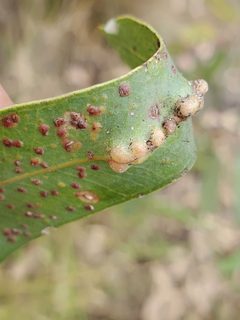
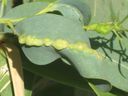
Distinguished from other gall wasps by its specific association with Eucalyptus, the spherical galls (up to 2.7 mm wide) on leaf buds, midribs, and petioles, and its brown body with blue-green iridescence. Galls progress through distinct color stages: green to pinkish to dark pink or red, eventually becoming dull brown or reddish with a corky, texture. Molecular identification may be required where males occur, as these are morphologically distinct from females.
Images
Appearance
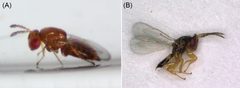
Tiny approximately 1 mm in length. Body brown with slight blue to green iridescence. Legs partially yellowish in color.
Habitat
Eucalyptus plantations and nurseries; specifically attacks new leaf buds, young branches, central , and petioles of trees. In native range, found in Queensland, Australia. In invaded regions, are more severe in hotter, drier agroecological zones and at lower altitudes; no infestation observed above 1938 m elevation.
Distribution
Native to Queensland, Australia. across northern, eastern, and southern Africa; Asia (China, India, Iran, Israel, Thailand, Vietnam, and others); Europe (France, Greece, Italy, Portugal, Spain, United Kingdom); Pacific region; southern South America (Argentina, Brazil, Paraguay, Uruguay); Middle East; Mexico; and the United States (Florida). Continues to spread.
Seasonality
In temperate regions, 2–3 per year; in tropical regions, up to 6 generations per year. duration varies seasonally: 86–89 days from green galls in summer, 115–150 days from pink galls depending on temperature. Winter hibernation occurs in larval and pupal stages in colder climates, extending development to 150 days. more active in morning hours.
Host Associations
- Eucalyptus botryoides - bangalay
- Eucalyptus bridgesiana - apple box
- Eucalyptus camaldulensis - river red gum; type for description
- Eucalyptus globulus - Tasmanian blue gum
- Eucalyptus grandis - flooded gum
- Eucalyptus gunnii - cider gum
- Eucalyptus robusta - swamp mahogany
- Eucalyptus saligna - Sydney blue gum
- Eucalyptus tereticornis - forest red gum
- Eucalyptus viminalis - manna gum
- Eucalyptus maidenii - non-escaped attack in Uganda study, located outside ecological range of insect
- Eucalyptus urophylla - lower severity in hybrids with E. grandis compared to E. grandis × E. camaldulensis
Life Cycle
Female deposits minute in linear arrangement in of new leaf buds; whitish sap may exude from oviposition site. Gall development proceeds through five stages: tissue disruption, gall development, pink, dull pink, and exit hole formation. Larva develops inside gall; emerges after 3–4 months of growth within gall. Gall becomes spherical, up to 2.7 mm wide. Typically 3–6 galls per leaf, with up to 65 galls observed on single leaf. Adult longevity up to 7 days when fed honey water solution; shorter on water alone, young Eucalyptus leaves, or without food.
Behavior
females oviposit in new leaf buds, causing gall formation that can kill buds under heavy . Damage increases with coppice development but plateaus after coppice maturity; attacks coppices after leaves transition from red to green. Adults exhibit morning activity peak. primarily enables rapid increase and of new areas.
Ecological Role
Pest of Eucalyptus plantations causing growth impairment and economic losses. Subject to by native and introduced , including Megastigmus spp., Quadrastichus mendeli, Aprostocetus spp., and Selitrichodes spp. Quadrastichus mendeli has proven particularly effective in Mediterranean Basin. Parasitization rates can reach 67% or higher, contributing to .
Human Relevance
Major economic pest of Eucalyptus forestry industry globally, causing plantation losses, halted forestry activity, replacement of susceptible genetic material, and discarding of commercial . Subject to active programs using releases. Chemical profiles of Eucalyptus investigated as potential resistance markers for breeding programs.
Similar Taxa
- Other gall-forming EulophidaeL. invasa distinguished by specific Eucalyptus association, gall (spherical, color-changing galls on buds/midribs/petioles), and geographic origin; molecular or rearing confirmation typically required for definitive identification in invaded ranges.
More Details
Endosymbiotic bacteria
across China harbor endosymbiotic bacteria; functional effects and coevolutionary relationships under investigation.
Male rarity and function
Males are extremely rare (sex ratios typically 0.94–0.99 female-biased) and their functional role in remains unclear; first records from Uruguay and Paraguay documented in 2019 and 2022 respectively.
Biological control agents
Selitrichodes neseri, discovered in native Australian range in 2014, is -specific ectoparasitoid with potential as agent; Quadrastichus mendeli has short developmental time and rapid , achieving 26.8% in Paraguay.
Sources and further reading
- BugGuide
- Wikipedia
- GBIF taxonomy match
- iNaturalist taxon
- NCBI Taxonomy
- New NeoBiota special issue explores invasions in aquatic systems
- Leptocybe invasa . [Distribution map].
- Leptocybe invasa . [Distribution map].
- Biology, Damage and Parasitoids of Eucalyptus Gall Wasp, Leptocybe invasa Infesting
- Reproductive Biology of Leptocybe invasa Fisher & La Salle (Hymenoptera: Eulophidae)
- Eucalyptus infestation by Leptocybe invasa in Uganda
- Chemical profiles of Eucalyptus essential oils associated with genotypic resistance to Leptocybe invasa Perfis químicos de óleos essenciais de Eucalyptus associados à resistência genotípica a Leptocybe invasa
- Figure 1: Venn diagram of OTU distribution in Leptocybe invasa female and male adults.
- Biological control of Eucalyptus gall wasp, Leptocybe invasa Fisher & La Salle (Hymenoptera: Eulophidae) by its native parasitiods
- First Record of Leptocybe invasa Fischer & La Salle (Hymenoptera: Eulophidae) males from Uruguay
- Sensory Geneidentificationin the Transcriptome of the Ectoparasitoid Quadrastichus Mendeliinthe Eucalyptus Gall wasp Leptocybe Invasa
- Leptocybe invasa males and the parasitoid Quadrastichus mendeli (Hym.: Eulophidae): First report in Paraguay
- Comparative biology of Leptocybe invasa (Hymenoptera: Eulophidae) in green and pink galls on Eucalyptus in North Western India
- Coevolution and Functional Effects of Endosymbiotic Rickettsia in Leptocybe invasa Fisher & LaSalle (Hymenoptera: Eulophidae) Across China.