
Leptocybe
Fisher & La Salle, 2004
blue gum chalcid wasp, eucalyptus gall wasp
Species Guides
1- Leptocybe invasa(blue gum chalcid wasp)
Leptocybe is a of gall wasps in the Eulophidae, containing the single L. invasa. Native to Queensland, Australia, this genus has become globally significant as an pest of Eucalyptus plantations. The induces spherical galls on leaf buds and young tissues of multiple Eucalyptus species, causing substantial economic damage to forestry operations worldwide. The genus is characterized by extremely small body size, thelytokous parthenogenetic , and rapid expansion in introduced ranges.
Pronunciation
How to pronounce Leptocybe: /ˌlɛp.toʊˈsaɪ.biː/
These audio files are automatically generated. While they are not always 100% accurate, they are a good starting point.
Identification
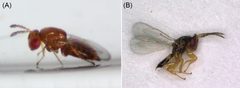
The Leptocybe is , containing only L. invasa. are minute slightly exceeding 1 mm in length. The body is brown with subtle blue to green iridescence, and portions of the legs are yellowish. No other Leptocybe have been described, so identification to genus level effectively identifies the species.
Images
Habitat
Native to eucalypt forests in Queensland, Australia. In invaded ranges, occurs wherever Eucalyptus are planted, including nurseries, plantations, and urban plantings. The specifically targets new leaf buds and young coppice growth on Eucalyptus trees.
Distribution
Native to Queensland, Australia. Introduced and established across northern, eastern, and southern Africa, Asia, the Pacific Region, Europe (as far north as the United Kingdom), southern South America, the Middle East, Mexico, and the United States. The appears to be continuing to expand its range.
Seasonality
Activity patterns vary by climate. In temperate regions, 2-3 occur annually; in tropical regions, up to 6 generations may occur. are more active in the morning hours. duration ranges from 86-150 days depending on season and gall type, with extended development in winter due to larval and pupal hibernation.
Host Associations
- Eucalyptus botryoides - bangalay
- Eucalyptus bridgesiana - apple box
- Eucalyptus globulus - Tasmanian blue gum
- Eucalyptus gunnii - cider gum
- Eucalyptus grandis - flooded gum
- Eucalyptus robusta - swamp mahogany
- Eucalyptus saligna - Sydney blue gum
- Eucalyptus tereticornis - forest red gum
- Eucalyptus viminalis - manna gum
- Eucalyptus camaldulensis - river red gum
Life Cycle
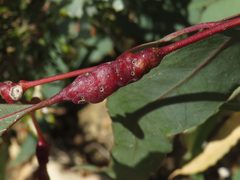
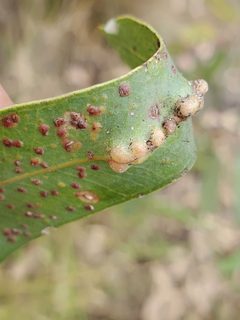
Females deposit minute in linear series within the of new Eucalyptus leaf buds. Oviposition sites may exude whitish sap. Gall development proceeds through distinct stages: initial tissue disruption, gall formation, pink phase, dull pink phase, and finally exit hole formation. Larvae develop internally as the gall enlarges, becoming spherical and reaching up to 2.7 mm width. emerge after 3-4 months of development within galls. Heavy can kill buds; surviving buds develop corky scar tissue that expands and changes color from green through pink to dull brown or reddish. Gall development stages and coloration vary seasonally, with green galls observed in summer and pink galls predominating in winter.
Behavior
occurs primarily through ; males are rare and their functional role remains unclear. Females live up to 7 days and can reproduce asexually, enabling rapid increase. Oviposition occurs specifically in new leaf buds and young coppice tissue after leaves transition from red to green. Damage intensity increases during coppice development but stabilizes after tree maturity. exhibit morning activity peaks.
Ecological Role
In its native Australian range, Leptocybe occupies a specialized gall-forming on Eucalyptus with natural enemy complexes that regulate . In introduced ranges, it functions as a significant forestry pest causing bud mortality, shoot deformation, and plantation economic losses. The serves as for multiple species including Quadrastichus mendeli, Selitrichodes neseri, Megastigmus spp., and Aprostocetus spp., which have been investigated and deployed as agents.
Human Relevance
Major economic pest of global Eucalyptus forestry and plantation industries. Causes direct damage through gall formation reducing timber quality and tree vigor, and indirect costs through plantation management, genetic material replacement, and control measures. Subject to intensive research and implementation. Control programs have utilized releases with documented success, including reduction of gall within 8 months of parasitoid establishment in some regions.
Sources and further reading
- BugGuide
- Wikipedia
- GBIF taxonomy match
- iNaturalist taxon
- NCBI Taxonomy
- Catalogue of Life
- Leptocybe invasa . [Distribution map].
- Leptocybe invasa . [Distribution map].
- Biology, Damage and Parasitoids of Eucalyptus Gall Wasp, Leptocybe invasa Infesting
- Parasitoids of the eucalyptus gall wasp Leptocybe spp.: a global review
- Reproductive Biology of Leptocybe invasa Fisher & La Salle (Hymenoptera: Eulophidae)
- Figure 1: Venn diagram of OTU distribution in Leptocybe invasa female and male adults.
- Biological control of Eucalyptus gall wasp, Leptocybe invasa Fisher & La Salle (Hymenoptera: Eulophidae) by its native parasitiods
- Sensory Geneidentificationin the Transcriptome of the Ectoparasitoid Quadrastichus Mendeliinthe Eucalyptus Gall wasp Leptocybe Invasa
- First Record of Leptocybe invasa Fischer & La Salle (Hymenoptera: Eulophidae) males from Uruguay
- Leptocybe invasa males and the parasitoid Quadrastichus mendeli (Hym.: Eulophidae): First report in Paraguay
- Comparative biology of Leptocybe invasa (Hymenoptera: Eulophidae) in green and pink galls on Eucalyptus in North Western India
- Coevolution and Functional Effects of Endosymbiotic Rickettsia in Leptocybe invasa Fisher & LaSalle (Hymenoptera: Eulophidae) Across China.