
Spodoptera eridania
Stoll, 1781
Southern Armyworm Moth, Southern Armyworm
Spodoptera eridania is a highly noctuid whose larvae are significant agricultural pests in tropical and subtropical regions of the Western Hemisphere. The has emerged as one of the most important pests of soybean in Brazil and Argentina, particularly in cotton-growing regions, while remaining a sporadic pest in the southern United States. Larvae feed gregariously when young, skeletonizing leaves, and become solitary as they mature, often boring into fruit. The species has been introduced to West Africa (Nigeria and Cameroon).
Pronunciation
How to pronounce Spodoptera eridania: /spɔˈdɒptɛrə ɛˈrɪdəniə/
These audio files are automatically generated. While they are not always 100% accurate, they are a good starting point.
Identification
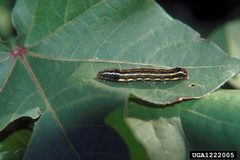
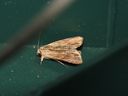
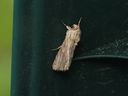
are distinguished from other Spodoptera by the combination of gray-brown forewings with variable pattern (including presence or absence of central bean-shaped spot) and opalescent white hind wings. Larvae are distinguished from similar species by the position of the dark lateral spot on the first abdominal segment (versus in S. exigua), the interruption of the subspiracular light-colored line by the black marking on the first abdominal segment (line is continuous in S. cosmioides), and the larger size of black spots on the first abdominal segment relative to those on the eighth when the line is absent (opposite pattern in S. cosmioides). The species rarely exhibits a black marking on top of the mesothoracic segment, which is almost always present in S. cosmioides.
Images
Habitat
Agricultural fields, particularly soybean, cotton, and vegetable crops; also found on various weeds in disturbed . Larvae are typically found on the lower parts of leaves. In northern Florida, larvae occur only in summer months despite being present year-round.
Distribution
Native range: North America (southern United States as far west as Kansas and New Mexico), through the Caribbean and Central America into South America (Brazil to Argentina). Introduced to West Africa: Nigeria and Cameroon. Present in Belgium (status doubtful) and Denmark.
Seasonality
are on wing year-round in tropical and subtropical regions. In northern Florida, adults occur throughout the year (withstanding several days of freezing weather), while larvae are present only in summer months. Approximately four per year occur in Florida, with one generation lasting 30–40 days.
Diet
Highly . Larvae feed on a wide range of vegetables (beet, cabbage, carrot, collard, cowpea, eggplant, okra, pepper, potato, sweet potato, tomato, watermelon), fruits (avocado, citrus), field crops (peanut, sunflower, velvet bean, tobacco, soybean), and various flowers. Preferred weed include Amaranthus and Phytolacca americana. Lima bean is a preferred host, possibly due to cyanogenic glycoside content. Grasses are rarely eaten.
Host Associations
- Solanum lycopersicum - feeds onheavy feeder on tomato in Florida
- Glycine max - feeds onmajor pest in Brazil and Argentina
- Gossypium - feeds onassociated with cotton-growing regions
- Amaranthus - preferred preferred weed
- Phytolacca americana - preferred preferred weed
- Phaseolus lunatus - preferred preferred , possibly due to cyanogenic glycosides
Life Cycle
Complete with four stages: , larva, pupa, . Eggs are flattened spheres measuring approximately 0.45 mm diameter and 0.35 mm height, green initially turning tan with age, laid in clusters covered with from the female's body; duration 4–6 days. Larvae have six instars, duration 14–20 days; feed gregariously when young, becoming solitary as they mature. Pupae are mahogany brown, 16–18 mm long and 5–6 mm wide, formed in soil at 5–10 cm depth; duration 11–13 days. occurs in pupae, with females larger due to an additional instar. Adult lifespan is positively correlated with pupal size in females but negatively in males. Total time approximately 30–40 days. Four generations estimated per year in Florida.
Behavior
Young larvae feed gregariously, skeletonizing leaves. As they mature, larvae become solitary and , hiding on lower leaf parts during the day. When food-stressed, larvae will eat portions of branches, bore into stem tissue, and attack tubers near the soil surface. Larvae readily bore into fruit, particularly tomatoes. are nocturnal.
Ecological Role
Larvae function as primary consumers and significant herbivores in agricultural . The serves as for numerous (Campoletis flavicincta, Chelonus insularis, Cotesia marginiventris, Euplectrus platyhypenae, Meteorus autographae, Meteorus laphygmae, Ophion flavidus) and flies (Choeteprosopa hedemanni, Eucelatoria rubentis, Euphorocera claripennis, Gonia crassicornis, Lespensia sp., Winthemia quadripustulata, Winthemia rufopicta), contributing to complexity.
Human Relevance
Major agricultural pest causing significant economic damage to soybean, cotton, and vegetable crops. In Brazil and Argentina, has emerged as one of the most important pests of soybean. In Florida, heavy feeder on tomatoes causing fruit damage. Subject of extensive research on alternative , particularly neem-based products containing , which reduce feeding and disrupt growth and development. Bt corn expressing Cry1F and Cry1F + Cry1A.105 + Cry2Ab2 proteins causes 100% mortality in larvae. Management relies primarily on foliar insecticides applied when larvae are small; insecticides are generally ineffective.
Similar Taxa
- Spodoptera cosmioidesLarvae easily confused in South America; distinguished by presence of dark spot on mesothoracic segment (usually absent in S. eridania), continuous subspiracular line (interrupted in S. eridania), and smaller first abdominal segment spots relative to eighth when line absent (opposite in S. eridania)
- Spodoptera exiguaLarvae can be confused due to dark lateral spot; distinguished by position on versus first abdominal segment in S. eridania
- Spodoptera frugiperdaSimilar distribution and pest status; distinguished by presence of four pinaculae per abdominal segment with Y-shaped marking in S. frugiperda
- Spodoptera ornithogalliSimilar distribution; distinguished by paired black triangular spots with uninterrupted yellow stripes in S. ornithogalli
Sources and further reading
- BugGuide
- Wikipedia
- GBIF taxonomy match
- iNaturalist taxon
- NCBI Taxonomy
- Catalogue of Life
- Quick Guide to Armyworms on Soybean | Beetles In The Bush
- Noctuidae | Beetles In The Bush | Page 2
- October | 2013 | Beetles In The Bush
- Brazil | Beetles In The Bush
- Lepidoptera | Beetles In The Bush | Page 6
- Argentina | Beetles In The Bush | Page 2