
Frankliniella occidentalis
(Pergande, 1895)
Western Flower Thrips, alfalfa thrips, California thrips
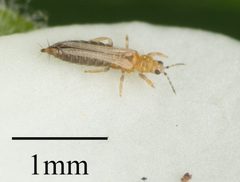
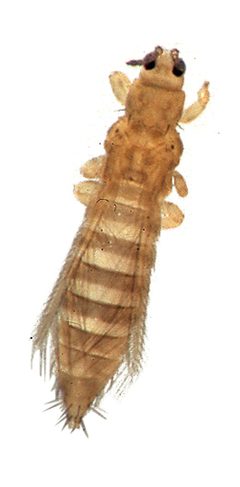
Frankliniella occidentalis, the western , is a minute insect native to the southwestern United States that has become a globally significant agricultural pest. measure approximately 1.5 mm in length. The feeds on plant fluids by piercing and sucking, causing direct damage to hundreds of species including tomatoes, grapes, strawberries, soybeans, and ornamentals. Its economic impact is compounded by its role as the principal of Tomato spotted wilt virus and other tospoviruses, which cause billions of dollars in crop losses worldwide. The species exhibits arrhenotokous , where unfertilized females produce haploid males. It has demonstrated high resistance to and has spread to Europe, Australia, South America, Asia, and Africa through transport of infested plant material.
Pronunciation
How to pronounce Frankliniella occidentalis: /fræŋklɪˈnɪlə ɒksɪdɛnˈtɑːlɪs/
These audio files are automatically generated. While they are not always 100% accurate, they are a good starting point.
Identification
are approximately 1.5 mm long. The can be distinguished from similar Frankliniella species including F. intonsa, F. pallida, and F. tenuicornis using analysis of ITS1 rDNA fragments, which yields species-specific restriction patterns. Molecular identification is particularly important given the difficulty of visual differentiation among these closely related thrips species.
Images
Habitat
Agricultural and horticultural environments including field crops, greenhouses, and ornamental plantings. studies on cucumber demonstrate preference for younger leaves at plant tips over older basal foliage.
Distribution
Native to western North America (southwestern United States). Introduced and established in Europe (widespread including UK, France, Germany, Italy, Spain, Netherlands, Scandinavia), Australia (first detected May 1993), New Zealand, South America (Argentina, Brazil, Chile, Colombia, Peru), Central America and Caribbean, Asia (Japan, Israel, Korea, Malaysia, Sri Lanka), Africa (Kenya, South Africa, Zimbabwe, Tunisia, Réunion), and Pacific islands. Present in Canada (British Columbia, Manitoba, Ontario) and throughout much of the United States.
Diet
Phytophagous. Feeds by piercing and sucking plant fluids from vegetative and reproductive tissues. Documented to feed on over 500 plant . Preferred feeding sites include flowers and young terminal leaves.
Life Cycle
Arrhenotokous : unfertilized females produce haploid male offspring; fertilized females produce female offspring. Sex ratio in flowers shows very low difference between males and females. Development includes , larval, prepupal, pupal, and stages. in greenhouse cucumber show increasing trends over multi-week monitoring periods, indicating rapid reproductive capacity.
Behavior
Settling varies by plant and chemical exposure. imidacloprid application increases settling by 48% in peanut but shows no effect in tomato. Feeding behavior involves probing and piercing plant tissue. Thrips preferentially aggregate on younger terminal leaves over older basal foliage. Demonstrates high resistance.
Ecological Role
Agricultural pest causing direct feeding damage and vectoring plant . Principal of Tomato spotted wilt virus ( Orthotospovirus, Tospoviridae, order Bunyavirales) and other tospoviruses. Transmits at least 23 approved and emerging tospovirus . Feeding causes leaf scarring, fruit deformation, and seedling damage, with soft tissues particularly susceptible.
Human Relevance
Major economic pest of global agriculture. Causes billions of dollars in damage through direct feeding and virus transmission. Affects fruit, vegetable, and ornamental crop production. Management relies heavily on , though resistance is widespread. Subject of extensive research on spray technologies, agents, and fungi ( bassiana, Verticillium lecanii) as alternatives to chemical control.
Similar Taxa
- Frankliniella intonsaSimilar ; both are significant crop pests and virus ; distinguished by of ITS1 rDNA.
- Frankliniella fuscaCo-occurs on tomato and peanut; differs in settling response to imidacloprid (F. fusca settling reduced in tomato, increased in peanut vs. opposite pattern in F. occidentalis).
- Frankliniella pallidaSimilar ; distinguished by molecular methods.
- Frankliniella tenuicornisSimilar ; distinguished by molecular methods.
Sources and further reading
- BugGuide
- GBIF taxonomy match
- iNaturalist taxon
- NCBI Taxonomy
- Catalogue of Life
- Probing the Molecular Interactions Between Western Flower Thrips and the Tomato Spotted Wilt Virus | Bug Squad
- Addie Abrams, Ph.D to Be, to Present Exit Seminar | Bug Squad
- Addie Abrams Targeting Aphids and Thrips in California Lettuce | Bug Squad
- Bugs for All, All for Bugs | Bug Squad
- From Honey Bees to Flower Thrips to Asian Longhorned Beetles | Bug Squad
- Targeting Thrips | Bug Squad
- PCR-RFLP method to distinguish Frankliniella occidentalis, Frankliniella intonsa, Frankliniella pallida and Frankliniella tenuicornis
- Frankliniella occidentalis . [Distribution map].
- Frankliniella occidentalis . [Distribution map].
- Frankliniella Occidentalis (Thysanoptera: Thripidae) Population Dynamics on
- The usage possibilities of entomopathogenic fungi in the control of western flower thrips, Frankliniella occidentalis (Pergande) (Thysanoptera: Thripidae) Entomopatojen fungusların Batı çiçek thripsi, Frankliniella occidentalis (Pergande) (Thysanoptera: Thripidae) ile mücadelede kullanım olanakları
- Effect of Imidacloprid on Settling Behavior of Frankliniella occidentalis and Frankliniella fusca (Thysanoptera: Thripidae) on Tomato and Peanut
- Selectivity of <I>Frankliniella occidentalis</I> (Pergande) on different host vegetables
- Host Plant, Temperature, and Photoperiod Effects on Ovipositional Preference of Frankliniella occidentalis and Frankliniella fusca (Thysanoptera: Thripidae)
- Demographic effect of arrhenotokous parthenogenesis and bisexual reproduction ofFrankliniella occidentalis
- Imidacloprid Effects on Probing and Settling Behavior of Frankliniella fusca and Frankliniella occidentalis (Thysanoptera: Thripidae) in Tomato
- Extracellular DNA triggers glucosinolate-dependent defence responses against Frankliniella occidentalis.