
Frankliniella
Karny, 1910
Species Guides
2- Frankliniella occidentalis(Western Flower Thrips)
- Frankliniella tritici(eastern flower thrips)
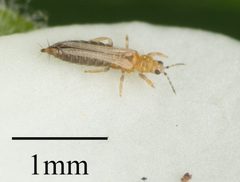
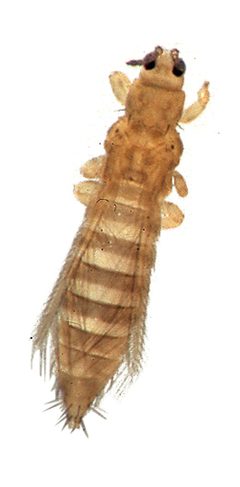
Frankliniella is a of thrips in the Thripidae containing approximately 230 with distribution. The genus was established by Karny in 1910. Several species are significant agricultural pests, notably Frankliniella occidentalis (western flower thrips) and F. intonsa, which cause direct feeding damage and plant viruses including tomato spotted wilt virus. Species exhibit considerable morphological variability, complicating identification.
Pronunciation
How to pronounce Frankliniella: /fræŋkˌlɪnɪˈɛlə/
These audio files are automatically generated. While they are not always 100% accurate, they are a good starting point.
Identification
-level identification within Frankliniella is challenging due to high morphological variability. Molecular methods such as of ITS1 rDNA fragments have been developed to distinguish economically important species including F. occidentalis, F. intonsa, F. pallida, and F. tenuicornis. These methods can identify single specimens at larval or stages.
Images
Habitat
Agricultural crops including lettuce, tomato, pepper, and cucurbits; also found on wild plants and flowering vegetation such as Echinacea .
Distribution
; occur on multiple continents including North America, Europe, Asia, Central and South America. Specific distribution records include Denmark, Norway, and Sweden.
Seasonality
Activity patterns vary by and climate; in temperate regions, increase through summer with multiple possible. At temperatures above 90°F, some species can complete a generation in less than two weeks.
Diet
Phytophagous; feeding includes plant tissues, pollen, and fluids extracted via . Pollen constitutes a major food source for flower-inhabiting .
Host Associations
- tomato (Solanum lycopersicum) - pest for F. occidentalis and F. fusca; feeding damage and virus transmission
- peanut (Arachis hypogaea) - pest for F. occidentalis and F. fusca
- lettuce (Lactuca sativa) - pestMajor crop for western flower thrips
- pepper (Capsicum spp.) - pestAffected by western flower thrips and tomato spotted wilt virus
- cucurbits (Cucurbitaceae) - pest for F. intonsa and F. cephalica in Panama
- cone flower (Echinacea spp.) - Supports of flower thrips and their
Life Cycle
Development includes , nymph, and stages without a pupal stage. Nymphs are typically translucent yellow and flightless; adults are winged and range from yellow to dark brown depending on . Multiple occur annually in favorable conditions.
Behavior
Settling on plants is modified by exposure; imidacloprid has been observed to increase settling of F. occidentalis on peanut while reducing settling of F. fusca on tomato. Ovipositional preference is influenced by host plant, temperature, and .
Ecological Role
Herbivore and plant virus ; prey for minute pirate bugs (Orius spp.) and other natural enemies. Some serve as food sources for predatory insects in flowering plant .
Human Relevance
Major agricultural pest causing billions of dollars in crop damage worldwide through direct feeding and virus transmission. Western flower thrips (F. occidentalis) is a globally of particular concern. Management relies heavily on , though resistance is documented; using Orius and spray technologies are active research areas.
Similar Taxa
- Thrips palmiOverlaps in geographic range and cucurbit use; molecular methods required for reliable differentiation from Frankliniella
More Details
Notable species
Frankliniella occidentalis (western flower thrips): global pest native to western North America. Frankliniella intonsa: significant pest in Europe and Asia. Frankliniella fusca (tobacco thrips): important in southeastern U.S. agriculture.
Virus transmission
F. occidentalis is the principal of tomato spotted wilt virus ( Orthotospovirus), which infects over 1000 plant . Virus is transmitted in a circulative-propagative manner.
Research tools
Genomic resources have been developed for F. occidentalis, enabling studies of molecular interactions with plant viruses and identification of competence determinants.
Sources and further reading
- BugGuide
- Wikipedia
- GBIF taxonomy match
- iNaturalist taxon
- NCBI Taxonomy
- Catalogue of Life
- Probing the Molecular Interactions Between Western Flower Thrips and the Tomato Spotted Wilt Virus | Bug Squad
- Addie Abrams, Ph.D to Be, to Present Exit Seminar | Bug Squad
- Addie Abrams Targeting Aphids and Thrips in California Lettuce | Bug Squad
- Outstanding Group of UC Davis Graduate Students at ESA Meeting | Bug Squad
- Bugs for All, All for Bugs | Bug Squad
- Life and death in a cone flower: Minute pirate bugs, Orius spp., and their prey, flower thrips, Frankliniella spp. — Bug of the Week
- PCR-RFLP method to distinguish Frankliniella occidentalis, Frankliniella intonsa, Frankliniella pallida and Frankliniella tenuicornis
- Molecular identification, occurrence and distribution of Thrips palmi, Frankliniella intonsa and Frankliniella cephalica (Thysanoptera: Thripidae) on cucurbit crops in Panama
- Effect of Imidacloprid on Settling Behavior of Frankliniella occidentalis and Frankliniella fusca (Thysanoptera: Thripidae) on Tomato and Peanut
- Host Plant, Temperature, and Photoperiod Effects on Ovipositional Preference of Frankliniella occidentalis and Frankliniella fusca (Thysanoptera: Thripidae)
- Imidacloprid Effects on Probing and Settling Behavior of Frankliniella fusca and Frankliniella occidentalis (Thysanoptera: Thripidae) in Tomato
- Life History Characteristics of Frankliniella occidentalis and Frankliniella intonsa (Thysanoptera: Thripidae) in Constant and Fluctuating Temperatures
- Extracellular DNA triggers glucosinolate-dependent defence responses against Frankliniella occidentalis.