
Thripinae
Stephens, 1829
Genus Guides
12- Arorathrips
- Bregmatothrips
- Ctenothrips
- Echinothrips
- Frankliniella
- Limothrips(Grain thrips)
- Megalurothrips(bean flower thrips)
- Psilothrips
- Salpingothrips
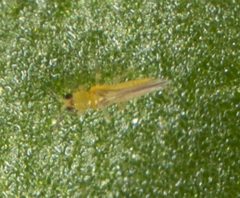
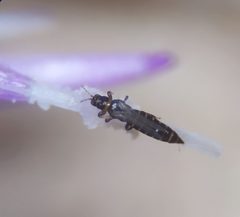
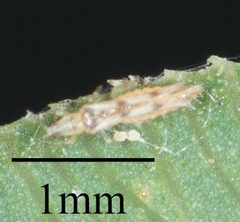
Thripinae is a of thrips (order Thysanoptera, Thripidae) comprising approximately 1,400 across 150 . The subfamily contains the majority of economically significant pest thrips, including species that damage crops through direct feeding and virus transmission. A 2012 molecular found Thripinae to be , indicating that taxonomic revisions are needed to clarify relationships within the group. Members are distributed worldwide, with particularly high diversity in tropical and subtropical regions.
Pronunciation
How to pronounce Thripinae: /ˈθraɪpaɪniː/
These audio files are automatically generated. While they are not always 100% accurate, they are a good starting point.
Identification
Members of Thripinae can be distinguished from other Thripidae using morphological characters detailed in regional identification keys. The Anaphothrips -group within Thripinae is characterized by the absence of long setae on the pronotum. Male Thripinae possess pore plates (glandular areas or areae porosae) on abdominal sternites, with variation in their form and distribution sometimes diagnostic at the genus level. Some genera exhibit distinctive , such as Nandithrips which lacks ocellar setae pairs I and II.
Images
Habitat
Agricultural and horticultural crops, ornamental flowers, and vegetable crops; also found in adjacent native and weedy vegetation. occupy lowland and highland areas, with many associated with specific plant . Some show specialized host associations, such as Pandanothrips species inhabiting Pandanus plants.
Distribution
Worldwide distribution with centers of diversity in tropical and subtropical regions. Documented from Malaysia, India, Southeast Asia, Australia, Africa, Japan, and North America. Many have expanded their ranges through international trade in greenhouse plants and agricultural products.
Seasonality
Activity patterns vary by and region; in temperate areas, some pest species are active year-round in greenhouses while showing seasonal peaks in field . In South Australia, of pest thrips species was found to vary significantly by season.
Diet
Phytophagous; feeding on plant foliage, flowers, and fruits. Many are , feeding across multiple plant , though some show narrower ranges. Documented host plant families include Asteraceae, Fabaceae, Orchidaceae, Rosaceae, Solanaceae, and many others.
Host Associations
- Acanthaceae - Strobilanthes crispus, Pseuderanthemum carruthersii
- Apocynaceae - Allamanda oenotheraefolia, Plumeria rubra
- Orchidaceae - Arundina graminifolia, Dendrobium spp., Cattelya spp., Phalaenopsis spp., Vanda spp., Oncidium sp., Aracnis sp.
- Fabaceae - Vigna sinensis, Erythrina fusca, Caesalpinia pulcherrima, Cassia fistula, Pithecellobium jiringa, Peliophorum pterocarpum, Canavalia rosea
- Asteraceae - Chrysanthemum morifolium, Chrysanthemum indicum, Cosmos spp., Tagetes spp., Sphagneticola trilobata, Aster dumosus, Dahlia sp., Gerbera sp., Tanacetum parthenium
- Solanaceae - Capsicum annuum, Solanum torvum, Solanum melongena
- Rosaceae - Rosa spp., Fragaria ananassa, Prunus persica, Rosa alba
- Myrtaceae - Psidium guajava
- Anacardiaceae - Mangifera spp.
- Euphorbiaceae - Jatropha integerrima
- Lamiaceae - Orthosiphon aristatus, Salvia farinacea
- Rubiaceae - Ixora sp., Coffea spp. (for some Craspedothrips )
- Verbenaceae - Stachytarpheta mutabilis, Clerodendrum paniculatum, camara, Verbena sp.
- Alliaceae - Agapanthus campanulatus
- Balsaminaceae - Impatiens spp.
- Caryophyllaceae - Gypsophila sp.
- Iridaceae - Gladiolus sp.
- Plantaginaceae - Antirrhinum sp.
- Nyctaginaceae - Bougainvillea sp.
- Plumbaginaceae - Plumbago auriculata
- Malpighiaceae - Tristellateia australasiae
- Moraceae - Artocarpus champeden
- Passifloraceae - Turnera ulmifolia
- Heliconiaceae - Heliconia sp.
- Amaryllidaceae - Hymenocallis speciosa
- Araceae - Zantedeschia aethiopica
- Arecaceae - Areca catechu
- Pandanaceae - Pandanus (specialized Pandanothrips)
- Urticaceae - Pouzolzia petandra subsp. wightii (for Nandithrips pouzolziae)
Behavior
Feeding activities cause fruit scarring and flower discolouration. Many occur in large . Several species are of plant tospoviruses including Tomato Spotted Wilt Virus (TSWV) and Impatiens Necrotic Spot Virus (INSV). Crops infested by thrips may be banned from importation into countries with strict biological procedures.
Ecological Role
Agricultural pests causing direct damage to crops through feeding and indirect damage through virus transmission. Reduction of crop yields occurs through foliage and flower dropping. Some may interact with native vegetation, though Australian studies suggest native plants generally have low likelihood of hosting pest thrips species.
Human Relevance
Major economic significance as agricultural and horticultural pests. Notable pest include Scirtothrips dorsalis (chili thrips), (), Thrips tabaci (onion thrips), Thrips hawaiiensis, and Frankliniella occidentalis (western flower thrips). The western flower thrips has expanded from western North America to Europe and Asia through trade in greenhouse plants. Several species are . Virus transmission by thrips creates additional economic impact beyond direct feeding damage.
More Details
Taxonomic Status
A 2012 molecular found Thripinae to be ; further work is needed to clarify relationships within the group.
Pore Plate Variation
Males of some exhibit distinctive pore plate distributions, such as the discontinuous pattern in Nandithrips with a single circular or oval pore plate medially on abdominal sternites II and V–VII.
Sources and further reading
- BugGuide
- Wikipedia
- iNaturalist taxon
- NCBI Taxonomy
- Catalogue of Life
- An illustrated key to the genera of Thripinae (Thysanoptera) from India
- The economically important thrips from Malaysia, with a key to species (Thysanoptera, Thripinae)
- An illustrated key to the genera of Thripinae (Thysanoptera) from South East Asia
- The Palaeotropical genus Craspedothrips, with new species from Africa and Malaysia (Thysanoptera, Thripinae)
- Australian Thripinae of the Anaphothrips genus-group (Thysanoptera), with three new genera and thirty-three new species
- The risk of exotic and native plants as hosts for four pest thrips (Thysanoptera: Thripinae)
- A remarkable new genus of Thripinae (Thysanoptera, Thripidae) without anteocellar setae from India
- A new genus of Thripinae (Thysanoptera, Thripidae) collected from Pandanus in Japan, Malaysia and Australia, with three new species
- Contribution to the subfamily Panchaetothripinae (Thysanoptera, Thripidae) from Saudi Arabia, with two new genera records and an illustrated key.
- Mitogenome characterization and phylogeny of Neohydatothrips gracilipes (Thripidae: Sericothripinae).
- Full-Length Transcriptome Profiling of the Complete Mitochondrial Genome of Sericothrips houjii (Thysanoptera: Thripidae: Sericothripinae) Featuring Extensive Gene Rearrangement and Duplicated Control Regions.