
Thripidae
Stephens, 1829
Common Thrips
Subfamily Guides
3is the most -rich of thrips, comprising over 290 and approximately 2,000 species. Members are characterized by derived morphological traits including a downward-curving saw-like ovipositor, narrow wings with two longitudinal , and bearing six to ten antennomeres with stiletto-like forked sense cones on segments III and IV. The family is divided into four : Thripinae (227 genera), Panchaetothripinae (38 genera), Dendrothripinae (16 genera), and Sericothripinae (11 genera). Many species are economically significant agricultural pests, with some exhibiting characteristics.
Pronunciation
How to pronounce Thripidae: //ˈθraɪpɪdiː//
These audio files are automatically generated. While they are not always 100% accurate, they are a good starting point.
Identification
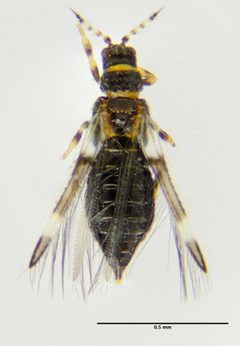
Distinguished from other thrips by the combination of: downward-curving saw-like ovipositor; narrow wings with exactly two ; and with stiletto-like forked sense cones on segments III and IV. The Thripinae contains the majority of and is characterized by typical thrips ; other subfamilies (Panchaetothripinae, Dendrothripinae, Sericothripinae) exhibit more specialized morphological adaptations. Identification to or species level requires examination of chaetotaxy, wing venation details, and antennal segmentation.
Images
Appearance
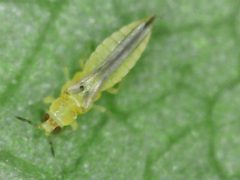
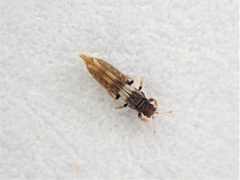
Small, slender insects typically measuring 1–2 mm in length. Wings narrow and elongated with fringed margins, bearing two longitudinal . with six to ten segments, featuring distinctive stiletto-like forked sense cones on antennomeres III and IV. Ovipositor saw-like in structure, curving ventrally. Body form generally cryptophilous, adapted for inhabiting narrow spaces such as leaf bases and flower structures.
Habitat
Predominantly cryptophilous, occupying narrow protected microhabitats including leaf bases, leaf axils, flower structures, and other concealed plant surfaces. Agricultural thrive in greenhouse environments, field crops, and orchards. Some associated with grasses in tropical and subtropical regions.
Distribution
distribution with highest diversity in tropical and subtropical regions. Present across all continents including North America, South America, Europe, Asia, Africa, and Australia. Individual distributions vary widely, with some exhibiting expansion (e.g., Scirtothrips dorsalis in Turkey, Frankliniella occidentalis globally).
Seasonality
Activity patterns vary by and climate; many temperate species exhibit peak during summer months. In agricultural systems, population surges often correlate with dry conditions and plant . Some species show seasonal immigration patterns into orchards synchronized with surrounding host plant availability.
Diet
Almost exclusively phytophagous, feeding on plant tissues using distinctive rasping-sucking mouthparts. Feeding involves rasping plant with a single functional , then imbibing exuded cell contents through formed siphons. plants span diverse angiosperm including Fabaceae, Solanaceae, Asteraceae, and others. Some are ; others exhibit host specialization.
Host Associations
- Glycine max (soybean) - pestCaliothrips phaseoli
- Allium cepa (onion) - pestCaliothrips phaseoli
- Citrus sinensis (orange) - pestScirtothrips dorsalis
- Tagetes spp. (marigold) - pestNeohydatothrips samayunkur
- Gossypium spp. (cotton) - pestNeohydatothrips gracilipes
- Persea americana (avocado) - pestNeohydatothrips burungae
- Jasminum sambac - Neohydatothrips
- Poaceae (grasses) - Phibalothrips
- Solanaceae - various pest
- Fabaceae - various pest
Life Cycle
Development exhibits intermediate characteristics between incomplete and complete . First- and second-instar nymphs are active feeding stages. Third and fourth instars become non-feeding quiescent stages termed propupa and pupa, respectively. to egg development can occur in approximately two weeks under favorable conditions. Sex ratios in field often show female , suggesting facultative in some .
Behavior
Strongly thigmotactic, preferring tight spaces between plant structures. and nymphs often aggregate in protected locations on plants. Some exhibit seasonal migratory , moving between alternate host plants and crop systems. Defecation patterns observed with fecal deposits placed on leaf hairs, possibly to avoid fouling feeding surfaces.
Ecological Role
Primary consumers in plant-based . Some function as for plant pathogenic viruses including Tomato spotted wilt virus and Impatiens necrotic spot virus. Serve as prey for predatory mites, fungi, and other natural enemies. can disrupt native plant-insect dynamics.
Human Relevance
Major economic importance as agricultural pests. such as Frankliniella occidentalis (western flower thrips), Scirtothrips dorsalis (chilli thrips), and () cause significant crop losses globally. Damage includes direct feeding injury, virus transmission, and cosmetic damage to fruits and flowers. Control is complicated by cryptic habits, short times, and developing resistance. Subject to and programs using fungi and predatory mites.
Similar Taxa
- AeolothripidaeBoth contain with banded wing patterns; Aeolothripidae are predominantly predatory with different antennal structure and lack the saw-like ovipositor characteristic of .
- PhlaeothripidaeLargest thrips by some measures; distinguished by tube-like terminal abdominal segment and different wing venation patterns.
- MerothripidaePrimitive thrips with reduced wing venation and different antennal .
Misconceptions
The singular form 'thrip' is grammatically incorrect; the correct singular is 'a thrips' (identical to plural form), analogous to 'deer' or 'sheep'. The name is sometimes misspelled as 'Thripedae' in older literature. Many historical and tribal divisions within Thripidae reflect ecological convergence rather than phylogenetic relationships, leading to ongoing taxonomic revision.
More Details
Taxonomic instability
More than half of are monobasic (single ), and molecular phylogenetic studies have revealed that the largest Thripinae is . Recent revisions have elevated tribes Dendrothripini and Sericothripini to subfamily status, with further reorganizations anticipated as comprehensive phylogenetic analyses proceed.
Mouthpart morphology
possess a highly derived feeding apparatus with only one functional —the other aborts during embryonic development. This asymmetrical mandible is used to rupture plant , after which fluids are imbibed through a siphon formed by remaining mouthparts. This represents a functionally intermediate condition between chewing and .
Entomopathogenic susceptibility
Members of are susceptible to by fungi including bassiana, Metarhizium anisopliae, and Verticillium lecanii, which can cause natural in and are utilized in programs.
Sources and further reading
- BugGuide
- Wikipedia
- GBIF taxonomy match
- iNaturalist taxon
- NCBI Taxonomy
- Catalogue of Life
- Thripidae | Beetles In The Bush
- ID Challenge #6 | Beetles In The Bush
- Reporte de Caliothrips phaseoli (Hood) (Thysanoptera: Thripidae: Panchaeothripinae) en cebolla en Panamá Report of Caliothrips phaseoli (Hood) (Thysanoptera: Thripidae: Panchaeothripinae) in onion in Panama
- A new harmful thrips species in orange in Antalya Province: Scirtothrips dorsalis Hood (Thysanoptera: Thripidae) A new harmful thrips species in orange in Antalya Province: Scirtothips dorsalis Hood (Thysanoptera: Thripidae)
- The usage possibilities of entomopathogenic fungi in the control of western flower thrips, Frankliniella occidentalis (Pergande) (Thysanoptera: Thripidae) Entomopatojen fungusların Batı çiçek thripsi, Frankliniella occidentalis (Pergande) (Thysanoptera: Thripidae) ile mücadelede kullanım olanakları
- A new species of Neohydatothrips (Thysanoptera: Thripidae) from India
- New records of Panchaetothripinae from Japan (Thysanoptera, Thripidae)