
Haplothrips
Amyot & Serville, 1843
Species Guides
2- Haplothrips graminis
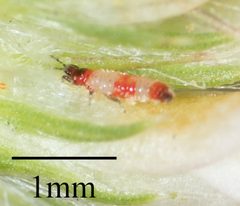
- Haplothrips leucanthemi(clover thrips)
Haplothrips is a of medium-sized in the Phlaeothripidae, containing approximately 240 extant with worldwide distribution. Species occupy diverse ecological roles: most feed and breed in flowers, with northern hemisphere species specializing on Asteraceae and Poaceae, while Australian species utilize broader ranges. Some species are predatory, including H. faurei and H. victoriensis used in of mites. Several species are agricultural pests, notably H. aculeatus and H. ganglbaueri on millet, and H. tritici on wheat.


Pronunciation
How to pronounce Haplothrips: /ˈhæpləˌθrɪps/
These audio files are automatically generated. While they are not always 100% accurate, they are a good starting point.
Identification
Medium-sized with one pair of 8-segmented and three pairs of legs. Usually with two pairs of well-developed wings; forewings distinctly constricted in the middle. bears short mouth cone and deeply retracted maxillary stylets. Second through seventh abdominal tergites each bear two pairs of sigmoid wing-retaining setae. In males, ninth abdominal tergite has setae S2 short and stout; eighth abdominal sternite usually lacks pore plate (except H. dissociatus with small pore plate). Subgenus Haplothrips distinguished by duplicated cilia on forewings. Forewing constriction shared with other Haplothripini.
Images
Habitat
Most inhabit flowers; northern hemisphere species prefer Asteraceae and Poaceae flowers, Australian species occur on diverse plant . Some species associated with leaves. The Hawaiian species H. rosai occurs on fungi.
Distribution
Worldwide. Documented from Denmark, Norway, Sweden (GBIF). Mexico (new descriptions). Australia (diverse fauna with identification keys available).
Diet
Flower-feeding on Asteraceae and Poaceae (northern hemisphere); diverse plant (Australia). Some leaf-feeding. Predatory species include H. faurei and H. victoriensis (prey on mites). H. rosai believed to feed on fungi.
Ecological Role
Flower-inhabiting ; some predatory on mites and used in . Agricultural pest species cause measurable crop damage. H. tritici quantified per wheat spike in field studies.
Human Relevance
Several are agricultural pests: H. aculeatus and H. ganglbaueri damage millet; H. tritici infests wheat; unspecified species damage cashew. Predatory species H. faurei and H. victoriensis employed in biological mite control. Microbial biofertilizers (Bacillus subtilis, Pseudomonas fluorescens) evaluated for integrated management of H. tritici, reducing to 6.20 /spike and severity to 20%.
Similar Taxa
- Other HaplothripiniShare forewing constriction; distinguished by combination of male genitalia characters, wing ciliation patterns, and abdominal setation
Sources and further reading
- BugGuide
- Wikipedia
- GBIF taxonomy match
- iNaturalist taxon
- NCBI Taxonomy
- Catalogue of Life
- Biological Insights into Microbial Biofertilizers for Sustainable Wheat Cultivation and the Management of Haplothrips tritici (Kurdjumov)
- Nuevos tisanopteros mexicanos del genero Haplothrips (Thysanoptera: Phlaeothripidae)