
Phlaeothripidae
Uzel, 1895
Tube-tailed Thrips
Subfamily Guides
2- Idolothripinae(spore-feeding thrips)
- Phlaeothripinae
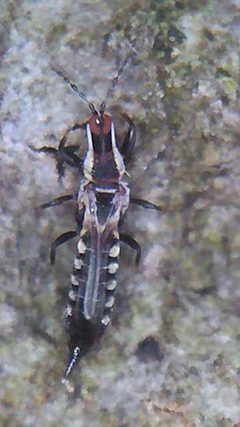
is the sole extant of the suborder Tubulifera, comprising approximately 3,400 across two : Idolothripinae (80 ) and Phlaeothripinae (nearly 400 genera). Members are distinguished by a tubular modification of the last abdominal segment. The family includes the largest species, with Idolothrips marginatus reaching 14 mm in body length. Many species are fungivores, particularly in tropical regions, though feeding habits vary considerably across the family.
Pronunciation
How to pronounce Phlaeothripidae: /flaɪoʊˈθrɪpɪdiː/
These audio files are automatically generated. While they are not always 100% accurate, they are a good starting point.
Identification
Distinguished from all other (suborder ) by the tubular modification of the last abdominal segment. Generally larger than Terebrantia thrips. Within the , Idolothripinae is characterized by enlarged, often toothed fore and broad, sclerotized pelta, while Phlaeothripinae typically lacks these features. identification is often complicated by considerable and , particularly in such as Hoplothrips.
Images
Habitat
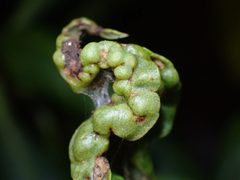
Diverse including tropical forests, temperate regions, and various microhabitats. Many inhabit dead leaves, dead branches of woody angiosperm trees, and bark crevices. Some species occur on live plant foliage, causing leaf rolling or deformation. Australian species of Bactrothrips are mainly associated with dry fruiting capsules of Eucalyptus trees. Members of the tribe Plectrothripini are found mainly under bark or on dead branches and do not inhabit leaf-litter.
Distribution
distribution with strong representation in tropical regions. Documented from Sweden (49 ), India (Karnataka State), China, Japan, Iran, Brazil, southern United States (Florida), Australia, and Dominican Republic (Miocene amber). The extinct Rohrthripidae represents the only other known member of suborder Tubulifera.
Diet
Highly variable across the . Many are fungivores, feeding on fungal or their liquid breakdown products. Some are spore-feeders (e.g., Bactrothrips). Others feed on live plant tissue: Pseudophilothrips ichini feeds on Brazilian peppertree (Schinus terebinthifolia), Holopothrips claritibialis causes leaf damage to Mollinedia schottiana, and Hoplandrothrips species cause leaf rolling on Coffea plants. Aleurothrips fasciapennis feeds on whiteflies.
Life Cycle
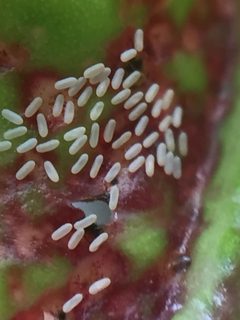
Development includes larval instars with distinct morphological characteristics; second larval instar of Neoheegeria dalmatica has covered by dense microtrichia (distinguishing it from related ). Males of some (e.g., Bactrothrips) possess lateral abdominal but lack fore tarsal teeth, structures with significance in sexual .
Ecological Role
Important decomposers in forest through on dead plant material. Some act as agents: Leptothrips mali is used to control mites, and Pseudophilothrips ichini has been studied for over 20 years as a potential biocontrol agent for Brazilian peppertree in Florida.
Human Relevance
Several are economically significant. Gynaikothrips ficorum (Cuban laurel thrips), Liothrips vaneeckei (lily ), and Haplothrips species are agricultural or horticultural pests. Conversely, Leptothrips mali and Pseudophilothrips ichini are valued as biocontrol agents. The is also subject to taxonomic research due to its morphological diversity and complex species-level identification.
Sources and further reading
- BugGuide
- Wikipedia
- GBIF taxonomy match
- iNaturalist taxon
- NCBI Taxonomy
- Catalogue of Life
- Phlaeothripidae Archives - Entomology Today
- Two Thrips for Possible Biological Control of Brazilian Peppertree
- Identification key and checklist to the Swedish Phlaeothripidae (Thysanoptera)
- Brazilian Peppertree Thrips Pseudophilothrips ichini (Hood) (Insecta: Thysanoptera: Phlaeothripidae)
- New records of thrips (Thysanoptera: Phlaeothripidae) from Karnataka, India
- Identification key to and checklist of the Swedish Phlaeothripidae (Thysanoptera)
- The genus Terthrothrips Karny (Thysanoptera: Phlaeothripidae) from China with one new species
- Cephalothrips (Thysanoptera: Phlaeothripidae) in Iran with two new species and key to species
- ADACTYLIDIUM DIGNUM SP. N., A NEW SPECIES OF ACAROPHENACIDAE (ACARI, HETEROSTIGMATA) ASSOCIATED WITH ACANTHOTHRIPS NODICORNIS (THYSANOPTERA, PHLAEOTHRIPIDAE) FROM EUROPEAN RUSSIA
- Australian spore-feeding Thysanoptera of the genus Bactrothrips (Phlaeothripidae – Idolothripinae)
- Morphology of Neoheegeria dalmatica Schmutz, 1909 (Thysanoptera, Phlaeothripidae) larvae—their diagnostic characteristics
- A new Holopothrips species (Thysanoptera: Phlaeothripidae) damaging Mollinedia (Monimiaceae) leaves in Southern Brazil
- Hoplothrips species recorded from China (Thysanoptera, Phlaeothripidae), with one new species from Yunnan
- A new species of Chiridurothrips Okajima from Miocene amber of the Dominican Republic (Thysanoptera: Phlaeothripidae)