
Scirtothrips
Shull, 1909
leaf-feeding thrips, citrus thrips, chilli thrips
Species Guides
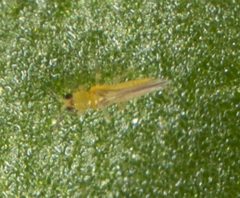
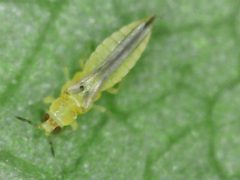
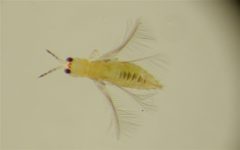
1- Scirtothrips dorsalis(chilli thrips)
Scirtothrips is a of leaf-feeding thrips in the Thripidae, established by Shull in 1909. The genus includes economically significant pest such as the (S. dorsalis), citrus thrips (S. citri), and South African citrus thrips (S. aurantii), which damage agricultural crops through piercing-sucking feeding on tender leaves, buds, and fruit. Species exhibit diverse associations ranging from highly host-specific forms on Australian Acacia to broadly pests. The genus has undergone taxonomic revision, with Labiothrips synonymised under Scirtothrips.
Pronunciation
How to pronounce Scirtothrips: //skɪrˈtoʊθrɪps//
These audio files are automatically generated. While they are not always 100% accurate, they are a good starting point.
Identification
identification requires examination of morphological characters including body coloration, setal patterns, wing venation, and antennal segmentation. Australian species have been distinguished through identification keys based on S. albomaculatus and S. akakia species-groups. Distinguishing Scirtothrips from other thrips involves characteristics of the pronotum, forewing structure, and abdominal tergite chaetotaxy. Specific identification typically requires slide-mounted specimens and reference to taxonomic revisions.
Images
Habitat
vary by : Australian species predominantly occupy arid zones, with three species (S. dorsalis, S. dobroskyi, S. tenor) in northern tropical areas. Agricultural pest species occur in cultivated systems including citrus groves, tea plantations, strawberry fields, and blueberry orchards. in Florida occupy woodland borders adjacent to crop fields.
Distribution
Native range includes Australia (with most to arid areas), Asia (India, China, Southeast Asia, Japan, Korea), and Africa (South Africa, Egypt). established in North America (Florida, California, Hawaii, Texas), Central America and Caribbean (Barbados, Jamaica, Puerto Rico, Saint Lucia, Saint Vincent and the Grenadines, Trinidad and Tobago), South America (Suriname, Venezuela), and Oceania (Papua New Guinea, Solomon Islands). S. aurantii introduced to Queensland, Australia.
Diet
Phytophagous; piercing-sucking feeding on plant sap. Specific feeding targets include tender leaves, buds, and fruit of plants. S. dorsalis feeds on tea leaves and strawberry plants. S. citri and S. aurantii feed on citrus fruit and foliage. S. perseae specialises on avocado. Feeding damage produces characteristic : pale thin lines parallel to leaf midvein, distorted buds, brownish damaged tissues, 'sand paper' and 'silvered' corky lines on fruit surfaces.
Host Associations
- Camellia sinensis (tea) - primary S. dorsalis; major pest causing 12–15% crop loss in Indian tea plantations
- Citrus spp. (citrus) - primary S. citri, S. aurantii; fruit scarring renders produce unmarketable
- Fragaria × ananassa (strawberry) - primary S. dorsalis; important economic pest in Florida
- Vaccinium spp. (blueberry) - primary S. dorsalis; target of current research
- Persea americana (avocado) - primary S. perseae; specialised association
- Acacia spp. - Multiple Australian ; S. albomaculatus and S. akakia species-groups
- Allocasuarina spp. - Australian
- Brachychiton spp. - Australian
- Hakea spp. - Australian
- Kunzea spp. - Australian
- Cycads (two genera) - Australian
- Tree ferns - Australian
- Vitis rotundifolia (muscadine grape) - reproductive S. dorsalis in Florida woodland borders
- Prunus caroliniana (Laurel cherry) - reproductive S. dorsalis in Florida
- Celtis laevigata (sugarberry) - reproductive S. dorsalis in Florida
- Bidens pilosa (Spanish needles) - reproductive S. dorsalis in Florida
- Ludwigia peruviana (Peruvian water primrose) - reproductive S. dorsalis in Florida
- Ambrosia spp. (ragweed) - reproductive S. dorsalis in Florida
- Liquidambar styraciflua (sweetgum) - reproductive S. dorsalis in Florida
- Quercus nigra (water oak) - reproductive S. dorsalis in Florida
Life Cycle
Development from to varies by plant and temperature. Laboratory studies on S. dorsalis at 25°C ± 2°C, 70–80% RH, 12L:12D demonstrated cultivar-specific variation: total developmental period shortest on TV1 tea cultivar, longest on TV23. Includes egg, larval, and adult stages. Larvae reared individually on leaf material with regular replacement. Adult female longevity and reproductive parameters vary significantly among host cultivars.
Behavior
Exhibits weak capability and aggregated distribution across plant . establishment linked to climate change, deforestation, and over-reliance on chemical in agricultural systems. Host selection behaviour disrupted by herbivory-induced plant volatiles.
Ecological Role
Major agricultural pest causing significant economic damage through direct feeding injury. S. dorsalis established as key pest in tea plantations of north-eastern India over five decades. S. citri and S. aurantii threaten citrus production in multiple regions. S. dorsalis in Florida strawberry and blueberry production. Some Australian appear restricted to native flora with limited agricultural impact.
Human Relevance
Economic pests requiring in citrus, tea, strawberry, and blueberry production. Research targets include programs, cultivar screening, , and plant defense inducers. Subject of classical and efforts. serves as model organism for studying herbivore-induced plant volatiles and selection disruption.
Similar Taxa
- Thrips (genus)Both in Thripidae; distinguished by pronotal structure, wing venation, and abdominal chaetotaxy patterns
- Frankliniella (genus)Common thrips in same ; Scirtothrips typically with more pronounced leaf-feeding damage and distinct antennal structure
More Details
Taxonomic history
The Labiothrips Bhatti & Mound has been synonymised with Scirtothrips. The New Zealand S. pan was removed from the Australian list as a misidentification.
Species diversity
Twenty-one recognised from Australia including eleven newly described species. Two new species-groups distinguished based on S. albomaculatus and S. akakia, both with multiple species on Acacia.
Research significance
Current research focuses on S. dorsalis in southern highbush blueberries, including spray studies, cultivar resistance screening, and grower surveys. modelling using parameters demonstrates cultivar effects on growth and .
Sources and further reading
- BugGuide
- Wikipedia
- GBIF taxonomy match
- iNaturalist taxon
- NCBI Taxonomy
- Catalogue of Life
- Publications | Entomology Research Museum
- citrus thrips (Scirtothrips citri) - Entomology Today
- Scirtothrips dorsalis Archives - Entomology Today
- Scirtothrips citri Archives - Entomology Today
- Mandarin Boom Means Citrus Pest Management Must Evolve
- How One Entomologist Found Her Calling in Crop Protection
- Expanding Host Range of Invasive Pest Scirtothrips dorsalis Hood in the U.S.A.
- The genus Scirtothrips in Australia (Insecta, Thysanoptera, Thripidae)
- Biology and Life Table Parameters of Scirtothrips dorsalis Hood 1919 (Thysanoptera: Thripidae) on Tea Cultivars
- Scirtothrips dorsalis . [Distribution map].
- Scirtothrips aurantii . [Distribution map].
- Scirtothrips perseae . [Distribution map].
- A Herbivory-Induced Volatile Disrupts Host Selection by Chilli Thrips, Scirtothrips dorsalis, on Strawberry.