
Chrysoperla externa
(Hagen, 1861)
green lacewing
Chrysoperla externa is a of green lacewing in the Chrysopidae, native to the Americas. Like other members of the Chrysoperla, its larvae are predatory on soft-bodied insects, particularly aphids, making it valuable for biological pest control. The species is part of the taxonomically challenging Chrysoperla carnea-group, in which species are often difficult to distinguish morphologically and are instead identified by their species-specific vibrational songs. It has been documented across much of South America and in parts of North America including Hawaii.
Pronunciation
How to pronounce Chrysoperla externa: /ˌkɹɪsəˈpɜːlə ɛkˈstɜːnə/
These audio files are automatically generated. While they are not always 100% accurate, they are a good starting point.
Identification
-level identification within the Chrysoperla carnea-group requires analysis of vibrational songs, as morphological differences are minimal. produce species-specific substrate-borne vibrations by oscillating their ; males and females engage in duetting prior to mating. Molecular methods (mitochondrial haplotypes) may assist identification. Distinguishing C. externa from other green lacewings in the field is generally not possible without specialized equipment for song recording or genetic analysis.
Images
Appearance
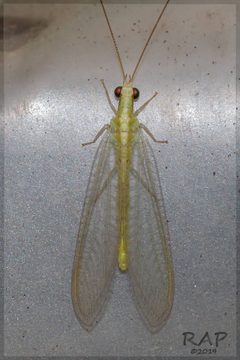
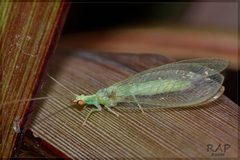
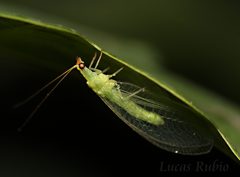
have delicate, transparent wings with dense, net-like venation characteristic of Neuroptera. Body is typically pale green. are long and . are large and golden or coppery. Wings are held roof-like over the body when at rest. Overall size is small to medium for lacewings, with body length approximately 10-15 mm and wingspan roughly 20-30 mm. Larvae are elongate, alligator-like, with prominent sickle-shaped for capturing prey.
Habitat
Found in diverse environments including agricultural fields, gardens, and natural vegetation. Associated with supporting abundant , which serve as prey for larvae. Distribution records indicate presence across varied biomes from tropical to temperate regions in the Americas.
Distribution
Native to South America with records from Brazil (Acre, Amazonas, Bahia, Distrito Federal, Espírito Santo, Minas Gerais, Mato Grosso, Mato Grosso do Sul, Pernambuco, Paraná, Rio de Janeiro, Rio Grande do Norte, Rondônia, Roraima, Rio Grande do Sul, Santa Catarina, São Paulo) and elsewhere in the Neotropics. Present in North America and Hawaii, where it may be naturally occurring or introduced. The ' presence in North America appears more recent and potentially expanding.
Seasonality
are active during warmer months. In temperate regions, adults may overwinter and become active again in spring. Activity patterns likely vary with latitude and local climate conditions.
Diet
Larvae are predatory on soft-bodied arthropods, particularly aphids (Aphididae), but also mites and other small plant-feeding insects. of Chrysoperla typically feed on nectar, pollen, and honeydew, though specific dietary habits for C. externa adults are not separately documented.
Life Cycle
Complete with , larva, pupa, and stages. Eggs are laid on stalks (peduncles), typically on vegetation near prey sources. Larvae pass through three instars, actively hunting aphids and other soft-bodied prey. occurs in a silken cocoon. Multiple per year likely occur in favorable climates.
Behavior
are or and attracted to lights. Mating involves vibrational duetting: one sex initiates a -specific song by oscillating its against a substrate, and the other responds with matching vibrations if . This is critical for species recognition and reproductive isolation among cryptic species in the carnea-group.
Ecological Role
Larvae function as important agents of aphids and other soft-bodied plant pests, potentially reducing pest in agricultural and horticultural systems. may contribute to pollination through nectar feeding.
Human Relevance
Used or considered for use in biological pest control programs, particularly for management. Commercial insectaries may raise Chrysoperla for biocontrol, though accurate species identification is challenging and mislabeling has occurred. The species' apparent to hot, arid conditions in parts of its range may make it particularly suitable for pest control in such environments.
Similar Taxa
- Chrysoperla carnea-group speciesMultiple cryptic within this group are morphologically nearly identical to C. externa; reliable separation requires song analysis or molecular methods.
- Chrysoperla zastrowiAnother member of the carnea-group that has recently naturalized in the Americas; shares green lacewing appearance and requires song or genetic analysis for definitive identification.
- Other green lacewings (Chrysopidae)General similarity in body form, green coloration, and net-veined wings; many require expert examination or rearing to .
More Details
Acoustic species identification
The Chrysoperla carnea-group, including C. externa, is a classic example of cryptic distinguished by . Each species produces a unique substrate-borne song pattern, and successful mating requires song matching between partners. This has complicated historical and biocontrol applications, as morphological identification is unreliable.
Taxonomic history
Originally described as Chrysopa externa by Hagen in 1861, later transferred to Chrysoperla. The was long subsumed under the concept of a single widespread 'Chrysoperla carnea' before modern integrative (combining song analysis, , and genetics) revealed numerous distinct species.
Sources and further reading
- BugGuide
- GBIF taxonomy match
- iNaturalist taxon
- NCBI Taxonomy
- Catalogue of Life
- Detailed External Anatomy
- Drought-Tolerant, Aphid-Hungry Lacewing Species Arrives in Americas
- Bug Eric: Last Night to Blacklight?
- Sulfoxaflor Found to Be Less Harmful to Beneficial Predators of Soybean Aphids
- Stories about small insects and making a big difference - Buglife Blog - Buglife
- From Hillside to Hearthside: Tracking the Elongate Hemlock Scale's Journey on Christmas Trees