
Chrysoperla harrisii
(Fitch, 1855)
Harris's Green Lacewing
Chrysoperla harrisii is a green lacewing in the Chrysopidae, native to North America. are predatory and feed on soft-bodied insects and honeydew. The species belongs to the Chrysoperla carnea-group, a complex of morphologically similar species that are difficult to distinguish without specialized techniques such as vibrational song analysis. Larvae are aggressive of aphids, mites, and other small arthropods, making this species valuable for biological pest control.
Pronunciation
How to pronounce Chrysoperla harrisii: //ˌkrɪsoʊˈpɛrlə ˈhærɪsaɪ//
These audio files are automatically generated. While they are not always 100% accurate, they are a good starting point.
Identification
Identification to level within the Chrysoperla carnea-group requires analysis of male genitalia, vibrational courtship songs, or . Externally, C. harrisii resembles other green lacewings in the carnea-group, including C. carnea and C. rufilabris. The species can be distinguished from brown lacewings ( Hemerobiidae) by its green coloration and larger size. Distinguishing C. harrisii from other Chrysoperla species in the field is not possible without capturing specimens for laboratory analysis.
Images
Appearance
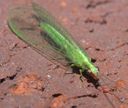
have delicate, pale green bodies with large, transparent, net-veined wings that are held roof-like over the body at rest. The are golden or -colored. are long and thread-like. Body length ranges from 12–20 mm. Wingspan approximately 20–30 mm. Coloration may shift to brown or reddish tones in autumn and winter. Like other members of the Chrysoperla carnea-group, C. harrisii lacks reliable external morphological features to distinguish it from closely related without dissection or molecular analysis.
Habitat
Found in a variety of vegetated including agricultural fields, gardens, orchards, forests, and riparian areas. are often associated with stands of herbaceous vegetation and shrubs where prey are abundant. The tolerates a range of climatic conditions across its North American range.
Distribution
Native to North America. Present across much of the United States and southern Canada. Records indicate presence from the eastern United States westward, though precise range boundaries within the carnea-group complex remain incompletely resolved due to historical taxonomic confusion.
Seasonality
are active from spring through autumn, with peak activity during summer months. Adults overwinter, often in sheltered locations. In autumn and early spring, adults may appear brown or reddish rather than green. Activity patterns vary with latitude, with longer seasons in southern portions of the range.
Diet
Larvae are predatory, feeding on aphids, mites, scale insects, , small caterpillars, and other soft-bodied arthropods. are also predatory but supplement their diet with honeydew and pollen. The is considered a with high voracity.
Life Cycle
Holometabolous development with four stages: , larva, pupa, and . Females deposit eggs individually on stalks (egg stalks) attached to vegetation. Larvae pass through three instars, actively hunting prey. Mature larvae spin silken cocoons in which they pupate. Multiple per year occur in most of the range. Adults overwinter, often in protected microhabitats.
Behavior
are or and strongly attracted to light, frequently appearing at blacklights and porch lights. Adults produce vibrational courtship songs by oscillating their against the substrate, creating -specific acoustic signals used in mate recognition. This duetting is characteristic of the Chrysoperla carnea-group. Larvae are active hunters that can consume large numbers of prey daily.
Ecological Role
Important agent in natural and agricultural . Larvae function as that suppress of aphids and other plant-feeding pests. contribute to and may also serve as when feeding on pollen. The supports ecosystem services in programs.
Human Relevance
Used in commercial for management of aphids and other soft-bodied pests in greenhouses and field crops. Often sold commercially, though accurate identification in the trade has been problematic due to morphological similarity within the carnea-group. Conservation of natural supports sustainable agriculture.
Similar Taxa
- Chrysoperla carneaMember of the same ; morphologically indistinguishable without song analysis or genital dissection; historically confused in literature and commerce
- Chrysoperla rufilabrisAnother North American green lacewing used in biocontrol; reddish tinge to in some specimens; also member of carnea-group requiring specialized techniques for definitive identification
- Chrysoperla zastrowiAfro-Eurasian now naturalized in southwestern North America; adapted to hot, arid conditions; distinguished by song and preference
- Hemerobius spp.Brown lacewings in Hemerobiidae; smaller, brown-colored, similar net-veined wings but distinct family-level characters
More Details
Taxonomic History
Originally described as Chrysopa harrisii by Fitch in 1855. Transferred to Chrysoperla as part of revisions splitting the historically broad genus Chrysopa. The Chrysoperla carnea-group, including C. harrisii, was long treated as a single widespread (C. carnea) until research beginning in the 1980s revealed multiple cryptic species distinguishable primarily by vibrational songs.
Acoustic Communication
Like other members of the carnea-group, C. harrisii communicates through substrate-borne vibrational signals. Males and females engage in duetting, with -specific song patterns preventing hybridization with sympatric . This acoustic isolation mechanism has been critical in revealing the hidden diversity within the group.
Sources and further reading
- BugGuide
- GBIF taxonomy match
- iNaturalist taxon
- NCBI Taxonomy
- Catalogue of Life
- Primary Type List | Entomology Research Museum
- Drought-Tolerant, Aphid-Hungry Lacewing Species Arrives in Americas
- Bug Eric: Last Night to Blacklight?
- Sulfoxaflor Found to Be Less Harmful to Beneficial Predators of Soybean Aphids
- Stories about small insects and making a big difference - Buglife Blog - Buglife
- Bug Eric: Blacklighting Already?