
Chrysopa nigricornis
Burmeister, 1839
Black-horned Green Lacewing
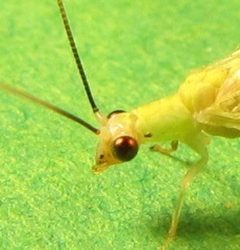
Chrysopa nigricornis, commonly known as the Black-horned Green Lacewing, is a of green lacewing in the Chrysopidae. It is distributed across Central America and North America. The species exhibits a facultative larval during the third instar within its cocoon, induced by short-day acting on the first three free-living larval stages. As both larvae and , it is predatory, feeding on soft-bodied insects such as aphids.
Pronunciation
How to pronounce Chrysopa nigricornis: /ˈkrɪsoʊpə ˌnɪɡərˈkɔrnɪs/
These audio files are automatically generated. While they are not always 100% accurate, they are a good starting point.
Images
Distribution
Central America and North America, including the northeastern United States (e.g., New York state).
Diet
Both larval and stages are predatory. Larvae feed on soft-bodied insects including aphids, mites, , and soft scales. Adults have been observed to feed on aphids, pollen, and honeydew.
Life Cycle
Development includes , three larval instars, pupa, and . Third-instar larvae enter within a cocoon under short-day conditions (approximately 12 hours of light or less). Diapause terminates spontaneously after approximately 140 days under continued short-day conditions, or can be hastened to about 40 days by exposure to long-day conditions (16 hours light) after 4-6 weeks of diapause. The egg stage and cocoon-enclosed third instar do not influence diapause induction.
Behavior
Exhibits photoperiodic response for induction; short-day conditions experienced by first, second, and free-living third instars trigger diapause entry. Diapause development occurs under short-day conditions, with temperature subsequently governing post-diapause development rate.
Ecological Role
of soft-bodied insects, including agricultural pests such as aphids.
Human Relevance
Used as a agent for pest management. Larvae are known as 'aphid lions' due to their voracious consumption of aphids.
Similar Taxa
- Chrysopa spp.Other green lacewings share similar appearance and larval predatory habits; specific identification requires examination of wing venation, body markings, and structure.
- Chrysoperla spp.Closely related with overlapping distribution and ecological role; distinguished by subtle morphological differences in wing venation and coloration.
Sources and further reading
- BugGuide
- Wikipedia
- GBIF taxonomy match
- iNaturalist taxon
- NCBI Taxonomy
- Catalogue of Life
- Encyrtid Holdings | Entomology Research Museum
- Looking for Lygus | Bug Squad
- The Beauty and the Beast | Bug Squad
- Bug Eric: Tiny Wasp Hero Slays Redback Spiders in Australia
- Bug Eric: Tree Cricket Courtship
- LARVAL DIAPAUSE IN CHRYSOPA NIGRICORNIS: SENSITIVE STAGES, CRITICAL PHOTOPERIOD, AND TERMINATION (NEUROPTERA: CHRYSOPIDAE)