
Melanocallis caryaefoliae
(Davis, 1910)
Black Pecan Aphid
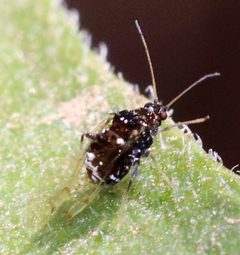
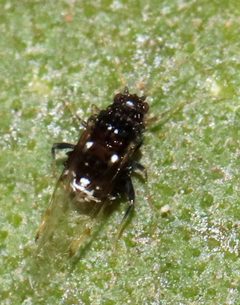
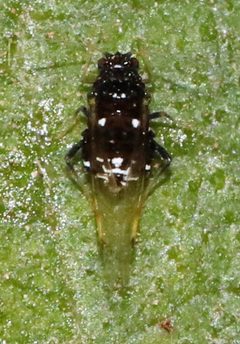
Melanocallis caryaefoliae, commonly known as the black pecan , is a specialized pest of pecan trees (Carya illinoinensis). Among aphid attacking pecans, it produces the most severe foliar and achieves the highest mean on susceptible cultivars. While feeding, it injects a toxin that causes bright yellow between leaf , which subsequently turn brown and die. Premature defoliation from heavy reduces nut fill and can diminish the following year's production. Unlike yellow pecan aphids, M. caryaefoliae is considered more destructive even at low densities, with as low as three aphids per compound leaf.
Pronunciation
How to pronounce Melanocallis caryaefoliae: /mɛˌlænoʊˈkælɪs kæriˌeɪˈfoʊliˌi/
These audio files are automatically generated. While they are not always 100% accurate, they are a good starting point.
Identification
Distinguished from yellow pecan aphids (Monelliopsis pecanis and Monellia caryella) by its black coloration and the distinctive feeding damage it produces—bright yellow rectangular between major leaf that later turn brown. Yellow aphids hold wings roof-like or flat over the body and lack this toxic lesion . Parasitized yellow aphids turn black and may be mistaken for live black pecan aphids; however, parasitized aphids are dead, immobile, and stuck to the leaf surface, whereas live black pecan aphids fly when disturbed. stages lack wings and are difficult to identify visually.
Images
Appearance
Pear-shaped body typical of aphids. Nymphs are dark olive-green; are black and may be winged. Winged forms have been observed. stages lack wings, making them difficult to distinguish from other pecan-feeding aphids by appearance alone. Adults are tiny, consistent with the small size characteristic of aphids.
Habitat
Foliage of pecan trees (Carya illinoinensis); primarily colonizes the undersides of leaves. often begin in the interior, shady portions of the tree . Occurs in commercial pecan orchards and non-commercial plantings where trees are present.
Distribution
Pecan-growing regions of Texas and the southeastern United States; distribution corresponds to the range of its plant, Carya illinoinensis. Specific geographic limits beyond Texas have not been documented in available sources.
Seasonality
overwinter in bark crevices on twigs and trunks. Nymphs emerge in spring and feed on newly expanded leaves. typically remain low until August or September, when densities often increase rapidly. Sexual forms (males and females) develop in late September and October, followed by egg-laying for .
Diet
Phloem sap of pecan (Carya illinoinensis); feeds on foliage using to extract water and nutrients from leaf .
Host Associations
- Carya illinoinensis - obligatepecan; sole documented
Life Cycle
overwinter in bark crevices. In spring, nymphs hatch and feed on new foliage. Nymphs mature in approximately one week and reproduce parthenogenetically, giving birth to live young—all individuals are female during spring and summer. Sexual forms (males and females) develop in fall; females deposit eggs. Multiple occur annually, though the exact number has not been documented.
Behavior
Feeds primarily on the undersides of leaves, though occasionally found on upper surfaces. When disturbed, fly readily—a behavioral trait useful for distinguishing live individuals from parasitized yellow aphids. Produces honeydew during feeding, which supports growth.
Ecological Role
Pest of pecan causing direct foliar damage through toxic saliva injection; reduces photosynthetic capacity and tree vigor. Honeydew production supports fungi that further reduce . Serves as prey for natural enemies including lacewings, lady beetles, spiders, and .
Human Relevance
Major economic pest of commercial pecan production. Feeding damage reduces current-year nut yield and quality, and premature defoliation diminishes reserves, lowering subsequent year's production. treatment is recommended when densities reach three per compound leaf. Susceptibility varies by cultivar: 'Pawnee' shows least susceptibility to aphids generally, while 'Cheyenne' requires treatment at high, persistent densities. Insecticide applications can disrupt , leading to secondary pest .
Similar Taxa
- Monelliopsis pecanis (yellow pecan aphid)Also feeds on pecan foliage; distinguished by yellow coloration, roof-like wing posture, lack of black wing stripe, and absence of toxic yellow leaf . Holds wings roof-like over body versus flat in related .
- Monellia caryella (blackmargined aphid)Also yellow-bodied; distinguished by black stripe along outer wing margin held flat over body. Less destructive than M. caryaefoliae; usually decline without measurable damage.
- Parasitized yellow pecan aphidsTurn black and may be confused with live black pecan aphids; distinguished by immobility and adherence to leaf surface (dead), versus active response when disturbed.
Sources and further reading
- BugGuide
- GBIF taxonomy match
- iNaturalist taxon
- NCBI Taxonomy
- Catalogue of Life
- Insects and mites that feed on leaves - AgriLife Extension Entomology
- Managing Insect and Mite Pests of Commercial Pecans in Texas - AgriLife Extension Entomology
- Probing Behavior and Density of Monelliopsis pecanis, Monellia caryella, and Melanocallis caryaefoliae (Homoptera: Aphididae) on Pecan Cultivars