
Monellia caryella
(Fitch, 1855)
Blackmargined Pecan Aphid, Black Margined Aphid
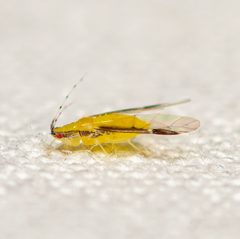
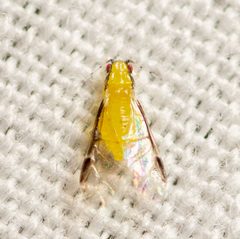
Monellia caryella, commonly known as the blackmargined pecan , is a small sap-feeding insect and significant pest of pecan (Carya illinoinensis) orchards in North America. are distinguished by a prominent black stripe along the outer margin of their wings, which are held flat over the body. typically increase from June to August, then decline after approximately three weeks; on most cultivars usually subside without causing measurable damage, though the 'Cheyenne' cultivar is notably susceptible. The is subject to substantial mortality from fungi, particularly during autumn when environmental conditions favor fungal growth.
Pronunciation
How to pronounce Monellia caryella: /moʊˈnɛliə kɛˈriɛlə/
These audio files are automatically generated. While they are not always 100% accurate, they are a good starting point.
Identification
possess a distinctive black stripe along the outer margin of the wings, which are held flat over the body; this contrasts with the related yellow pecan aphid (Monelliopsis pecanis), which holds its wings roof-like and lacks the marginal stripe. aphids lack wings and are difficult to distinguish from other pecan-feeding aphids. Adults are yellowish in coloration with the characteristic dark wing markings.
Images
Habitat
Pecan orchards and native pecan (Carya illinoinensis) stands; specifically occupies the middle and lower levels of pecan trees. Intracanopy distribution shows preferential of middle and lower leaves rather than upper canopy foliage.
Distribution
Native to and widespread in pecan-growing regions of North America, particularly the south-central and southeastern United States including Texas. GBIF records indicate presence in Brazil (Paraná, Rio Grande do Sul, São Paulo), though records for Spain and Israel are marked doubtful.
Seasonality
typically increase to large numbers from June through August, then decline after approximately three weeks. Peak abundance occurs in late August to early September in Texas pecan orchards. hatch in spring when pecan leaves begin to expand; sexual forms appear in late September and October, followed by egg deposition for overwintering.
Diet
Phloem sap feeder on pecan (Carya illinoinensis); feeding involves distinct phases including activities, phloem salivation, and phloem ingestion as documented by electrical penetration graph analysis.
Host Associations
- Carya illinoinensis - primary pecan; sole documented for this
Life Cycle
Overwinters as hidden in bark crevices on twigs and tree trunks. Nymphs hatch in spring and feed on newly expanded pecan leaves, maturing in approximately one week. is parthenogenetic during spring and summer, with females producing live young without mating. Sexual males and females develop in late September and October; females deposit eggs that survive winter in bark crevices.
Behavior
Exhibits vertical stratification within tree , with and nymphs preferentially inhabiting middle and lower canopy leaves. Produces honeydew as a byproduct of phloem feeding; honeydew accumulation supports growth on leaves.
Ecological Role
Pest of commercial pecan production; feeding activity can reduce leaf and photosynthetic capacity when are high and persistent, though on most cultivars typically decline without causing measurable yield loss. Serves as for diverse natural enemy including lacewings, lady beetles, predatory , and ; also subject to substantial mortality from fungi (Neozygites sp., Entomophthora planchoniana, Erynia sp.) particularly during autumn.
Human Relevance
Economic pest of pecan orchards requiring monitoring and occasional intervention, particularly on susceptible cultivars such as 'Cheyenne'. Management emphasizes treatment thresholds based on and persistence rather than honeydew alone, as often crash rapidly due to weather, physiological effects, or natural enemies. Broad-spectrum insecticide use can disrupt and trigger secondary pest of aphids or mites.
Similar Taxa
- Monelliopsis pecanisAlso a yellow pecan aphid pest; distinguished by roof-like wing posture and absence of black marginal stripe on wings
- Melanocallis caryaefoliaeBlack pecan aphid; much more destructive than M. caryella, causes characteristic yellow spotting between leaf and premature defoliation
- Monelliopsis nigropunctataYellow pecan aphid with similar and associations; shows different intracanopy distribution patterns
Sources and further reading
- BugGuide
- GBIF taxonomy match
- iNaturalist taxon
- NCBI Taxonomy
- Catalogue of Life
- Managing Insect and Mite Pests of Commercial Pecans in Texas - AgriLife Extension Entomology
- Crapemyrtle Aphid: A Cosmopolitan Pest of a Popular Ornamental Tree
- Pathogenic fungal dynamics in a fall population of the blackmargined aphid (Monellia caryella)
- Probing Behavior and Density of Monelliopsis pecanis, Monellia caryella, and Melanocallis caryaefoliae (Homoptera: Aphididae) on Pecan Cultivars
- Intracanopy Distribution and Seasonal Abundance of the Yellow Pecan Aphids Monellia caryella and Monelliopsis nigropunctata (Homoptera: Aphididae)1
- Comparative studies of developmental biology, preference and feeding behavior of Monellia caryella on Juglandaceae native to North America
- Reproductive Response of Aphelinus perpallidus (Hymenoptera: Aphelinidae) to Age of Its Parent and Density of Its Host, Monellia caryella (Homoptera: Aphidae)
- SEASONAL ABUNDANCE AND DISTRIBUTION OF PREDATORS AND PARASITES ASSOCIATED WITH MONELLIOPSIS PECANIS BISSELL AND MONELLIA CARYELLA (FITCH) (HOMOPTERA: APHIDAE)1