
Monellia
Oestlund, 1887
Blackmargined aphid, Yellow pecan aphid
Species Guides
2- Monellia caryella(Blackmargined Pecan Aphid)
- Monellia microsetosa
Monellia is a of aphids in the Aphididae, native to North America. The genus includes notable pecan pest , particularly Monellia caryella (blackmargined ) and Monellia costalis (yellow pecan aphid). These aphids feed on phloem sap from pecan and hickory trees, causing direct damage through sap removal and indirect damage via honeydew production that supports growth. The genus is subject to significant pressure from diverse natural enemy including lacewings, lady beetles, , and fungi.
Pronunciation
How to pronounce Monellia: /moʊˈnɛliə/
These audio files are automatically generated. While they are not always 100% accurate, they are a good starting point.
Identification
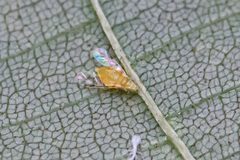
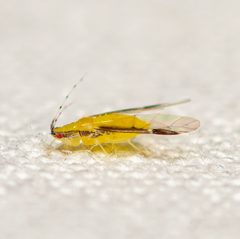
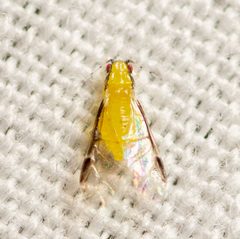
Monellia are distinguished from the closely related Monelliopsis by wing posture and coloration. Monellia caryella (blackmargined ) holds its wings flat over the body and displays a prominent black stripe along the outer wing margin. Monelliopsis pecanis (yellow pecan aphid) holds its wings roof-like over the body and lacks the black marginal stripe. stages of both genera lack wings and are difficult to distinguish. Monellia are typically yellowish-green with dark markings; nymphs are pale to bright yellow.
Images
Habitat
Pecan orchards and native stands of Carya (hickory and pecan). Associated with Juglandaceae native to North America. Found in tree , with distribution throughout the canopy rather than concentrated at specific heights.
Distribution
Northern America. Documented in the United States, particularly in pecan-growing regions of Texas, Georgia, and other southeastern and south-central states. Monellia costalis has been introduced to Israel.
Seasonality
overwinter in bark crevices on twigs and trunks. Nymphs emerge in spring when leaves begin to expand. typically increase from June through August, with peak abundance during summer months. Monellia caryella populations often decline after approximately three weeks of high . Sexual forms appear in late September and October, followed by egg deposition for .
Diet
Phloem sap from pecan (Carya illinoinensis) and hickory (Carya spp.) trees. Feeding occurs on leaf using .
Host Associations
- Carya illinoinensis - primary pecan
- Carya spp. - primary hickory
- Juglandaceae - -level associationnative North American
Life Cycle
Holocyclic with sexual and . overwinter in bark crevices. Fundatrices (stem mothers) hatch in spring and produce parthenogenetic females. Multiple parthenogenetic generations occur through spring and summer. In late autumn, sexual morphs (males and females) develop, mate, and produce eggs. Development from nymph to occurs in approximately one week under favorable conditions.
Behavior
Feeds in colonies on leaf undersides and . Excretes honeydew in large quantities, which accumulates on leaves and supports growth. Winged forms develop when colonies become crowded or quality declines. Probing varies among pecan cultivars, affecting establishment and .
Ecological Role
Herbivore and pest of pecan and hickory. Serves as for diverse natural enemies including (Chrysopa rufilabris, C. quadripunctata, Micromus posticus, Coniopteryx simplicior, Olla abdominalis, Coleomegilla maculata, Hippodamia convergens, Allograpta obliqua), (Aphelinus perpallidus, Alloxysta schlingeri), and fungi (Neozygites sp., Entomophthora planchoniana, Zoophthora radicans). Honeydew production indirectly affects plant health through interference with . May serve as alternative prey supporting natural enemy that control other pecan pests.
Human Relevance
Significant economic pest of commercial pecan production. Direct feeding damage reduces tree vigor and nut yield. Honeydew and reduce photosynthetic and harvest quality. Monellia caryella is generally less damaging than Monelliopsis pecanis, with typically declining without intervention. resistance has been documented. Management relies on monitoring, selective insecticide use, and conservation of natural enemies. Broad-spectrum insecticides can induce secondary outbreaks by destroying natural enemy .
Similar Taxa
- MonelliopsisCo-occurs on pecan; distinguished by wing posture (roof-like vs. flat), presence/absence of black wing margin stripe, and generally greater damage potential in M. pecanis
- Melanocallis caryaefoliaeBlack pecan aphid; co-occurs on pecan, more damaging at lower densities, produces characteristic yellow spotting on leaves rather than general
More Details
Natural Enemy Dynamics
Approximately 33 aphidophagous have been documented associated with Monellia and Monelliopsis pecanis. abundance tracks abundance closely; abundance varies independently. No directional or height preferences in tree were observed for predators or parasites.
Fungal Pathogen Interactions
Subject to caused by fungi. Fungal-induced mortality in Monellia caryella correlates with minimum temperature and leaf wetness hours. Neozygites sp. and Entomophthora planchoniana are primary , with Neozygites responsible for approximately 54% of fungal mortality.
Cultivar Susceptibility
Probing and vary significantly among pecan cultivars. 'Cheyenne' is particularly susceptible to Monellia caryella; 'Pawnee' shows lowest susceptibility to yellow aphids generally.
Sources and further reading
- BugGuide
- Wikipedia
- GBIF taxonomy match
- iNaturalist taxon
- NCBI Taxonomy
- Catalogue of Life
- Managing Insect and Mite Pests of Commercial Pecans in Texas - AgriLife Extension Entomology
- Crapemyrtle Aphid: A Cosmopolitan Pest of a Popular Ornamental Tree
- Pathogenic fungal dynamics in a fall population of the blackmargined aphid (Monellia caryella)
- Monellia costalis (Fitch), a new host forZoophthora radicans (Brefeld) Batko andEntomophthora Planchoniana Cornu (Zygomycetes: Entomophthoraceae) in Israel
- Probing Behavior and Density of Monelliopsis pecanis, Monellia caryella, and Melanocallis caryaefoliae (Homoptera: Aphididae) on Pecan Cultivars
- Intracanopy Distribution and Seasonal Abundance of the Yellow Pecan Aphids Monellia caryella and Monelliopsis nigropunctata (Homoptera: Aphididae)1
- Comparative studies of developmental biology, preference and feeding behavior of Monellia caryella on Juglandaceae native to North America
- Reproductive Response of Aphelinus perpallidus (Hymenoptera: Aphelinidae) to Age of Its Parent and Density of Its Host, Monellia caryella (Homoptera: Aphidae)
- SEASONAL ABUNDANCE AND DISTRIBUTION OF PREDATORS AND PARASITES ASSOCIATED WITH MONELLIOPSIS PECANIS BISSELL AND MONELLIA CARYELLA (FITCH) (HOMOPTERA: APHIDAE)1