
Shivaphis celti
Das, 1918
Asian Woolly Hackberry Aphid
Shivaphis celti is an native to Asia that has established in North America. It is a herbivore that feeds exclusively on hackberry trees (Celtis spp.), causing distinctive woolly or waxy secretions on leaves and branches. The species has been documented across much of the continental United States and is considered a nuisance pest in urban areas where hackberry is planted as an ornamental.
Pronunciation
How to pronounce Shivaphis celti: //ˈʃiːvəfɪs ˈkɛltaɪ//
These audio files are automatically generated. While they are not always 100% accurate, they are a good starting point.
Identification
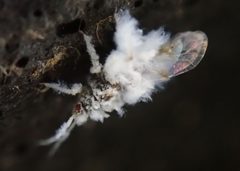
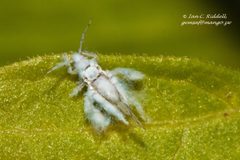
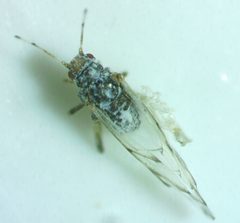
Shivaphis celti can be recognized by the dense white woolly wax secretions produced by colonies, which coat leaves, petioles, and branches of hackberry trees. These waxy filaments distinguish it from other aphids on Celtis. The aphids themselves are small and typically concealed beneath the wax masses. Confirmation requires microscopic examination; the has reduced siphunculi (cornicles) and specific antennal and caudal characteristic of the Shivaphis.
Images
Habitat
Associated exclusively with hackberry trees (Celtis spp.), including C. occidentalis, C. laevigata, and related . Occurs in natural woodland settings, riparian corridors, and urban/suburban environments where hackberry is planted as a shade tree. Colonies develop on new growth, leaf undersides, and along leaf petioles.
Distribution
Native to Asia; introduced and established in North America. Documented across the conterminous 48 United States. Records indicate presence from the eastern seaboard westward across the Great Plains and into the Southwest.
Diet
phloem feeder on hackberry (Celtis spp.). Sucks sap from leaves, petioles, and young stems. Does not feed on other plant .
Host Associations
- Celtis occidentalis - common hackberry
- Celtis laevigata - sugarberry
- Celtis - -wide association
Behavior
Forms dense colonies on new growth and leaf undersides. Produces copious amounts of white woolly wax that covers the colony and surrounding plant tissue. This waxy secretion is a defensive that may deter and . Honeydew is heavy, leading to growth on underlying surfaces. Winged stages () develop for of new trees.
Ecological Role
herbivore that can reach high densities on hackberry, potentially causing leaf curling, premature leaf drop, and branch dieback in heavy . Honeydew production supports fungi and may attract ants and other honeydew-feeding insects. Serves as prey for and , though the waxy secretions provide some protection.
Human Relevance
Considered a significant nuisance pest in urban areas due to aesthetic damage to hackberry trees, sticky honeydew accumulation on vehicles and surfaces, and associated growth. The woolly wax and honeydew can create maintenance issues in landscapes and along streets lined with hackberry. Not known to plant . Control typically involves or insecticidal soaps directed at early-season colonies.
Similar Taxa
- Pachypsylla spp.hackberry psyllids also form galls on Celtis leaves, but produce discrete nipple or blister galls rather than woolly wax secretions; psyllids are jumping insects with different body form
- other Aphididae on Celtis aphids may occur on hackberry but do not produce the characteristic dense woolly wax masses; require microscopic examination for definitive separation
Sources and further reading
- BugGuide
- Wikipedia
- GBIF taxonomy match
- iNaturalist taxon
- NCBI Taxonomy
- Catalogue of Life
- Graphisurus triangulifer in Missouri | Beetles In The Bush
- Bug Eric: Hackberry Psyllids: A Fixture of Fall
- Listen to the trees: a detective work on the origin of invasive species
- Chrysobothris viridiceps | Beetles In The Bush
- Another new record for northwestern Oklahoma | Beetles In The Bush
- In Search of Britain’s Endemics - Buglife Blog - Buglife