
Tinocallis
Matsumura, 1919
elm aphids, crapemyrtle aphids
Species Guides
3- Tinocallis takachihoensis(Japanese elm aphid)
- Tinocallis ulmifolii(Elm Leaf Aphid)
- Tinocallis ulmiparvifoliae(elm aphid)
Tinocallis is a small of aphids in the Calaphidinae, comprising eight described . Most species are associated with Ulmaceae (elm ), though one notable exception, T. kahawaluokalani (the crapemyrtle aphid), is a pest of Lagerstroemia indica. Species exhibit with both parthenogenetic summer and sexual autumn generations producing . Several species are economically significant as pests of ornamental trees in urban landscapes.
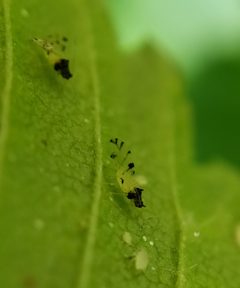
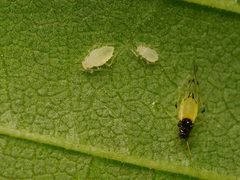
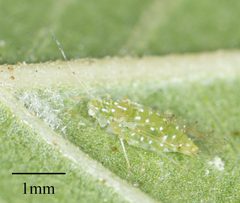
Pronunciation
How to pronounce Tinocallis: //ˌtaɪnoʊˈkælɪs//
These audio files are automatically generated. While they are not always 100% accurate, they are a good starting point.
Identification
Tinocallis can be distinguished from related by their association with Ulmaceae (except T. kahawaluokalani on Lagerstroemia), and by morphological features detailed in the illustrated key by Quednau (2001). T. kahawaluokalani specifically is recognized by its restriction to crape myrtle, shiny black winter laid in branch crevices, and females in summer .
Images
Habitat
Primary is on trees in the Ulmaceae (elms, zelkovas, planes). Tinocallis kahawaluokalani occupies a derived habitat on ornamental crape myrtle trees (Lagerstroemia indica) in urban environments of the southeastern United States and Brazil. overwinter on leafless branches in bark crevices and folds.
Distribution
The has a broad distribution including Palearctic, Nearctic, and Oriental regions. Specific records include: Denmark, Norway, Sweden (GBIF); Brazil (Paraná State, Curitiba) for T. kahawaluokalani; and widespread occurrence in the southeastern United States for T. kahawaluokalani. are native to regions where their Ulmaceae occur naturally.
Seasonality
Holocyclic produce multiple parthenogenetic during summer. In autumn, females and males appear, mate, and produce winter that persist from early autumn through winter on leafless branches. Summer colonies feed actively on leaf undersides of terminal branch portions.
Diet
Phloem-feeding herbivores. Tinocallis kahawaluokalani feeds specifically on the underside of Lagerstroemia indica leaves, primarily on terminal portions of branches. Other feed on Ulmaceae foliage.
Host Associations
- Lagerstroemia indica L. - sole of T. kahawaluokalani
- Ulmaceae - -level associationprimary for most Tinocallis including elms (Ulmus), zelkovas (Zelkova), and plane trees (Platanus)
Life Cycle
Holocyclic and . Summer: several successive parthenogenetic produced by females. Autumn: generation of females and alate males that copulate; females deposit shiny black, oval winter with smooth on branch folds and crevices. Eggs persist through winter on deciduous, leafless trees.
Behavior
Tinocallis kahawaluokalani exhibits -dependent responses to urban temperature, with density decreasing in hotter microclimates contrary to expectations for this guild. are laid preferentially on middle branch portions (30-60 cm from apex) rather than or basal sections, with higher oviposition rates on older (20-30 year) trees. No preference for cardinal branch positions has been observed. Colonies aggregate on undersides of leaves on terminal branch portions.
Ecological Role
As herbivores, Tinocallis function as phloem consumers on their trees. Heavy of T. kahawaluokalani cause leaf yellowing and shedding, abundant honeydew production that supports growth, and reduced photosynthetic capacity and landscape value. The species serves as prey for including lady beetles, Orius insidiosus, and lacewings, and has been used in studies of urban dynamics and services. -infested trees with high natural enemy densities can provide associational pest resistance to nearby plants through predator spillover.
Human Relevance
T. kahawaluokalani is a significant pest of crape myrtle, one of the most common ornamental street trees in the southeastern United States. Management relies on natural by ; vegetation thresholds around trees can enhance Orius insidiosus and reduce needs. Other occasionally damage elm and plane trees in urban and forest settings.
Similar Taxa
- TherioaphisBoth are in tribe Therioaphidini and share Calaphidinae placement; distinguished by associations and morphological details in Quednau's key
- MonelliopsisRelated in Calaphidinae also associated with Ulmaceae; morphologically similar but distinguished by key characters
More Details
Taxonomic history
The was established by Matsumura in 1919. Quednau (2001) provided a world review recognizing eight and offering an illustrated identification key. The genus has been placed in tribe Therioaphidini within Calaphidinae.
Notable species
Tinocallis kahawaluokalani (Kirkaldy) is the most economically significant due to its status as primary pest of crape myrtle in urban landscapes. Other species include T. ulmiparvifoliae (Japanese elm aphid), T. platani (plane tree ), T. saltans, T. zelkovae, T. zelkowae, T. ulmifolii, and T. caryaefoliae.
Research significance
T. kahawaluokalani has become a model organism for urban insect research, with studies examining temperature effects, complexity influences on natural enemies, and distribution patterns. The demonstrates that urban pest can decrease with hotter temperatures contrary to typical expectations for piercing-sucking herbivores.
Sources and further reading
- BugGuide
- Wikipedia
- GBIF taxonomy match
- iNaturalist taxon
- NCBI Taxonomy
- Catalogue of Life
- Publications | Entomology Research Museum
- crapemyrtle aphid - Tinocallis kahawaluokalani - Entomology Today
- Tinocallis kahawaluokalani Archives - Entomology Today
- A Day in the Life of an Urban Insect Ecologist
- Scale Insects on Urban Trees Benefit Spiders, Other Natural Enemies in Plants Below
- aphids, spider, and flies - Entomology Today
- A REVIEW OF THETINOCALLISOF THE WORLD (HOMOPTERA: APHIDIDAE)
- Modeling egg distribution of Tinocallis kahawaluokalani (Kirkaldy) (Hemiptera: Aphididae) on Lagerstroemia indica L. (Lythraceae)
- Effects of temperature and habitat complexity on an urban tree pest (Tinocallis kahawaluokalani), natural enemies, and predation services in the city