
Nomotettix cristatus
(Scudder, 1862)
crested pygmy grasshopper, crested grouse locust, northern crested grouse locust
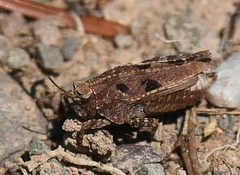
Nomotettix cristatus is a small pygmy in the Tetrigidae, commonly known as the crested pygmy grasshopper or crested grouse locust. It is one of approximately 35 Nearctic of Tetrigidae. The species exhibits three recognized with distinct geographic distributions across North America. Like other members of its family, it is characterized by an elongated pronotum that extends over the , a trait distinguishing pygmy grasshoppers from typical grasshoppers in Acrididae.
Pronunciation
How to pronounce Nomotettix cristatus: /ˌnɔmoʊˈtɛtɪks krɪˈsteɪtəs/
These audio files are automatically generated. While they are not always 100% accurate, they are a good starting point.
Identification
Members of Nomotettix can be distinguished from other Nearctic Tetrigidae by features of the pronotum and body proportions. N. cristatus specifically is recognized by the crested or elevated carina of the pronotum, which gives the its . The three (N. c. cristatus, N. c. compressus, N. c. floridanus) differ in pronotal shape and geographic distribution. Accurate identification to subspecies level requires examination of pronotal compression and the degree of crest development.
Images
Habitat
Associated with moist environments near water, including lake shores, pond margins, and stream edges. Found in leaf litter and ground-level vegetation in these .
Distribution
North America (Nearctic region). Documented from Alberta, Connecticut, Florida, Georgia, and Illinois. The show geographic partitioning: N. c. cristatus in northern regions, N. c. compressus in intermediate areas, and N. c. floridanus in Florida.
Behavior
are capable of jumping using enlarged hind typical of Orthoptera.
Similar Taxa
- Tetrix speciesAlso small pygmy grasshoppers with elongated pronota, but differ in pronotal carination and body proportions; Tetrix is more widespread in the Holarctic and more frequently encountered by naturalists.
- Paratettix speciesNearctic pygmy grasshoppers with similar preferences near water, but differ in pronotal shape and geographic distribution patterns.
Sources and further reading
- BugGuide
- Wikipedia
- GBIF taxonomy match
- iNaturalist taxon
- NCBI Taxonomy
- Catalogue of Life
- The mini grasshoppers that outlived dinosaurs: the fascinating world of Tetrigidae | Blog
- Bug vs. bug - Assassinating stink bugs is the game of the wheel bug, Arilus cristatus — Bug of the Week
- Death of a stink bug, Part 2: Bug vs. Bug - Brown Marmorated Stink Bug, Halyomorpha halys, meets the wheel bug, Arilus cristatus — Bug of the Week
- To eat a stink bug, part 3 - Bug vs Bug, Brown Marmorated Stink Bug, Halyomorpha halys, meets the wheel bug, Arilus cristatus — Bug of the Week
- Bugs in orange and black: Three assassins - milkweed assassin bug, Zelus longipes; orange assassin bug, Pselliopus barberi; and wheel bug, Arilus cristatus — Bug of the Week
- Bugs in Orange and Black III – Argus tortoise beetle, Chelymorpha cassidea; oleander caterpillar, Syntomeida epilais; and wheel bug, Arilus cristatus (MISSING LINKS) — Bug of the Week