
Tetrix
Latreille, 1802
ground-hoppers, pygmy grasshoppers
Species Guides
5- Tetrix arenosa(Obscure pygmy grasshopper)
- Tetrix brunnerii(Brunner's pygmy grasshopper)
- Tetrix ornata(ornate pygmy grasshopper)
- Tetrix sierrana(Sierra Pygmy Grasshopper)
- Tetrix subulata(Slender Ground-hopper)
Tetrix is a of ground-hoppers ( Tetrigidae) comprising at least 180 described of minute jumping insects. These pygmy grasshoppers are characterized by their small size (typically around 1 cm), enlarged pronotum that often extends over the , and association with moist near water. The genus has a Holarctic distribution with particular research focus on European and North American species, though this represents only a small fraction of global diversity. Some Tetrix species exhibit incomplete reproductive isolation where sympatric, with documented heterospecific courtship and mating between closely related species.
Pronunciation
How to pronounce Tetrix: /ˈtɛtrɪks/
These audio files are automatically generated. While they are not always 100% accurate, they are a good starting point.
Identification
Distinguished from other Tetrigidae by combination of small size, pronotal , and genitalic characters requiring microscopic examination. Within the genus, identification relies on pronotum shape (length, extension, presence of or lateral carinae), forewing development, and male genitalia. Tetrix species may be confused with Paratettix, from which they differ in details of pronotal and genital structure. Sympatric species pairs such as T. subulata and T. undulata require careful examination of pronotum proportions and male .
Images
Appearance
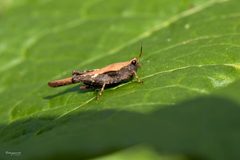
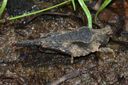
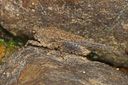
Small orthopterans, typically approximately 10–15 mm in length. The pronotum is enlarged and often extends posteriorly over the , sometimes with extreme modifications including projections, spines, or warty ornamentation. Wings are frequently reduced or abbreviated, with some appearing wingless or with wings not reaching beyond the pronotum. Body form is compact and somewhat humpbacked. Coloration is generally cryptic, often brown, gray, or mottled to match substrate, though some species display contrasting markings such as bold white femoral bands.
Habitat
Moist environments including leaf litter, pond margins, stream banks, and wet meadows. Often found in association with mosses, , and decaying vegetation. Some occupy coniferous forest, broadleaf forest, grassland, and shrubland across altitudinal gradients. Habitat specificity varies by species, with some showing narrow moisture requirements while others demonstrate broader ecological .
Distribution
Holarctic distribution encompassing Europe, northern Asia, and North America. Well-documented in western and Central Europe, with extending into the Palearctic and Nearctic regions. Records from Australasia, Albania, Amur region, and Assam indicate broader geographic representation. The is most thoroughly studied in Europe and North America, though these regions contain only about 2% of described Tetrigidae diversity.
Seasonality
activity period varies by and latitude. In temperate regions, adults are present during spring and summer months. Field collections of T. japonica documented adult specimens from June through September. Specific depends on local climate and conditions.
Diet
feeding strategy dominated by detrital organic matter, including mosses, , lichens, and plant detritus. Gut microbiome analysis of T. japonica confirms capacity for lignocellulose degradation and processing of recalcitrant plant polymers. Diet distinct from predominantly herbivorous orthopterans, reflecting to detrital food resources in moist microhabitats.
Life Cycle
Hemimetabolous development with , nymph, and stages. Nymphs resemble adults in general form but lack fully developed wings and reproductive structures. Laboratory of T. japonica maintained through three under controlled conditions (25±2°C, 60±10% relative humidity, 14:10 light:dark ), suggesting multivoltine potential in favorable conditions. Specific details of egg and strategy vary among .
Behavior
Strong jumping ability using enlarged hind despite small body size. Some capable of despite abbreviated wings, as observed in related Malagasy tetrigids with similar . Males produce courtship including approach and mounting attempts. Reproductive interference documented between sympatric species, with heterospecific courtship and mating occurring. Males of T. subulata and T. undulata preferentially approach T. undulata females, while females of both species fail to discriminate against heterospecific males.
Ecological Role
Contribute to decomposition and nutrient cycling in moist terrestrial through consumption of detrital organic matter. Gut microbiome facilitates breakdown of recalcitrant plant polymers, nitrogen cycling, and detoxification of secondary metabolites. Serve as prey items for and vertebrate in leaf litter and riparian . Ecological plasticity enables of diverse from forests to grasslands.
Human Relevance
Subject of taxonomic and ecological research due to understudied status relative to other orthopteran groups. Some serve as models for studying reproductive interference and species coexistence. of certain species may be of conservation concern where degradation affects moist microhabitats. Amateur naturalists contribute observational data through platforms such as iNaturalist, expanding knowledge of distribution and .
Similar Taxa
- ParatettixOverlapping distribution and ; distinguished by pronotal details and male genitalia structure. Both contain frequently misidentified by non-.
- TettigideaNearctic of pygmy grasshoppers with similar ground-hopper habitus; differs in pronotal shape and geographic range, with Tettigidea primarily North American while Tetrix is Holarctic.
- NomotettixNearctic with abbreviated wings and pronotal extension; separation requires examination of shape and pronotal carination.
Misconceptions
Frequently mistaken for grasshoppers (Acrididae) due to small size; these are pygmy grasshoppers with distinct evolutionary history and . The 'pygmy ' reflects convergence in jumping , not phylogenetic relationship to true grasshoppers. Some with reduced wings have been assumed flightless, yet capability has been documented in similarly morphologized relatives.
More Details
Research bias
European and North American Tetrix are disproportionately studied relative to global diversity. Only 2% of Tetrigidae diversity occurs in these regions, yet 12 of 19 most frequently observed species on iNaturalist are from Europe and North America, highlighting geographic in ecological knowledge.
Evolutionary history
Tetrigidae has persisted for more than 230 million years, indicating ancient lineage that survived multiple mass extinctions. Tetrix represents a derived within this ancient family.
Sources and further reading
- BugGuide
- Wikipedia
- GBIF taxonomy match
- iNaturalist taxon
- NCBI Taxonomy
- Catalogue of Life
- The mini grasshoppers that outlived dinosaurs: the fascinating world of Tetrigidae | Blog
- A “Giant” Pygmy | Beetles In The Bush
- Social Behavior on the Lek in Black Grouse, Lyrurus Tetrix Tetrix (L.)
- Reproductive Interference between the Common Ground-hopper Tetrix undulata and the Slender Ground-hopper Tetrix subulata (Orthoptera, Tetrigidae)
- Habitat-driven variation in gut microbiome composition and function of the pygmy grasshopper (Tetrix japonica) across diverse ecosystems in China.