
Greenideinae
Baker, 1920
Genus Guides
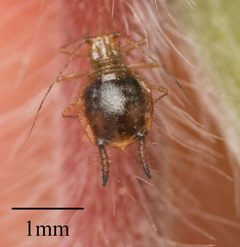
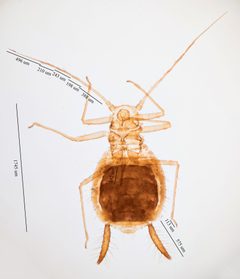
1Greenideinae is a of aphids (Aphididae) comprising approximately 179 extant across 18 in three tribes: Cervaphidini, Greenideini, and Schoutedeniini. Species are primarily distributed in eastern and southern Asia, with many exhibiting specialized associations with woody plants, particularly in Fagaceae. The subfamily has been extensively studied for its complex symbiotic relationships with microbial associates, including the primary endosymbiont *Buchnera aphidicola* and diverse secondary .

Pronunciation
How to pronounce Greenideinae: /ˌɡriːˈnaɪdɪˌniː/
These audio files are automatically generated. While they are not always 100% accurate, they are a good starting point.
Identification
Greenideinae aphids are distinguished from other by a combination of morphological features including siphuncular structure and antennal segmentation, though specific diagnostic characters vary among tribes. The subfamily is most reliably identified through molecular phylogenetic analysis or examination of established morphological keys at the level.
Images
Habitat
Primarily associated with young leaves and shoots of woody plants in subtropical and temperate forest . show varying degrees of host specificity, with some restricted to single plant while others exhibit broad polyphagy across multiple plant families.
Distribution
Eastern and southern Asia, including China (92 recorded ), India, Nepal, Vietnam, South Korea, and other regions of Southeast Asia. Distribution patterns have been influenced by geological events including the uplift of the Qinghai-Tibetan Plateau.
Diet
Phloem sap from plants. Nutritional deficiencies in phloem sap, particularly , are compensated by the primary endosymbiont *Buchnera aphidicola*.
Host Associations
- Fagaceae - primary Major for tribe Greenideini; basal *Mollitrichosiphum* feed primarily on Fagaceae
- Euphorbiaceae - primary Primary for tribe Schoutedeniini
- Fabaceae -
- Myrtaceae -
- Tiliaceae -
- Betulaceae - Includes *Alnus* as for some
- Juglandaceae -
- Moraceae -
- Lauraceae - Includes *Litsea* as
- Sabiaceae - Includes *Meliosma* as
Life Cycle
; exhibit either holocyclic (with sexual phase and production) or anholocyclic (parthenogenetic year-round) cycles depending on species and environmental conditions. is , with females giving birth to live young.
Behavior
Ecological Role
Herbivores that function as phloem sap feeders on woody plants. Serve as for diverse of (including Coccinellidae, Syrphidae, Chrysopidae, and spiders) and (Aphelininae and Aphidiinae). The represents a model system for studying insect-microbe , with documented phylosymbiosis between and microbial community structure.
Human Relevance
Some are agricultural and horticultural pests. The serves as a biocontrol target, with in Aphidiinae and Aphelininae being investigated for potential. *Mollitrichosiphum* species have been proposed as indicators for studying biogeographical patterns and evolutionary history through their associated *Buchnera* endosymbionts.
Similar Taxa
More Details
Microbial Symbiosis
Greenideinae harbors complex microbial dominated by the primary endosymbiont *Buchnera aphidicola* and various secondary including *Serratia symbiotica*, *Arsenophonus*, **, *Hamiltonella defensa*, **, *Spiroplasma*, and *Fukatsuia symbiotica*. The exhibits phylosymbiosis, where phylogenetic relationships correlate with microbial community dissimilarities.
Tribal Classification
The is divided into three tribes: Cervaphidini (6 : *Anomalaphis*, *Anomalosiphum*, *Brasilaphis*, *Cervaphis*, *Meringosiphon*, *Sumatraphis*), Greenideini (7 genera: *Allotrichosiphum*, *Eutrichosiphum*, *Greenidea*, *Greenideoida*, *Mesotrichosiphum*, *Mollitrichosiphum*, *Tritrichosiphum*), and Schoutedeniini (3 genera: *Eonaphis*, *Paulianaphis*, *Schoutedenia*).
Evolutionary History
Phylogenetic studies of *Mollitrichosiphum* indicate with *Buchnera* endosymbionts at both intraspecific and interspecific levels. diversification has been driven by geographical isolation, particularly associated with the uplift of the Qinghai-Tibetan Plateau (c. 11.0–10.6 mya), and by plant range expansion with Fagaceae likely representing the ancestral host.
Sources and further reading
- BugGuide
- Wikipedia
- iNaturalist taxon
- NCBI Taxonomy
- Catalogue of Life
- Phylosymbiotic Structures of the Microbiota in Mollitrichosiphum tenuicorpus (Hemiptera: Aphididae: Greenideinae)
- Updated Checklist of Greenideinae (Aphididae : Hemiptera) and its Host Plants In India
- Insights Into the Species-Specific Microbiota of Greenideinae (Hemiptera: Aphididae) With Evidence of Phylosymbiosis
- A new record of the genus Mollitrichosiphum Suenaga (Hemiptera, Aphididae, Greenideinae) from South Korea
- Microbiota associated with Mollitrichosiphum aphids (Hemiptera: Aphididae: Greenideinae): diversity, host species specificity and phylosymbiosis
- Species Differentiation of Chinese Mollitrichosiphum (Aphididae: Greenideinae) Driven by Geographical Isolation and Host Plant Acquirement
- Biodiversity of predators and parasitoids of greenideine aphids (Insecta: Hemiptera: Aphididae: Greenideinae) and their host plant associations in India
- Phylogenetic congruence between Mollitrichosiphum (Aphididae: Greenideinae) and Buchnera indicates insect–bacteria parallel evolution
- Review and Key to the World Parasitoids (Hymenoptera: Braconidae: Aphidiinae) of Greenideinae Aphids (Hemiptera: Aphididae), Including Notes on Invasive Pest Species