
Greenidea psidii
van der Goot, 1917
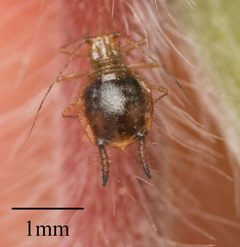
Greenidea psidii is a of in the Aphididae, Greenideinae. It was described by van der Goot in 1917 and has been recorded in Brazil, Hawaii, and the continental United States. The species is associated with plants in the Psidium, particularly Psidium guajava (guava) and Psidium cattleianum (strawberry guava). It has been recently detected as a non-native species in new geographic regions, raising interest in its potential as an emerging pest.
Pronunciation
How to pronounce Greenidea psidii: //ɡreː.nɪˈde.a ˈpsi.di.a//
These audio files are automatically generated. While they are not always 100% accurate, they are a good starting point.
Identification
Diagnostic characters distinguishing Greenidea psidii from similar include morphological features of the siphunculi and cauda. A comparative synopsis with Greenidea ficicola highlights differences in these structures; images of these characters are available in taxonomic literature. Accurate identification requires examination of these specific morphological traits rather than association alone.
Images
Distribution
Native range unclear; recorded in Brazil (Paraná, Santa Catarina, and São Paulo States), Hawaii (United States), and the conterminous 48 United States. In Brazil, specifically documented in Curitiba, Paraná.
Host Associations
- Psidium guajava - Recorded in Paraná, Santa Catarina, and São Paulo States, Brazil
- Psidium cattleianum - Recorded in Curitiba, Paraná, Brazil
Human Relevance
Potential emerging pest of guava (Psidium guajava) and related Myrtaceae. Its detection in new geographic regions, including the United States, has prompted interest in monitoring and management strategies for forest and agricultural pests.
Similar Taxa
- Greenidea ficicolaMorphologically similar; both have been recently recorded in Brazil and require comparison of siphunculi and cauda for accurate identification. G. ficicola is associated with Ficus species rather than Psidium.
More Details
Taxonomic Note
The has been treated under the subgenus Trichosiphum as Greenidea (Trichosiphum) psidii, though this classification varies among sources. Catalogue of Life lists it as a synonym, while GBIF treats it as accepted.
Invasion Biology Context
The has been discussed in the context of the HOMED project, a Horizon 2020 initiative focused on holistic management of emerging forest pests and in Europe, though it is not exclusively a forest pest.