
Odontomachus haematodus
(Linnaeus, 1758)
two-spined trapjaw ant
Odontomachus haematodus is a large, aggressive of trap-jaw native to South America that has established introduced across the southeastern United States, particularly along the Gulf Coast. The species is notable for its powerful, spring-loaded capable of rapid snapping movements used in prey capture and defense. are active both diurnally and nocturnally, foraging in and around rotting wood and occasionally nesting within plants such as Aechmea aquilega. Research has documented this species as a of Thoropa taophora tadpoles and has identified unique involving dialkyltetrahydrofurans, compounds previously unknown in eusocial insects.
Pronunciation
How to pronounce Odontomachus haematodus: /oˌdɔntoʊˈmækəs hɪˈmætədəs/
These audio files are automatically generated. While they are not always 100% accurate, they are a good starting point.
Identification
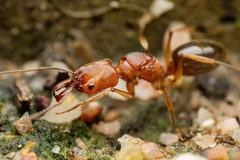
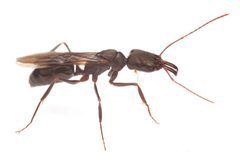
O. haematodus is larger and more aggressive than other Odontomachus occurring in the United States. The species can be distinguished from the sympatric O. ruginodis and O. relictus by morphological characters detailed in taxonomic keys; males across these species show more similar chemical signatures than females, though species-specific differences remain detectable. The species exhibits the characteristic trap-jaw shared with , with spring-loaded jaws capable of rapid closure.
Images
Habitat
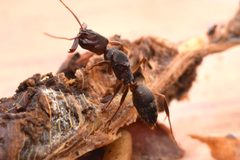
Nests primarily in rotting wood. Has been documented nesting within plants, specifically Aechmea aquilega, in certain locations. In introduced U.S. range, found in landscaped areas near buildings, often in mulch beneath hedges.
Distribution
Native to South America; recorded from Colombia (Leticia, Villavicencio) and widespread across Brazil (Acre, Alagoas, Amazonas, Amapá, Bahia, Ceará, Distrito Federal, Espírito Santo, Goiás, Maranhão, Minas Gerais, Mato Grosso do Sul, Mato Grosso, Pará, Paraíba, Pernambuco, Piauí, Paraná, Rio de Janeiro, Rio Grande do Norte, Rondônia, Roraima, Rio Grande do Sul, Santa Catarina, Sergipe, São Paulo, Tocantins). Introduced to the United States, with confirmed spread across the Gulf Coast from Alabama to at least as far east as Pensacola, Florida. First unofficially recorded in Alabama in 1956.
Diet
. Documented predator of Thoropa taophora tadpoles. Foraging capture prey using rapid snapping.
Behavior
forage both during the day and nocturnally. Relies on fast snapping of jaws for prey capture and defense. Exhibits the characteristic trap-jaw escape jumping using against the ground to propel into the air, and bouncer defense jumping using jaws against objects to propel backwards.
Ecological Role
in native and introduced ranges. Potential impacts on native in invaded areas remain poorly studied.
Human Relevance
Introduced in the southeastern United States with expanding range. Aggressive nature and large size may increase its ecological impact relative to other introduced trap-jaw ants.
Similar Taxa
- Odontomachus ruginodisPreviously thought confined to Orlando region and south, but now confirmed over 100 miles north in Gainesville, Florida; smaller and less aggressive than O. haematodus
- Odontomachus relictus to endangered scrub on central Florida's ancient sand ridges; restricted distribution compared to O. haematodus
- Odontomachus brunneusNative southeastern U.S. ; subject of early natural history studies but distinct from introduced O. haematodus
Sources and further reading
- BugGuide
- Wikipedia
- GBIF taxonomy match
- iNaturalist taxon
- NCBI Taxonomy
- Catalogue of Life
- Powerful Trap-jaw Ants are Gaining Ground in the Southeastern United States
- Different Insect Species Use Different Chemicals to Identify Queens
- How an "Insect Ecologist at Heart" Got Focused on Pest Management Research
- Uncategorized | Blog - Part 17
- Trap-Jaw Ant Jumps with Its Legs or Its Mandibles
- Study Uncovers Unseen Details and Images of Ant Development