
Odontomachus brunneus
(Patton, 1894)
Florida Trap-jaw Ant, Brown Trap-jaw Ant
Odontomachus brunneus is a trap-jaw notable for possessing the fastest predatory appendages recorded in the animal kingdom, with closure speeds reaching 126-230 km/h. exhibit cooperative rescue toward trapped nestmates and maintain humid nest chambers that occasionally provide refugia for other species such as green anole . The species has a distinctive seasonal breeding cycle with concentrated in the first six months of the year.
Pronunciation
How to pronounce Odontomachus brunneus: /oʊˌdɒntoʊˈmækəs ˈbrʌnjuːəs/
These audio files are automatically generated. While they are not always 100% accurate, they are a good starting point.
Identification
Distinguished from other Odontomachus by geographic range (southeastern United States, Central America, West Indies) and brown coloration. The extremely rapid closure (130 microseconds average) is a -level trait; species-level identification requires geographic and morphological examination. Distinguished from other trap-jaw genera by mandible structure and Ponerinae characteristics.
Images
Appearance
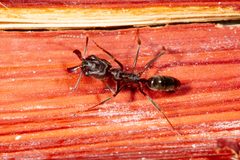
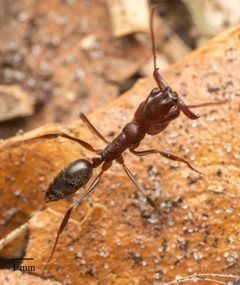
possess characteristic trap-jaw capable of opening to 180 degrees and snapping shut with extreme speed. The mandibles permit both rapid predatory strikes and slow, precise movements for nest maintenance and care. Body coloration is brown (consistent with the specific epithet 'brunneus').
Habitat
Nests in soil with chambers providing humid microhabitat conditions. Found in mixedgrass and bunchgrass prairies, mountain meadows, parklands, and disturbed areas. Nest architecture includes chambers with moist soil suitable for maintaining humidity.
Distribution
Southeastern United States, parts of Central America, and the West Indies. Specific documented locations include Florida (USA), Colombia (Leticia, Villavicencio, Atlántico, Magdalena), and multiple Brazilian states (Acre, Alagoas, Amazonas, Bahia, Distrito Federal, Espírito Santo, Goiás, Maranhão, Minas Gerais, Mato Grosso do Sul, Mato Grosso, Pará, Paraíba, Rio de Janeiro, Rondônia, Sergipe, São Paulo).
Seasonality
occurs during the first six months of the year with no offspring produced in the latter six months. Foraging activity is reduced during the breeding period and increases substantially after breeding concludes. In temperate regions, activity patterns follow seasonal temperature cycles with basking observed.
Host Associations
- Anolis carolinensis - commensalGreen anole found in 2 of 24 excavated nest chambers; ants did not disturb eggs, humid nest microhabitat may benefit egg development
Life Cycle
Seasonal breeding cycle with offspring production restricted to first six months of year. Complete with , larva, pupa, and stages typical of ants. Specific developmental durations not documented.
Behavior
exhibit rescue toward trapped nestmates, responding to distress signals emitted by captured individuals. Signals appear to be -specific and have an optimal effective range; may involve both stridulation (audible signals) and chemical communication. When threatened, workers use as a catapult to eject intruders or fling themselves backward to escape. Foraging is slow during breeding periods and doubles afterward. Workers are generally timid, accepting only prey they can reliably subdue. Basking behavior observed, with individuals presenting a side perpendicular to sunlight and lowering the associated hindleg to expose the .
Ecological Role
with extremely rapid prey capture capability. Creates humid soil microhabitats through nest construction that may provide refugia for other . Potential role in soil aeration and nutrient cycling through nest excavation.
Human Relevance
Subject of biomechanical research due to record-breaking speed. Occasionally associated with human-disturbed . No documented agricultural or medical significance.
Similar Taxa
- Other Odontomachus speciesShare trap-jaw and rapid closure capability; distinguished by geographic distribution, coloration, and subtle morphological differences
- Solenopsis speciesCo-occur in southeastern US; distinguished by structure, (Solenopsis more aggressive, attacking indiscriminately), and lack of trap-jaw mechanism
More Details
Mandible Biomechanics
Peak force exerted by reaches approximately 300 times body weight. Mandible closure triggered by contact with sensory hairs on inner mandible surfaces. Dual-function mandibles allow both explosive predatory strikes and delicate manipulation for care and nest construction.
Communication Signals
Distress signals from trapped elicit rescue attempts from nestmates. Signals are -specific and distance-dependent. Stridulation produces audible signals that may function in rescue communication alongside chemical cues.
Sources and further reading
- BugGuide
- Wikipedia
- GBIF taxonomy match
- iNaturalist taxon
- NCBI Taxonomy
- Catalogue of Life
- Grasshoppers of Colorado
- Grasshoppers of Colorado
- Grasshoppers of Colorado
- Species Records and Accounts
- Bruner Slantfaced Grasshopper
- Field Guide
- Do Odontomachus brunneus nestmates request for help and are taken care of when caught?
- Green Anole (Anolis carolinensis) Eggs Associated with Nest Chambers of the Trap-Jaw Ant Odontomachus brunneus