
Odontomachus ruginodis
Smith, 1937
rough-node snapping ant, rough-node trap-jaw ant
Odontomachus ruginodis is a of trap-jaw native to the southeastern United States, known for its powerful spring-loaded capable of snapping shut at high speeds. The species has been observed expanding its range northward from its previously known distribution centered on the Orlando, Florida area. Research has revealed that queens of this species use unique cuticular chemical compounds—specifically dialkyltetrahydrofurans—to distinguish themselves from , a signaling system distinct from both other Odontomachus species and the broader class of compounds once thought universal among eusocial insects. Like other trap-jaw ants, it is an active with a venomous sting.
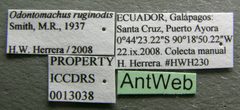
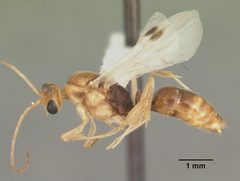
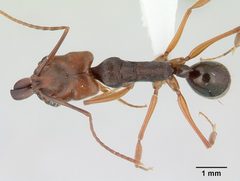
Pronunciation
How to pronounce Odontomachus ruginodis: /oʊˌdɒntoʊˈmækəs ˌruːdʒɪˈnoʊdɪs/
These audio files are automatically generated. While they are not always 100% accurate, they are a good starting point.
Identification
Odontomachus ruginodis can be distinguished from other Nearctic Odontomachus by the (rough) sculpturing on its petiolar node, which gives the species its . It is smaller and less aggressive than O. haematodus, with which it shares overlapping range in Florida. It can be separated from O. relictus, a Florida restricted to ancient scrub on sand ridges, by both morphological and habitat differences. Queens produce unique cuticular chemical signatures dominated by dialkyltetrahydrofurans, compounds not found in queens of the closely related O. relictus or O. haematodus.
Images
Habitat
Found in landscaped areas near human structures, typically in mulch beneath hedges. Previously thought to be restricted to central and southern Florida, but has been documented in similar anthropogenic as far north as Gainesville, Florida.
Distribution
Native to the southeastern United States. Documented from the Orlando, Florida region southward through the Florida peninsula, with confirmed records extending north to Gainesville, Florida. GBIF records also indicate presence in the Galápagos Islands, Rica, and Colombia, though the status of these (native or introduced) requires verification.
Life Cycle
progress through three larval instars before . First and second instar larvae possess four adhesive ('sticky doorknobs') on their surface used to attach to nest walls and ceilings. Third instar larvae develop silk-spinning pseudopalps. These traits have been documented in Odontomachus trap-jaw ants generally; specific developmental details for O. ruginodis have not been independently described.
Behavior
Possesses the characteristic trap-jaw mechanism: spring-loaded mandibles capable of snapping shut at extremely high speeds, used for prey capture and escape jumping. When disturbed, can perform 'escape jumps' by striking mandibles against the ground to propel itself backward through the air. Has been observed as a for phorid flies in the Dohrniphora, which are attracted to injured individuals and sever the for feeding or oviposition.
Ecological Role
Active in soil and leaf litter . Serves as for specialized phorid flies. Expanding range into new territories may alter competitive dynamics with native , though specific interactions remain unstudied.
Human Relevance
Occasionally encountered in urban and suburban landscaped environments. Expanding northward range appears facilitated by human-modified such as mulched planting beds. Not known to be a significant pest or to pose substantial sting hazard to humans relative to larger, more aggressive O. haematodus.
Similar Taxa
- Odontomachus haematodusLarger and more aggressive with overlapping Florida distribution; distinguished by size, reduced petiolar node sculpturing, and different chemical signatures
- Odontomachus relictusFlorida restricted to endangered scrub on ancient sand ridges; distinguished by habitat specificity, genetic differentiation, and unique blends
- Odontomachus brunneusSoutheastern U.S. with broader distribution; differs in preference and morphological details of the petiole
More Details
Queen pheromone chemistry
Queens of O. ruginodis produce cuticular chemical signals containing dialkyltetrahydrofurans, a compound class previously known from butterflies but newly documented in eusocial insects. These compounds are completely distinct from the signaling chemistry of O. relictus and O. haematodus, challenging the assumption that eusocial insects share common chemical classes for recognition.
Range expansion
First documented more than 100 miles north of its previously known range limit in 2015, with specimens collected in Gainesville, Florida from landscaped areas near commercial buildings. The mechanism and timing of this expansion remain uncharacterized.
Sources and further reading
- BugGuide
- Wikipedia
- GBIF taxonomy match
- iNaturalist taxon
- NCBI Taxonomy
- Catalogue of Life
- Powerful Trap-jaw Ants are Gaining Ground in the Southeastern United States
- Different Insect Species Use Different Chemicals to Identify Queens
- How an "Insect Ecologist at Heart" Got Focused on Pest Management Research
- Uncategorized | Blog - Part 17
- Trap-Jaw Ant Jumps with Its Legs or Its Mandibles
- Study Uncovers Unseen Details and Images of Ant Development