
Odontomachus relictus
Deyrup & Cover, 2004
Florida Scrub Trap-jaw Ant
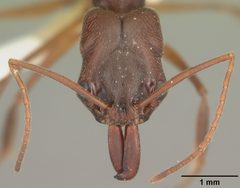
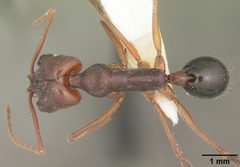
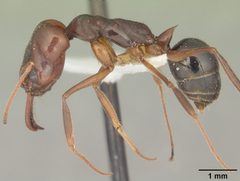
Odontomachus relictus is a of trap-jaw to Florida, where it inhabits endangered scrub on ancient sand ridges. It was described by Deyrup & Cover in 2004. Research suggests that on separate sand ridges may represent distinct species, which would make them among the rarest ants in North America. The species possesses the characteristic spring-loaded of the Odontomachus.
Pronunciation
How to pronounce Odontomachus relictus: /oʊˌdɒntoʊˈmɑːkəs rɪˈlɪktəs/
These audio files are automatically generated. While they are not always 100% accurate, they are a good starting point.
Identification
Odontomachus relictus can be distinguished from other southeastern U.S. trap-jaw ants by its restricted distribution in central Florida's scrub . Unlike the spreading Odontomachus haematodus and O. ruginodis, O. relictus is confined to ancient sand ridges. Genetic and behavioral differences have been observed between on separate ridges, suggesting potential cryptic speciation. Queens use unique dialkyltetrahydrofuran compounds as chemical signals to distinguish themselves from , a profile distinct from the related O. ruginodis and O. haematodus.
Images
Habitat
Endangered scrub on ancient sand ridges in central Florida. The shows strong site fidelity to these specific geological formations.
Distribution
to Florida, United States. Restricted to ancient sand ridges in central Florida. Not known to be spreading or expanding its range.
Behavior
on separate sand ridges display distinct , indicating potential reproductive isolation. Like other Odontomachus , individuals possess spring-loaded capable of rapid closure. The species has been observed to exhibit the characteristic trap-jaw defensive behaviors, though specific behavioral details for O. relictus are limited.
Similar Taxa
- Odontomachus ruginodisAlso found in Florida but has expanded its range northward to Gainesville and is associated with landscaped areas near buildings, unlike the restricted scrub of O. relictus.
- Odontomachus haematodusLarger and more aggressive than O. relictus; has spread across the Gulf Coast from Alabama to Florida, showing expansion rather than restricted distribution.
More Details
Conservation Concern
If on separate sand ridges are confirmed as distinct , O. relictus would represent one of the rarest in North America due to its extremely limited distribution in endangered .
Chemical Communication Research
A 2015 study by Adrian Smith et al. found that O. relictus queens use a unique blend of dialkyltetrahydrofuran compounds to signal , chemically distinct from both O. ruginodis and O. haematodus. Two of these compounds were previously unknown to science.
Sources and further reading
- BugGuide
- Wikipedia
- GBIF taxonomy match
- iNaturalist taxon
- NCBI Taxonomy
- Catalogue of Life
- Powerful Trap-jaw Ants are Gaining Ground in the Southeastern United States
- Different Insect Species Use Different Chemicals to Identify Queens
- How an "Insect Ecologist at Heart" Got Focused on Pest Management Research
- Uncategorized | Blog - Part 17
- Trap-Jaw Ant Jumps with Its Legs or Its Mandibles
- Study Uncovers Unseen Details and Images of Ant Development