
Notiophilus biguttatus
(Fabricius, 1779)
spotted big-eyed beetle, Common springtail stalker
Notiophilus biguttatus is a predatory ground beetle in the Carabidae, native to the Palearctic and introduced to North America. It is a specialized of springtails (Collembola), particularly Orchesella cincta, and exhibits distinctive mass aerial during July in some . The has been extensively studied for its -dependent , food-limited growth, and reproductive costs including accelerated ageing.
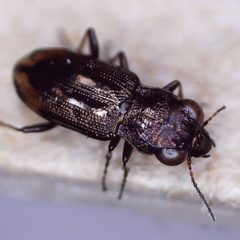
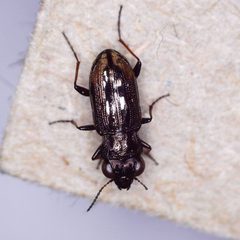
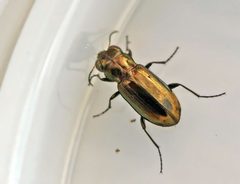
Pronunciation
How to pronounce Notiophilus biguttatus: //ˌnoʊtiˈɒfɪləs baɪˌɡʌˈteɪtəs//
These audio files are automatically generated. While they are not always 100% accurate, they are a good starting point.
Images
Habitat
Pine plantations and agricultural landscapes in northern Europe; also found in mosaic of temporary patches in intensive agroecosystems. Field studies indicate association with habitats supporting abundant .
Distribution
Native to the Palearctic: Europe (including Austria, Belarus, Belgium, Bosnia and Herzegovina, Bulgaria, Corsica, Croatia, Cyprus, Czech Republic, Denmark, Estonia, Faroe Islands, Finland, France, Germany, Great Britain, Hungary, Iceland, Ireland, Italy, Kaliningrad, Latvia, Liechtenstein, Lithuania, Luxembourg, Moldova, Northern Ireland, North Macedonia, Norway, Poland, Portugal, Russia, Sardinia, Sicily, Slovakia, Slovenia, Spain, Sweden, Switzerland, Netherlands, Ukraine, Yugoslavia). Introduced to North America: Canadian records from Nova Scotia, Newfoundland, New Brunswick, and British Columbia.
Seasonality
activity year-round with -bearing females present throughout the year except late winter/early spring and July. Mass aerial occurs during July.
Diet
Specialized of springtails (Collembola), particularly Orchesella cincta. Prey consumption is -dependent, with mortality of Orchesella cincta increasing significantly with prey density between low and moderate densities.
Life Cycle
Complete with larval and stages. Larval growth rate and adult body size are strongly influenced by temperature and food supply. Adult body size affected by temperature during larval period and more substantially by food availability.
Behavior
Exhibits -dependent search activity: prey traces increase frequency of runs and stops, with effect size dependent on gut contents. Mass aerial documented at high altitude (12–200 m) over agricultural land in July, with millions of individuals passing through 1 km² windows during brief migration periods. Migration by reproductively represents a recent to exploit temporary patches in intensive agroecosystems.
Ecological Role
regulating through -dependent mortality. has stabilizing effect on prey populations through relationship between predator and prey consumption.
Misconceptions
Earlier Dutch studies classified N. biguttatus as poorly dispersing and prone to isolation in natural remnants, contradicting later documentation of mass aerial . This discrepancy likely reflects recent evolutionary of migration in response to agricultural intensification.
More Details
Reproductive physiology
incurs a physiological cost of accelerated ageing; reproductive individuals exhibit reduced longevity compared to non-reproductive individuals. Females bear year-round except late winter/early spring and July. Fat content is low in spring and high from July through autumn. during starvation varies widely and appears related to reproductive status rather than fat content.
Laboratory feeding ecology
Temperature strongly influences larval and feeding rates, consequently affecting growth and oviposition rates. Prey supply affects fat content but not number of ripe in ovaries. Field show significant variation in fat content and body size across pine plantations, with body size ranging between laboratory maximum and minimum values.
Sources and further reading
- BugGuide
- Wikipedia
- GBIF taxonomy match
- iNaturalist taxon
- NCBI Taxonomy
- Catalogue of Life
- Erebidae | Beetles In The Bush | Page 2
- Mass aerial migration in the carabid beetle Notiophilus biguttatus
- Accelerated Ageing: A Cost of Reproduction in the Carabid Beetle Notiophilus biguttatus F.
- Life cycle and food availability indices in Notiophilus biguttatus (Coleoptera, Carabidae)
- Components of predatory behaviour underlying density-dependent prey-size selection by Notiophilus biguttatus F. (Carabidae, Coleoptera)
- Effects of hunger and prey traces on the search activity of the predatory beetle Notiophilus biguttatus
- Density dependent mortality in the springtail species Orchesella cincta due to predation by the carabid beetle Notiophilus biguttatus