
Notiophilus
Duméril, 1805
Species Guides
15- Notiophilus aeneus(Brassy Big-eyed Beetle)
- Notiophilus aquaticus(black-legged springtail-stalker)
- Notiophilus biguttatus(spotted big-eyed beetle)
- Notiophilus borealis(northern big-eyed beetle)
- Notiophilus directus(straight big-eyed beetle)
- Notiophilus intermedius(intermediate big-eyed beetle)
- Notiophilus nemoralis(woodland big-eyed beetle)
- Notiophilus nitens(bright big-eyed beetle)
- Notiophilus novemstriatus(nine-lined big-eyed beetle)
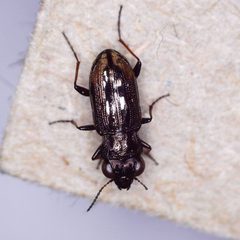
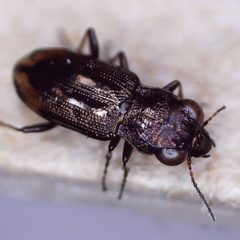
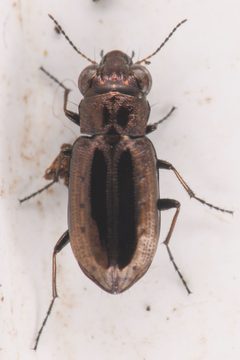
Notiophilus is a of ground beetles in the Carabidae, distributed across the Palearctic, Nearctic, Near East, and North Africa. The genus contains approximately 60 and is commonly known as ' stalkers' due to their specialized on Collembola. Members are distinguished by their distinctive shape and body proportions. Research on Notiophilus biguttatus has revealed notable including -dependent predation, chemically-mediated search behavior, and mass aerial in agricultural landscapes.
Pronunciation
How to pronounce Notiophilus: //ˌnoʊ.tiˈɒfɪləs//
These audio files are automatically generated. While they are not always 100% accurate, they are a good starting point.
Identification
Distinguished from other Carabidae by a distinctive shape and pronounced size-body ratio. Specific identification features for the as a whole are not documented in available sources; -level identification requires examination of detailed morphological characters not provided here.
Images
Habitat
Occurs in diverse terrestrial including pine plantations, thermophilic oak stands, forest clearings, pole-stage stands, and . Agricultural landscapes in northern Europe support that exploit temporary habitat patches.
Distribution
Native to the Palearctic, Nearctic, Near East, and North Africa. Documented occurrences include Denmark, Norway, Sweden, and Vermont (USA).
Seasonality
of Notiophilus biguttatus bear throughout the year except late winter/early spring and July. Mass aerial occurs during July in south-east UK.
Diet
Specialized of springtails (Collembola), particularly Orchesella cincta. Laboratory studies confirm predatory feeding on this prey type; no other prey documented in available sources.
Life Cycle
Larval development and body size are strongly influenced by temperature and food availability. production occurs year-round in females except during late winter/early spring and July. Fat content varies seasonally: low in spring, high from summer through autumn. incurs a cost of accelerated .
Behavior
Exhibits chemically-mediated search : prey traces increase run and stop frequency, with effect magnitude dependent on gut contents. Shows -dependent : mortality of Orchesella cincta increases with prey density due to search activity modification. Capable of mass aerial at high altitude; millions of individuals documented passing through 1 km² windows during brief July migration periods. Migration behavior appears to represent recent to exploit temporary patches in intensive agroecosystems.
Ecological Role
of , with -dependent mortality effects on prey. Proposed stabilizing influence on prey populations through density-dependent . Serves as bioindicator for forest management impacts, with fluctuating asymmetry in body traits reflecting environmental stress from disturbance.
Human Relevance
Used as bioindicator for assessing impacts of forest management practices such as clearing and stand development. Mass may influence agricultural pest management considerations.
Misconceptions
Earlier Dutch studies classified Notiophilus biguttatus as poorly dispersing with tendency toward isolation; subsequent research documented extensive high-altitude windborne , indicating this characterization was incomplete or -specific.
Sources and further reading
- BugGuide
- Wikipedia
- GBIF taxonomy match
- iNaturalist taxon
- NCBI Taxonomy
- Catalogue of Life
- Mass aerial migration in the carabid beetle Notiophilus biguttatus
- Accelerated Ageing: A Cost of Reproduction in the Carabid Beetle Notiophilus biguttatus F.
- Life cycle and food availability indices in Notiophilus biguttatus (Coleoptera, Carabidae)
- Components of predatory behaviour underlying density-dependent prey-size selection by Notiophilus biguttatus F. (Carabidae, Coleoptera)
- Těžba lesního porostu ovlivňuje fenotyp živočichů: případová studie fluktuující asymetrie u střevlíka Notiophilus rufipes (Coleoptera: Carabidae)
- Density dependent mortality in the springtail species Orchesella cincta due to predation by the carabid beetle Notiophilus biguttatus
- Effects of hunger and prey traces on the search activity of the predatory beetle Notiophilus biguttatus