
Notonecta indica
Linnaeus, 1771
backswimmer
Notonecta indica is a predatory aquatic true in the Notonectidae, commonly known as backswimmers. The has been documented in eastern Jamaica where it preys on mosquito larvae, particularly Aedes aegypti, with consumption rates increasing exponentially through nymphal development. consume approximately 38 mosquito larvae daily under laboratory conditions. The species occurs across a broad geographic range including the Caribbean, Central America, North America, Oceania, and South America. Development from to adult takes approximately 36 days under warm conditions, with shorter development times than temperate backswimmer species attributed to higher temperatures and food availability.
Pronunciation
How to pronounce Notonecta indica: /ˌnoʊtoʊˈnɛktə ˈɪndɪkə/
These audio files are automatically generated. While they are not always 100% accurate, they are a good starting point.
Identification
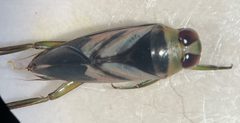
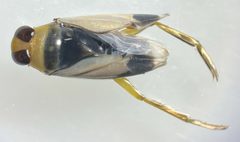
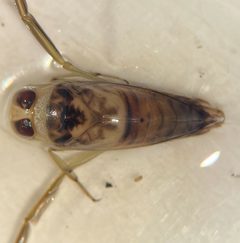
Distinguished from water boatmen ( Corixidae) by swimming upside down rather than right-side up, having a distinctly triangular cross-section with keel-like dorsum, and lacking spoon-shaped forelegs. of Notonecta are generally larger than water boatmen and display bolder color patterns with patches of black, yellowish-brown, red, or white rather than fine transverse lines. The front legs are short and unmodified, unlike the scoop-like forelegs of water boatmen. Possesses a four-segmented rostrum visible as a beak, whereas water boatmen have the rostrum to the . Hydrophobic hairs around the rear end and along the mid- are used for air storage and are visible when surfacing.
Images
Habitat
Temporary and permanent water bodies including partially vegetated tanks, sewage treatment ponds, and natural freshwater systems. In Jamaica, collected from an 18 m² partially vegetated tank and ponds of 306-1,013 m². Tolerates with partial vegetation cover and varying degrees of permanence. Capable of dispersing among habitats as environmental conditions change.
Distribution
Caribbean Sea region, Central America, North America, Oceania, and South America. Specifically documented in eastern Jamaica (Mona, Kingston and Hellshire, St. Catherine). The broad distribution suggests to diverse climatic conditions from tropical to temperate regions.
Diet
Mosquito larvae, particularly Aedes aegypti, with nymphal stages 1-2 consuming first and second instar larvae and later nymphal stages and consuming fourth instar larvae. Daily consumption increases exponentially through development: approximately 5.3 larvae/day (first instar nymphs) to 38.3 larvae/day (adults). Consumption is directly proportional to mosquito . Laboratory rearing utilized bloodworms and ground oats as supplementary food.
Life Cycle
stage mean duration 8.3 days (range 7-9 days). Five nymphal stages: N1 mean 4.7 days, N2 mean 4.9 days, N3 mean 4.4 days (shortest stage), N4 mean 5.4 days, N5 mean 8.2 days. Total development approximately 36.4 days; egg to approximately 53.2 days including adult longevity. Adult longevity mean 14.3 days (range 2-33 days). Preoviposition period documented but specific duration not stated. Eggs produced by field-collected adults (F0 ) were viable; F1 generation eggs were non-viable under laboratory conditions.
Behavior
Swims upside down using long hind legs modified as oars for rapid propulsion. Surfaces periodically to replenish air supply using hydrophobic hairs at the rear end and . Strong disperser capable of moving among permanent and temporary as conditions change. Uses forelegs to capture and handle prey, and haustellate mouthparts (rostrum) to remove causing prey desiccation. Demonstrates prey selectivity for mosquito larvae but can utilize alternative prey when mosquito densities are low. show significant individual variation in daily consumption rates. Primarily ; rarely attracted to lights at night unlike some aquatic insects.
Ecological Role
of mosquito larvae providing natural suppression. May indirectly reduce mosquito oviposition in through pressure. Potential agent for mosquito-borne including , , Zika, and , though effectiveness limited by spatial and temporal mismatches with mosquitoes in habitat preferences, patterns, and development times.
Human Relevance
Potential agent for - mosquitoes. Bites are painful and can occur when handled; bite sensation described as similar to a sting. Occasionally found in swimming pools and artificial water features where they may be perceived as nuisance pests.
Similar Taxa
- Notonecta glaucaTemperate backswimmer with longer development times; N. indica develops faster due to warmer conditions and greater food availability.
- Notonecta viridisAnother Notonecta used as biological indicator in lake ; specific habitat preferences and distribution differ.
- Corixidae (water boatmen)Superficially similar aquatic that swim right-side up, have flattened bodies, spoon-shaped forelegs for scooping detritus, and rostrums; not predatory on active prey like mosquito larvae.
Sources and further reading
- BugGuide
- Wikipedia
- GBIF taxonomy match
- iNaturalist taxon
- Bug Eric: Backswimmer or Water Boatman?
- EIVE 1.0 – The largest system of ecological indicator values in Europe | Blog
- Mean ecological indicator values: which system and which weighting approach to use
- Bug Eric: June 2014
- The life history and mosquito consumption dynamics of Notonecta indica (Hemiptera: Notonectidae) in eastern Jamaica
- Van Gölü Kıyı Habitatlarında Notonecta viridis Delcourt, 1909 (Hemiptera: Notonectidae) ve Bazı Chironomidae (Diptera) Türlerinin Biyolojik Gösterge Değerleri The Biological indicator values of Notonecta viridis Delcourt, 1909 (Hemiptera: Notonectidae) and Some Chironomidae (Diptera) Species in the Van Lake Shore Habitats