
Neoscona oaxacensis
(Keyserling, 1864)
Western Spotted Orbweaver, Zig-zag Spider
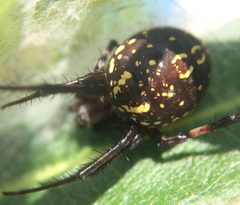
Neoscona oaxacensis is a large orb-weaving spider distributed across the Americas from the United States to South America, including the Galápagos Islands. Females reach 9–18 mm in body length, males 6–13 mm. The exhibits highly variable abdominal patterning, with a distinctive black-and-white pattern that aids identification. It constructs spiral orb webs to capture flying insects and is active primarily from late spring through autumn. The species was first described from Oaxaca, Mexico in 1863.
Pronunciation
How to pronounce Neoscona oaxacensis: /niːˈɒskənə oʊˌɑːxəˈsɛnsɪs/
These audio files are automatically generated. While they are not always 100% accurate, they are a good starting point.
Identification
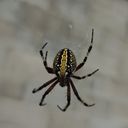
Distinguished from similar Neoscona by the black-and-white pattern on the , though this is highly variable between individuals. The abdominal pattern is more consistent and can help distinguish it from . Females have an epigyne approximately 2.5 times as long as wide when viewed from behind. Males possess a palp with an S-shaped conductor. South American specimens typically have a more slender abdomen with a more distinct light central band bearing a wavy border, compared to North American specimens. Galápagos specimens are among the largest recorded.
Images
Habitat
Found in diverse including wetlands, fields near water, mixed conifer and aspen forests, open meadows, and suburban areas. In arid regions, often associated with riparian corridors and areas with available moisture. Webs are typically constructed between vegetation at heights of 1.3–1.7 meters above ground.
Distribution
Native to the Americas. North American range extends from Kansas, Illinois, and Indiana west to Colorado, Utah, Nevada, California, and eastern Washington. Southward through Mexico (type locality: Oaxaca), Central America, to Venezuela and Peru. Also occurs on the Galápagos Islands, where it was formerly described as a separate (N. cooksoni).
Seasonality
active from late spring through autumn. In southern Arizona, adults abundant from late June into October. In California avocado orchards, spiderlings emerge from March through April, with adult numbers decreasing from May through late October. Adults do not overwinter; the persists as within silken sacs through winter.
Diet
Feeds on flying insects captured in orb webs, particularly barklice (), beetles (Coleoptera), and (Lepidoptera).
Life Cycle
Females deposit in spherical or convex silk egg sacs measuring 5–12 mm in diameter, usually concealed in rolled leaves. Spiderlings overwinter within egg sacs and emerge when day length and temperatures become suitable for prey availability. One per year in temperate regions.
Behavior
Primarily , with web repair, feeding, and mating occurring in early morning or at night. often occupy the hub (center) of their webs during the day; may retreat to the web periphery in curled leaves during intense midday heat. individuals typically build webs only at night and dismantle them at daybreak to avoid detection by . Can exhibit large, localized where individuals become exceedingly abundant in small areas.
Ecological Role
of flying insects; contributes to regulation of of barklice, beetles, and . Serves as prey for spider wasps (Pompilidae), particularly Poecilopompilus , which paralyze and provision nests with this spider. sacs are parasitized by ichneumonid wasps (Tromatobia sp.).
Human Relevance
Generally beneficial around human habitation due to on insect pests. Occasionally considered a nuisance when abundant near homes, where webs may be built across porches and doorways. Not dangerously venomous to humans or pets; bites are rare and not medically significant. Sometimes mistaken for other large orbweavers.
Similar Taxa
- Neoscona cruciferaOverlapping range in eastern and central North America; similar size and general appearance. Distinguished by less variable pattern and different markings.
- Araneus cavaticusShares "Barn Spider" with N. crucifera; similar use around buildings. Distinguished by different abdominal pattern and web architecture.
- Aculepeira packardiOccurs at high elevations and latitudes where ranges may overlap; similar appearance. Distinguished by abdominal markings and preference (high elevation/latitude).
Sources and further reading
- BugGuide
- Wikipedia
- GBIF taxonomy match
- iNaturalist taxon
- NCBI Taxonomy
- Catalogue of Life
- Bug Eric: Spider Sunday: Western Spotted Orbweaver
- Bug Eric: Wasp Wednesday: Poecilopompilus algidus
- Bug Eric: August 2015
- French mathematician and spider aficionado Cédric Villani honoured with a new orb-weaver | Blog
- Bug Eric: Spider Sunday: Hentz's Orbweaver
- orb weavers | Beetles In The Bush
- First Record of Tromatobia sp.1 Associated with the Egg Sacs of Neoscona oaxacensis 2 in Mexico