
Poecilopompilus
Howard, 1901
spider wasps
Species Guides
3- Poecilopompilus algidus(Spider Wasp)
- Poecilopompilus interruptus(Interrupted Spider Wasp)
- Poecilopompilus mixtus
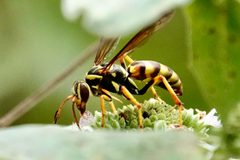
Poecilopompilus is a of spider wasps in the Pompilidae, distributed throughout the New World. These are notable for their Müllerian mimicry of social paper wasps (Polistes), sharing similar yellow and black or reddish-brown color patterns. Females hunt orbweaver spiders (Araneidae), paralyzing them with a sting and transporting them to underground burrows where an is laid on each spider. The genus contains approximately 37 recognized , with only a few extending into the United States.


Pronunciation
How to pronounce Poecilopompilus: //ˌpɛkɪloʊˈpɒmpɪləs//
These audio files are automatically generated. While they are not always 100% accurate, they are a good starting point.
Identification
Poecilopompilus can be distinguished from similar spider wasps by examining the and structure. Spider wasps possess relatively few, long antennal segments compared to the many short segments of ichneumon wasps they may resemble. Females of P. algidus have three strong spines on the front and strongly convergent inner eye margins at the top, while P. interruptus has four weak spines and parallel inner eye margins. The is also characterized by (burrowing) and prey transport of paralyzed orbweaver spiders held beneath the body during or dragged overland.
Images
Habitat
Open areas with bare soil suitable for burrow excavation, including roadsides, grasslands, and agricultural fields. Females often nest in the crotch of grass tussocks or other vegetation. frequently visit flowers and extrafloral , particularly sunflowers (Helianthus spp.), for nectar.
Distribution
New World distribution ranging from North America through Central and South America. In the United States, occurs from California east to Arizona, Utah, Texas, and Florida, and north to South Dakota, Minnesota, Michigan, and Massachusetts. The is predominantly tropical with limited representation in temperate North America.
Diet
feed on nectar from flowers and extrafloral . Females provision nests exclusively with orbweaver spiders ( Araneidae), including such as Neoscona oaxacensis. The larva consumes the paralyzed spider.
Host Associations
- Araneidae - preyorbweaver spiders, exclusive prey for larval provisioning
- Neoscona oaxacensis - preyWestern Spotted Orbweaver, documented prey
- Metepeira incrassata - -preycolonial labyrinth spider, subject to by Poecilopompilus mixtus
Life Cycle
Females excavate shallow burrows 2.5–11 cm deep, angled 45–90 degrees from the entrance, terminating in a spherical chamber. The paralyzed spider is placed in the chamber and a single is laid upon it. The burrow entrance is carefully concealed after oviposition. Larval development proceeds through feeding on the living but paralyzed , followed by within the nest.
Behavior
Solitary nesting with females hunting orbweaver spiders, stinging them into weak paralysis. Prey is transported backwards overland or carried in beneath the body to the nest site. Burrow excavation involves biting through soil and kicking debris with the front legs. Müllerian mimicry of social paper wasps provides protection through shared aposematic coloration.
Ecological Role
of orbweaver spiders, contributing to of this spider . Potential prey for birds and other . serve as when visiting flowers for nectar.
Human Relevance
Generally beneficial as of spiders and as . Capable of delivering a painful sting if handled, as documented from personal experience with P. interruptus. Often mistaken for paper wasps due to mimicry, potentially causing unnecessary alarm.
Similar Taxa
- PolistesMüllerian mimic; Poecilopompilus resembles paper wasps in coloration and pattern, but differs in solitary , longer legs, and different wing structure
- Ceratogastra ornataMimicry target; this ichneumon has been suggested to mimic Poecilopompilus in coloration, though spider wasps are slightly larger and differ in antennal structure
- AnopliusSimilar northern mimic; P. algidus in northern resembles black-bodied Anoplius spider wasps with red abdominal bands
- CeropalesPotential co-mimic; similar color pattern in some regions, such as Colorado Springs
More Details
Mimicry plasticity
P. algidus exhibits remarkable geographic variation in mimicry: southern resemble large paper wasps (Polistes), while northern populations mimic the black-and-red spider wasp Anoplius. This has resulted in recognition of at least four .
Social spider predation
Poecilopompilus mixtus preys on the colonial spider Metepeira incrassata, representing a significant mortality factor that may influence the evolution of social in this spider .
Sources and further reading
- BugGuide
- Wikipedia
- GBIF taxonomy match
- iNaturalist taxon
- NCBI Taxonomy
- Catalogue of Life
- Bug Eric: Wasp Wednesday: Poecilopompilus algidus
- Bug Eric: Wasp Wednesday: Neamblyjoppa?
- Bug Eric: Spider Sunday: Labyrinth Spiders
- Bug Eric: Ichneumon Wasp: Ceratogastra ornata
- Bug Eric: Wasp Wednesday: The Wasp Tree Part II
- Bug Eric: December 2013