
Metepeira
F. O. Pickard-Cambridge, 1903
labyrinth spiders, labyrinth orb-weavers
Species Guides
13- Metepeira arizonica(Arizona Labyrinth Orb-Weaver)
- Metepeira comanche
- Metepeira crassipes
- Metepeira datona
- Metepeira foxi
- Metepeira gosoga
- Metepeira grandiosa
- Metepeira labyrinthea(Labyrinth Orbweaver)
- Metepeira minima
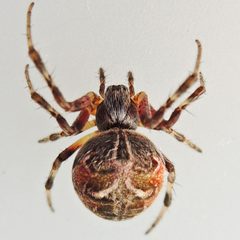
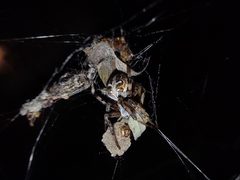
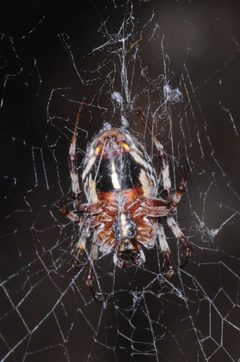
Metepeira is a of small orb-weaving spiders in the Araneidae, first described by F. O. Pickard-Cambridge in 1903. The genus contains 44 distributed from Argentina to Canada, with highest diversity in western North America and Mexico. These spiders construct distinctive webs combining a small orb web with a tangled, labyrinthine snare surrounding a thimble-like retreat. Some species exhibit facultative colonial , with individuals interlacing webs over large areas under conditions of high prey availability.
Pronunciation
How to pronounce Metepeira: //ˌmɛtɛˈpaɪrə//
These audio files are automatically generated. While they are not always 100% accurate, they are a good starting point.
Identification
Most reliably identified by web structure: a small orb web connected to a tangled, cobweb-like labyrinth surrounding a debris-decorated, tent-like retreat. The retreat is connected to the orb hub by a signal thread. Spiders hide inside the retreat rather than occupying the web center. -level identification is difficult due to variable coloration and requires examination of genitalia; the is most diverse in the western United States and Mexico.
Images
Habitat
Varied across : desert and mesquite grassland, tropical rainforest, agricultural areas, forest edges, shrubs, and low tree branches. Western North American species frequently encountered in arid . Metepeira labyrinthea occurs in shrubs and low branches along forest edges in eastern North America.
Distribution
Western Hemisphere from Argentina to Canada, including Caribbean islands. Center of diversity in western and southwestern United States and Mexico. Thirteen recognized in North America north of Mexico.
Seasonality
present in late summer and early autumn in northern latitudes; year-round activity possible in warmer regions. sacs overwinter, with spiderlings emerging when weather becomes favorable.
Life Cycle
Females produce one or more cone-shaped sacs covered in brown, papery silk, stacked above the retreat in the web. Egg sacs serve as stage; embryos or spiderlings remain insulated within silk until favorable conditions. Males reach maturity and wander in search of females without constructing webs.
Behavior
Constructs composite webs: small orb web for prey capture plus tangled labyrinthine snare with retreat. Hides in retreat, using signal thread to detect prey impacts on orb; dashes out to secure prey. Some (M. spinipes, M. incrassata) exhibit colonial under high prey availability, with individuals interlacing webs across large areas. Coloniality reduces per-capita risk from spider wasps and .
Ecological Role
of flying insects via orb webs. Colonial may influence local insect more intensively. Serve as for kleptoparasitic spiders (Argyrodes spp.) that steal prey or kill host spiders. sacs subject to by ichneumonid wasps.
Human Relevance
No documented medical or economic significance. Subject of behavioral research regarding sociality, , and reproductive strategies. Easily overlooked due to small size and cryptic retreat-dwelling .
Similar Taxa
- ArgyrodesKleptoparasitic theridiid spiders that inhabit Metepeira webs; distinguished by -level traits (Theridiidae vs. Araneidae) and (stealing prey vs. building capture webs)
- Other AraneidaeMany orb-weavers build similar orb webs; Metepeira distinguished by composite web structure with labyrinthine snare and retreat, and small body size
More Details
Social behavior
Coloniality in M. spinipes and M. incrassata is facultative and tied to El Niño-associated prey pulses. Colonial spiders trade-offs: reduced individual risk but increased kleptoparasite infiltration.
Kleptoparasite interactions
Documented for Argyrodes kleptoparasites; some Argyrodes kill Metepeira hosts outright, while others merely steal prey. Relationship ranges from commensal to parasitic depending on Argyrodes species and .
Sources and further reading
- BugGuide
- Wikipedia
- GBIF taxonomy match
- iNaturalist taxon
- NCBI Taxonomy
- Catalogue of Life
- Bug Eric: Spider Sunday: Labyrinth Spiders
- Bug Eric: ArachNovember?
- Bug Eric: Spider Sunday: Dewdrop Spiders
- Heterozygosity and fitness in a California population of the labyrinth spider Metepeira ventura (Araneae, Araneidae)
- Habitat Structure and Colonial Behaviorin Metepeira Spinipes (Araneae: Araneidae),an Orb Weaving Spider From Mexico
- Colony size and parasitoid load in two species of colonial Metepeira spiders from Mexico (Araneae: Araneidae)