
Metepeira labyrinthea
(Hentz, 1847)
Labyrinth Orbweaver
Metepeira labyrinthea, commonly known as the labyrinth orbweaver, is a small orb-weaving spider in the Araneidae. It is distinguished by its highly characteristic web structure, which combines a small orb web with an irregular, tangled snare and a debris-covered retreat. The occurs across much of the Americas and exhibits notable ecological interactions, including serving as to kleptoparasitic dewdrop spiders.
Pronunciation
How to pronounce Metepeira labyrinthea: /mɛtɛˈpɛɪrə læbɪˈrɪnθiə/
These audio files are automatically generated. While they are not always 100% accurate, they are a good starting point.
Identification
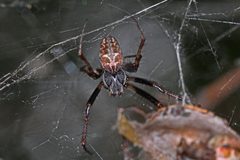
Most reliably identified by its distinctive web structure rather than alone. The combination web—featuring a small orb below and in front of an irregular, tangled retreat with woven debris—is highly characteristic. When web is absent, look for the light region, white sternal line, and relative leg segment lengths. Mature males wander without webs and are smaller with darker . Color pattern is variable and can cause confusion with other small orbweavers.
Images
Appearance
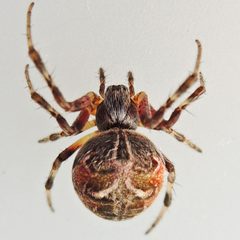
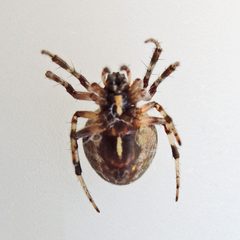
Small orb-weaving spider with thin legs and a round, bulbous . Females measure approximately 5.3 mm in body length ( 2.3 mm, abdomen 3.3 mm), with extended legs reaching 18.4 mm. Males are smaller, roughly three-quarters the female's length or slightly larger. Carapace brown or gray; abdomen dark with a white pattern. Legs alternately pale brown and dark brown. Sternum dark brown with a longitudinal yellow mark. Males have a darker carapace and greater contrast between dark and light leg areas.
Habitat
Open woodland and woodland edge, typically in shrubs and low tree branches 3–8 feet above ground. Favors locations with dead, bare lower branches such as orange trees. Often colonial, with multiple individuals occupying the same tree with webs spaced inches apart.
Distribution
Eastern United States north to southern Ontario, Canada; extends southward through the Neotropics to Argentina. Most common in the eastern half of the United States.
Seasonality
Active from March through October. reach maturity in late summer or early autumn in northern latitudes. Mating and -laying occur during the rainy season.
Diet
Passive that uses the orb portion of its web to capture flying insects. Prey is detected via signal threads extending from the retreat to the orb hub; the spider descends to secure and wrap entangled prey. Consumes soft parts of prey in the retreat, discarding remains.
Life Cycle
Females produce 5–6 sacs containing approximately 55 eggs each. Egg sacs are silken, cone-shaped, covered in brown papery silk, and suspended in the web near the retreat, camouflaged by debris. Spiderlings emerge self-sufficient and disperse by ballooning on silk threads.
Behavior
Constructs a composite web consisting of an incomplete orb with few spiral turns and an irregular, tangled retreat. The retreat functions as a shelter and hunting base. Males cease orb web construction after reaching maturity and wander to find females. Colonizes suitable with multiple individuals often found in close proximity.
Ecological Role
Serves as prey for spider wasps (Pompilidae: Poecilopompilus mixtus) and for parasitic (Ichneumonidae). Webs provide for kleptoparasitic dewdrop spiders (Argyrodes spp.), which steal captured prey; some Argyrodes have been documented preying directly on Metepeira. Functions as a mid-level in woodland .
Human Relevance
Generally harmless to humans due to small size. Occasionally encountered in gardens and orchards. Subject of ecological research on food limitation and reproductive output; supplemental feeding experiments demonstrated that prey availability limits production but not survival.
Similar Taxa
- Araneus pegniaSimilar small size and variable coloration; distinguished by -shaped abdominal pattern and different web structure (orb sometimes incomplete but lacks characteristic tangled retreat of Metepeira)
- Other Metepeira speciesThirteen occur in North America north of Mexico; most diverse in western U.S. and southwest. M. labyrinthea is the only species with the 'Labyrinth Spider' and is restricted to eastern North America; western species require examination of genitalia for definitive identification
More Details
Food Limitation Research
A 1980 field experiment at Patuxent Wildlife Research Center demonstrated that food is a limiting resource for production. Females with supplemental prey produced a of 145 eggs versus 65 eggs under natural prey conditions, though survival rates did not differ.
Web Structure Terminology
The web is classified as an 'incomplete orb' due to minimal spiral turns; most viscid thread is looped back and forth along rather than forming a traditional spiral.