
Metepeira arizonica
Chamberlin & Ivie, 1942
Arizona Labyrinth Orb-Weaver
Metepeira arizonica is an orb-weaving spider in the Araneidae, commonly known as the Arizona Labyrinth Orb-Weaver. It is one of approximately thirteen Metepeira recognized in North America north of Mexico. Like other members of its , it constructs a distinctive web architecture combining a small orb web with a tangled, cobweb-like snare surrounding a tubular retreat. The species occurs in arid and semi-arid of the southwestern United States and Mexico.
Pronunciation
How to pronounce Metepeira arizonica: //ˌmɛtɛˈpaɪrə ˌærɪˈzoʊnɪkə//
These audio files are automatically generated. While they are not always 100% accurate, they are a good starting point.
Identification
Identification to level is challenging due to highly variable coloration shared across Metepeira species. The most reliable field characteristic is the web architecture: a small, often inconspicuous orb web connected to a tubular, thimble-like retreat surrounded by tangled, cobweb-like silk and often decorated with debris. The retreat is frequently the most visible component. Geographic location (southwestern U.S. and Mexico) helps distinguish M. arizonica from the eastern M. labyrinthea. Examination of genitalia is required for definitive species identification.
Images
Appearance
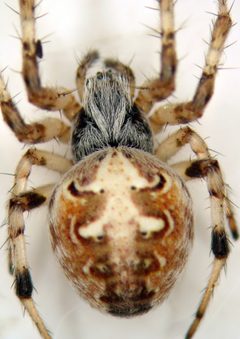
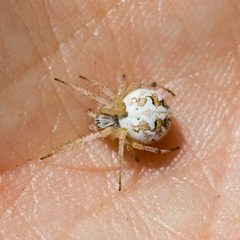
females measure 5.5–7.2 mm in body length; males are smaller at 3–4.5 mm. The color pattern is highly variable, making visual identification to difficult without associated web structure or geographic context. The typically shows mottled or patterned coloration. Males possess modified for sperm transfer. The overall body form is compact with relatively short legs compared to some other orb weavers.
Habitat
Arid and semi-arid environments in the southwestern United States and adjacent Mexico. include desert scrub, grasslands, and open woodlands. Webs are constructed in shrubs, low vegetation, and the lower branches of trees, typically at forest or woodland edges where vegetation structure supports web architecture.
Distribution
United States (southwestern states, primarily Arizona and adjacent areas) and Mexico. Records indicate presence in Middle America and North America regions.
Seasonality
are most commonly observed in late summer and early autumn. This timing aligns with reproductive activity, as mated females produce sacs during this period. Activity patterns in more southerly latitudes may extend earlier or later depending on local climate conditions.
Life Cycle
Mated females produce one or more sacs, each roughly cone-shaped and covered in brown, papery silk. Egg sacs are stacked above the spider within the tubular retreat. Spiderlings likely overwinter within the egg sac, emerging when conditions become favorable. Mature males wander in search of females and may be encountered away from webs.
Behavior
Constructs a compound web consisting of a small orb web for prey capture connected by a signal thread to a tubular retreat where the spider waits. When prey impacts the orb web, the spider rapidly descends the signal thread to subdue it. The tangled silk surrounding the retreat may function as a protective barrier or additional prey capture surface. Males are nomadic during the breeding season. No social has been documented for this , unlike the colonial M. spinipes and M. incrassata.
Ecological Role
As a small orb weaver, M. arizonica contributes to in arid , potentially helping regulate of small flying insects. Its web architecture provides microhabitat structure that may be exploited by other organisms. The serves as prey for spider wasps (Pompilidae) and potentially other arthropod , though specific records for M. arizonica are not documented.
Human Relevance
No significant direct interactions with humans. The poses no medical or economic importance. Like other small spiders, it may contribute to household pest control in rural areas but is not commonly encountered indoors. Web architecture may be noticed by observant naturalists in appropriate .
Similar Taxa
- Metepeira labyrintheaShares identical web architecture and highly variable coloration; distinguished primarily by geographic range (eastern U.S. and southern Ontario versus southwestern U.S. and Mexico)
- Other Metepeira speciesAll thirteen North American exhibit similar web structures and variable coloration; definitive identification requires examination of genitalia and precise geographic data
- Araneus speciesSome Araneus orb weavers have similarly mottled , but lack the compound web architecture with tubular retreat and tangled snare
More Details
Web architecture notes
The compound web structure—combining an orb web with a tangled retreat complex—is characteristic of the Metepeira and distinguishes these spiders from typical orb weavers that construct only the circular snare. The small size of the orb web relative to the overall web structure often makes it difficult to detect.
Taxonomic history
Described by Chamberlin & Ivie in 1942. The Metepeira has undergone taxonomic refinement, with thirteen currently recognized in North America north of Mexico. The southwestern U.S. and Mexico represent centers of diversity for the genus.