
Ceratogastra ornata
(Say, 1835)
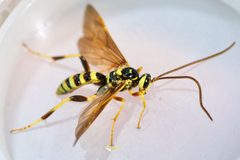
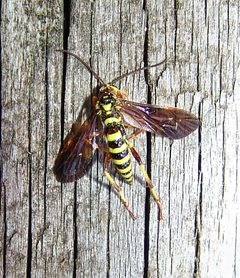
Ceratogastra ornata is a small ichneumon (10–12 mm) recognized by its yellow and reddish-brown or black coloration. Four are recognized across its broad North American range, with northern specimens darker and more reduced in yellow markings than southern and western . The has been suggested to mimic stinging spider wasps in appearance. Females are known to oviposit in flower buds, targeting or early instars of noctuid in the Feltia.
Pronunciation
How to pronounce Ceratogastra ornata: /sɛrətoʊˈgæstrə ɔrˈneɪtə/
These audio files are automatically generated. While they are not always 100% accurate, they are a good starting point.
Identification
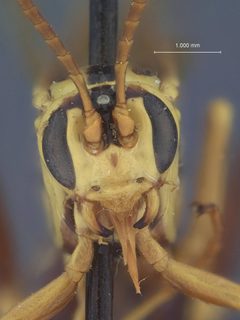
Distinguished from similar spider wasps (Pompilidae) by antennal structure: ichneumon wasps have many short antennal segments versus fewer, longer segments in spider wasps. Wing venation differs but is difficult to observe in the field. The "horse " in the forewing is visible in good images. Resembles spider wasps in the Poecilopompilus and Ceropales in coloration and pattern, but these are generally larger.
Images
Appearance
Small , 10–12 mm in body length. Ornately patterned with yellow and reddish-brown or black, with geographic variation in color intensity. Northern specimens generally darker with reduced yellow markings and darkened wings; southern and western specimens distinctly paler. with many short segments (characteristic of ichneumon wasps). Wings with venation including a "horse " near the middle of the forewing, with the "nose" pointed toward the wingtip.
Habitat
Found in varied across its range. frequently visit flowers, especially composites (Asteraceae).
Distribution
North America, from southern Ontario, Massachusetts, and southern Wisconsin west to eastern California and south to northern Florida, Louisiana, and Mexico. Four recognized with geographic variation in coloration.
Diet
feed on nectar from flowers, including extrafloral . Larvae are internal of noctuid caterpillars in the Feltia.
Host Associations
- Feltia - or newly-hatched caterpillars of noctuid in this are the larval . Female oviposit into flower buds where moth eggs have been laid.
- Ambrosia artemisiifolia - oviposition siteCommon Ragweed; observed site for oviposition by female .
- Eupatorium - oviposition siteThoroughworts; observed site for oviposition.
- Helianthus annuus - nectar sourceCommon Sunflower; observed feeding at extrafloral , but not known to oviposit here.
Life Cycle
Complete with larval stage. Female injects into egg or early instar caterpillar. Larva develops internally as , likely allowing host to mature partially before feeding in earnest and ultimately killing it. presumably occurs within or near host remains, though details are not fully documented.
Behavior
Females visit flowers to obtain nectar and to locate . Oviposition involves probing flower buds with the ovipositor, appearing to "sting" the flower but actually targeting concealed or larvae. have been observed on goldenrod flowers but do not oviposit there.
Ecological Role
of noctuid caterpillars, potentially regulating of pests. Acts as while foraging for nectar.
Human Relevance
agent for certain agricultural pests (cutworms). Subject of citizen science through image documentation on platforms such as Bugguide.net, where observations contribute to knowledge of distribution and .
Similar Taxa
- PoecilopompilusSpider wasp suggested as model for mimicry; similar color pattern but larger size and different antennal structure.
- CeropalesSpider wasp observed as potential mimicry model in Colorado Springs; similar appearance but larger size and fewer, longer antennal segments.
More Details
Mimicry
Suggested to be a mimic of stinging spider wasps, with striking similarities in color and pattern to Poecilopompilus and Ceropales .
Taxonomic Authority
described by Thomas Say in 1835.
Research Needs
and geographic range of most ichneumonid remain poorly known; image documentation encouraged to advance understanding.
Sources and further reading
- BugGuide
- GBIF taxonomy match
- iNaturalist taxon
- Catalogue of Life
- Bug Eric: Ichneumon Wasp: Ceratogastra ornata
- Bug Eric: December 2013
- A flower visiting jewel beetle that is not an Acmaeodera | Beetles In The Bush
- Chrysomelidae | Beetles In The Bush | Page 5
- Spring beetles on Coreopsis flowers | Beetles In The Bush
- A “Giant” Pygmy | Beetles In The Bush