
Ceropales
Latreille, 1796
cuckoo spider wasp
Species Guides
9- Ceropales bipunctata(two-spotted spider wasp)
- Ceropales elegans
- Ceropales hatoda
- Ceropales longipes
- Ceropales maculata(Kleptoparasitic spider wasp)
- Ceropales nigripes
- Ceropales pacifica
- Ceropales robinsonii
- Ceropales rugata
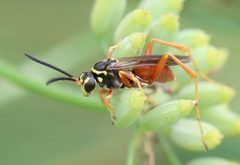
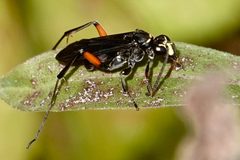
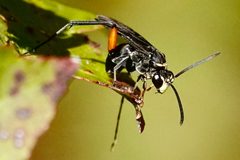
Ceropales is a of kleptoparasitic spider wasps in the Pompilidae, comprising approximately 30 described distributed worldwide. These are obligate that exploit the prey of other solitary wasps rather than hunting spiders themselves. The genus originated in Eurasia approximately 10.6 million years ago and achieved its distribution through multiple long-distance events across land bridges and oceanic barriers.
Pronunciation
How to pronounce Ceropales: /ˈsɛrəˌpeliz/
These audio files are automatically generated. While they are not always 100% accurate, they are a good starting point.
Identification
Ceropales can be distinguished from other spider wasps by their kleptoparasitic lifestyle and associated morphological traits. Fore wing venation and the shape of the female metasomal segments serve as key diagnostic characters for differentiating lineages within the . The genus currently lacks reliable subgeneric classification; previous subgenera (Bifidoceropales, Hemiceropales, Priesnerius) have been synonymized or redefined based on phylogenetic analysis revealing extensive morphological convergence due to similar parasitic lifestyles.
Images
Habitat
associations vary by . Ceropales bipunctata occupies coastal dune habitats along the Gulf of Saint Lawrence. Other species occupy diverse terrestrial habitats across their range, with distributions spanning Eurasia, the Americas, Africa, and Australia. Specific microhabitat preferences are poorly documented for most species.
Distribution
distribution achieved through rapid over approximately 10 million years. Native to Eurasia with subsequent of the Americas via the Bering land bridge and Isthmus of Panama, Africa across the Mediterranean region, and Australia through Sunda Plains. Documented from North America (including Vermont, New Brunswick, Ontario), Europe (Denmark, Norway, Sweden), and worldwide tropical to temperate regions.
Host Associations
- Anoplius cleora - confirmed of Ceropales bipunctata in New Brunswick; provisions nests with Arctosa littoralis spiders
- Anoplius aethiops - postulated primary Proposed of C. bipunctata in Ontario and western Québec based on body size, , and locality overlap
- Anoplius atrox - likely secondary Proposed of C. bipunctata in southwestern Ontario
- Pompilidae - Primary ; Ceropales takes spider prey from nests of other pompilid wasps
- Sphecidae - occasional Some sphecid that provision with spider prey are also exploited as
Behavior
Obligate kleptoparasite: females locate nests of solitary spider-hunting wasps and deposit on spiders that have been paralyzed and stored as provisions by the . The Ceropales larva consumes the host's provision, killing the host larva through resource competition. This eliminates the need for nest construction and direct prey capture. facilitated by parasitic lifestyle that reduces dependence on specific host or local prey availability.
Ecological Role
Acts as a secondary consumer and regulator of solitary spider-hunting wasps. Kleptoparasitic lifestyle may influence foraging and nest defense strategies. Serves as prey for various ; documented as food source for rodents and rock-crawlers (Grylloblattidae) in some .
Human Relevance
Of minimal direct economic importance. Occasionally encountered by entomologists and naturalists. Some have experienced regional declines (e.g., C. bipunctata in Ontario), prompting conservation assessment. Serves as model organism for studying evolution of and rapid biogeographic in insects.
Similar Taxa
- PoecilopompilusSimilar coloration and pattern; Ceratogastra ornata (Ichneumonidae) has been suggested to mimic Poecilopompilus spider wasps. Distinguished by wing venation and antennal segment number.
- CeratogastraIchneumonid frequently mistaken for Ceropales in the field; distinguished by many short antennal segments (vs. fewer, longer segments in spider wasps) and presence of 'horse ' in fore wing
More Details
Taxonomic instability
Subgeneric classification of Ceropales has undergone significant revision. Molecular phylogenetic studies have rejected previous subgeneric divisions (Bifidoceropales, Ceropales s. str., Hemiceropales, Priesnerius) due to morphological convergence from shared kleptoparasitic lifestyle. Fore wing venation and female metasomal shape remain the most reliable diagnostic characters.
Conservation status
Ceropales bipunctata experienced significant decline in Ontario, Canada, where it was considered extirpated until recent surveys. In contrast, the remains common in coastal New Brunswick. declines (Anoplius aethiops, A. atrox) may drive Ceropales changes in some regions.
Sources and further reading
- BugGuide
- Wikipedia
- GBIF taxonomy match
- iNaturalist taxon
- NCBI Taxonomy
- Catalogue of Life
- Bug Eric: Ichneumon Wasp: Ceratogastra ornata
- Bug Eric: December 2013
- Revealing diagnostic characters through morphological evolution in cleptoparasitic spider wasps (Hymenoptera, Pompilidae, Ceropales)
- Around the world in 10 million years: Rapid dispersal of a kleptoparasitoid spider wasp (Pompilidae: Ceropales)
- Host specialisation and the disparate fate ofCeropales bipunctata(Hymenoptera: Pompilidae) in New Brunswick and Ontario, Canada