
Ceropales bipunctata
Say, 1824
two-spotted spider wasp, kleptoparasitic spider wasp
Ceropales bipunctata is a , obligate kleptoparasitic spider wasp that cannot capture its own prey and must rely on provisions stolen from other spider wasps. The is notable for its distinctive cream-colored spots on the and its specialized parasitic lifestyle targeting the book lungs of spiders captured by . It occurs in two recognized with different geographic distributions and leg coloration.
Pronunciation
How to pronounce Ceropales bipunctata: /ˌsɛroʊˈpeɪliːz ˌbaɪˌpʌŋkˈteɪtə/
These audio files are automatically generated. While they are not always 100% accurate, they are a good starting point.
Identification
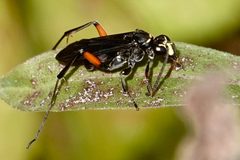
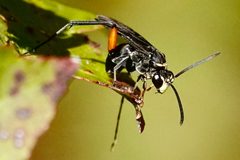
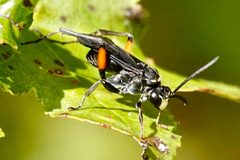
Distinguished from other spider wasps by the paired cream-colored spots on the . C. b. tibialis identified by red/pink coloration of all short legs and complete red on long leg pairs, versus typical leg coloration in nominate subspecies. Separated from ichneumon wasps by having fewer, longer antennal segments and different wing venation.
Images
Appearance
Medium-sized spider wasp with distinctive cream-colored dot on each side of the . Two recognized: C. b. bipunctata (nominate subspecies) with typical coloration, and C. b. tibialis with more black coloration, red/pink short legs, and entirely red on the long leg pairs.
Habitat
Dune systems along coastlines and open fields. In New Brunswick, specifically inhabits dune along the Gulf of Saint Lawrence. Appears to prefer open, sandy areas with sparse vegetation.
Distribution
Atlantic Coast of North America from New Brunswick, Canada southward; western extension to Ohio; disjunct in Midwest (Missouri, Arkansas). C. b. tibialis restricted to North and South Carolina; all other populations are C. b. bipunctata.
Seasonality
; active during daylight hours. visit flowers for nectar, particularly in late summer and fall when goldenrods bloom.
Diet
feed on nectar, primarily from goldenrods (especially Solidago canadensis, Canada goldenrod) and other common nectaring plants. Larvae are , feeding on spiders captured by .
Host Associations
- Anoplius cleora - primary (kleptoparasitized)Confirmed in New Brunswick; lays in book lung of Arctosa littoralis spider captured by this host
- Arctosa littoralis - prey of Lycosid spider that serves as actual food source for C. bipunctata larva
- Anoplius aethiops - postulated primary Inferred for Ontario/western Québec based on body size, , and locality overlap; has declined in eastern Canada
- Anoplius atrox - likely secondary Postulated for southwestern Ontario based on indirect evidence
- Sceliphron caementarium - occasional Sphecid whose spider prey is occasionally parasitized
Life Cycle
Female locates spider wasp dragging prey to its burrow, then lays single in the book lung of the paralyzed spider. The continues to its burrow and lays its own egg. Ceropales larva develops faster or consumes the host larva, then feeds on spider's non-vital organs initially, consuming vital organs in final instar. Pupates in host burrow and emerges later in same year.
Behavior
Obligate kleptoparasite that actively follows other spider wasps to their prey. Female intercepts wasp during transport of paralyzed spider to nest, quickly depositing in spider's book lung before host can complete burrow provisioning. Does not construct own nest or capture own prey.
Ecological Role
Kleptoparasite that exploits the hunting efforts of other spider wasps, potentially regulating of . As nectar feeder, contributes to pollination of goldenrod and other composite flowers.
Human Relevance
Subject of conservation concern due to significant declines in parts of range, particularly Ontario where formerly thought extirpated. Recent research in New Brunswick found to be common in coastal dune systems, prompting reassessment of conservation status. Not protected by law.
Similar Taxa
- Ceratogastra ornataIchneumon that mimics spider wasps including Ceropales in coloration; distinguished by many short antennal segments versus fewer longer segments in spider wasps
- Poecilopompilus spp.Stinging spider wasps suggested as mimicry model for Ceratogastra ornata; larger than Ceropales and not kleptoparasitic
More Details
Conservation status
declined significantly in Ontario, leading to belief it was extirpated there, but persists in New Brunswick coastal dunes. Disjunct Midwest (Missouri, Arkansas) of uncertain connectivity to Atlantic populations. Continuous populations between Atlantic Coast and Midwest unknown.
Taxonomic subspecies
Two : C. b. bipunctata (widespread except Carolinas) and C. b. tibialis (North and South Carolina only), distinguished by leg coloration and overall darkness.
Sources and further reading
- BugGuide
- Wikipedia
- GBIF taxonomy match
- iNaturalist taxon
- Catalogue of Life
- Bembicid Holdings | Entomology Research Museum
- Meloidae Holdings | Entomology Research Museum
- Bug Eric: Ichneumon Wasp: Ceratogastra ornata
- Bug Eric: January 2012
- Tabloid Sensationalism Aside, Lady Bugs Are Still Fascinating
- The mini grasshoppers that outlived dinosaurs: the fascinating world of Tetrigidae | Blog
- Host specialisation and the disparate fate ofCeropales bipunctata(Hymenoptera: Pompilidae) in New Brunswick and Ontario, Canada