
Ceropales maculata
(Fabricius, 1775)
Kleptoparasitic spider wasp
Species Guides
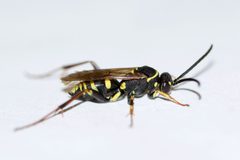
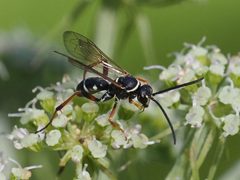
3Ceropales maculata is a kleptoparasitic in the Pompilidae, distributed across the Holarctic region of North America and Eurasia. Females are 6–9 mm in length, males 5–7.5 mm, with bold white markings on a black body and orange-red legs. This is an obligate kleptoparasite that intercepts other spider wasps transporting prey, laying in the book lungs of captured spiders. The larvae hatch, consume the egg, then feed on the spider.

Pronunciation
How to pronounce Ceropales maculata: /ˈsɛrəˌpeɪliz ˌmækjʊˈleɪtə/
These audio files are automatically generated. While they are not always 100% accurate, they are a good starting point.
Identification
In Britain, distinguished from Ceropales variegata by absence of red band on . Males distinguished from females by smaller size, slender shape, and lack of protruding ovipositor. Distinguished from Ceratogastra ornata (an ichneumon with similar coloration) by antennal structure: Ceropales has fewer, longer antennal segments versus many short segments in ichneumon wasps.
Images
Habitat
Sandy areas including heathlands, coastal dunes, and sand pits.
Distribution
Holarctic distribution: found in North America and Eurasia, including Belgium, Denmark, Norway, and Britain.
Seasonality
active from May to September; (one per year).
Diet
have been observed feeding on nectar of wild carrot (Daucus carota) flowers. Larvae are kleptoparasitic, feeding on and then the spider prey of other .
Life Cycle
. Females lay in book lungs of spiders captured by other spider wasps. Larvae hatch, locate and consume the egg, then feed on the spider.
Behavior
Kleptoparasitic: intercepts other spider wasps engaged in prey transport, allowing the to return to its nest where the larva develops. visit flowers for nectar.
Ecological Role
Kleptoparasite of solitary spider-hunting wasps; reduces reproductive success of .
Human Relevance
None documented; uncommon with minimal direct human interaction.
Similar Taxa
- Ceropales variegataSimilar size and ; distinguished by presence of red band on in C. variegata versus absence in C. maculata (in Britain)
- Ceratogastra ornataSimilar black-and-white color pattern; ichneumon with different antennal structure (many short segments versus fewer long segments) and different ( of , not kleptoparasite)
Sources and further reading
- BugGuide
- Wikipedia
- GBIF taxonomy match
- iNaturalist taxon
- NCBI Taxonomy
- Catalogue of Life
- Be careful around baldfaced hornets, Dolichovespula maculata — Bug of the Week
- An inside look at baldfaced hornets, Dolichovespula maculata — Bug of the Week
- High fiber diets for baldfaced hornets? Nah, construction materials for enlarging nests: Baldfaced hornets, Dolichovespula maculata — Bug of the Week
- What do insects do in winter, Part 2? Tolerating the big chill: Banded woolly bears, Pyrrharctia isabella, field crickets, Gryllus spp., baldfaced hornets, Dolichovespula maculata, and others — Bug of the Week
- Bug Eric: Window-winged Moths
- Bug Eric: Ichneumon Wasp: Ceratogastra ornata